UAB Magazine Online Features
Hands Across the Americas
Reaching Out to Guatemalan Women
By Jo Lynn Orr
 |
After seeing the needs of Guatemalan women firsthand as a graduate student, Nancee Neel helped start an organization to support women and girls through education, health care, and community building. Photo courtesy Rebecca Daubert |
The first time Nancee Neel visited Guatemala, she sensed an immediate connection. “I felt I had come home,” she recalls. It wasn’t the country’s breathtaking landscape of soaring mountains, lush cloud forests, and dazzling coastlines that drew her in; it was the people. “They are just amazing,” she says, “so loving and warm.”
Neel, an alumna of the UAB School of Public Health and former assistant professor in the school’s Department of Maternal and Child Health, first traveled to Guatemala in 1987 with David Coombs, Ph.D. (now professor emeritus of health behavior), to research her thesis for a master’s degree in public health. She returned the next year, and lived in Guatemala for six months while collecting information for her doctoral dissertation. Since then, she has gone back many times to learn more about the country’s culture, visit with friends, and make new ones.
Stepping Up
Seeking a way to improve the lives and health of Guatemalan women living in rural areas, Neel began informally working with a local cooperative called Pop Atz’iaq in 2004. She helped establish a microcredit fund for women and an educational scholarship program for girls. Then in 2006, she and some friends in Birmingham started Threads Weaving Dreams, a nonprofit organization that provides resources and support to Guatemalan women and their families through education, health care, and community building.
The Threads group also works with a clinic called Primeros Pasos, which has established the Stairway to Good Health (Escalera a Una Buena Salud) program to improve the health of women through nutrition education and other health-promotion efforts. Another Stairway goal is to improve participating women’s self-esteem and leadership qualities, and to foster community participation and awareness of gender and identity.
“It is an amazing three-year program,” Neel says. “The first year targets health education, including preventive measures and how to recognize different kinds of illnesses, as well as issues that arise at the family and community levels. They really educate the women, many of whom never had the opportunity to attend school. The second year is about empowerment—self-esteem, gender issues, participation in the political process—issues that the women have never had formal instruction in.”
The Hits Just Keep on Coming
UAB Alumnus Is Viral Video Star
By Caperton Gillett
 |
Brian Curtin (center) parlayed sink faucets, a UAB parking deck, and hundreds of hours of editing time into a smash hit YouTube film called Concrete Hustle. Now the UAB graduate and a cast and crew of fellow alums are back with a new viral phenomenon: Beyond Black Mesa. Click photo above to see a larger version. |
A few million people have seen Brian Curtin get his comeuppance in a UAB parking deck. He hopes that even more will tune in online to watch him get attacked by alien robots outside a Birmingham warehouse.
Bad things have been happening to this UAB graphic design graduate ever since he began making “stupid little short films” (his words) in high school using the video function on his still camera. He kept on making those films—with progressively advancing equipment and techniques—while he was at UAB, but it wasn’t until after he graduated in 2007 that Curtin found his cinematic calling.
Laser Blazer
As an art director at the Birmingham ad agency Big Communications, Curtin got plenty of experience using film-editing software—experience that spilled over into his own personal projects after work and on the weekends. Inspired by a raft of Star Wars-themed fan videos on YouTube, Curtin and some friends (including fellow UAB alumni Matt Hall and Mat Powell) decided they could make their own sci-fi movie, and make it better.
Following three months of elaborate choreography (it helped that he and another actor were “moderate breakdancers back in the day,” Curtin says), a month of shooting at a parking deck on UAB’s campus (first surreptitiously, later with an official permit), and six to eight months of post-production work on his computer, Curtin unleashed Concrete Hustle on the world.
The nearly four-and-a-half-minute film—a raging lightsaber battle involving three combatants, backflips, flying leaps, several stab wounds, and an apparent high-altitude fall off the parking deck—is a monument to non-stop action. And even though Concrete Hustle has no dialogue, it certainly spoke to its audience: As of November 1, it has been viewed more than 2.7 million times.
Brian Curtin returns to the parking deck to talk about his first million views, the enduring power of lightsabers, and the prospects of a Concrete Hustle 2 in this video. Story continues below video.
Bytes to Beats
In Sync With UAB’s Computer Music Ensemble
By Blake Tommey
Two words sum up the UAB Computer Music Ensemble (CME): far out. The 12-member group in the Department of Music mixes synthesizers with software—including Apple Logic, Reason, and ProTools—to create often-unconventional compositions.
Senior Andrew Hyde came to UAB to study music. What type of music, exactly, was still up in the air: he had no prepared instrument and wasn’t very keen on vocal performance, either. Then he discovered the CME.
“Singing in choir isn’t really my thing,” says the music technology major. “I’m here to write good music on computers and learn those techniques and styles. That’s my niche.” Hyde’s brand of music features everything from singing robots and electronic drum circles to Wii remotes that trigger modulated synthesizer notes.
(Story continues below slideshow)
The Work of Art
UAB Alumni Thrive in Creative Careers
By Glenny Brock
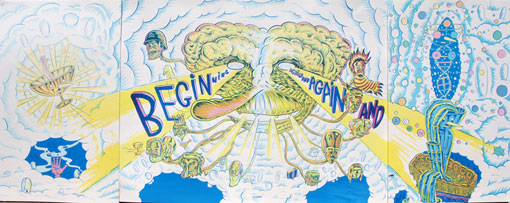 |
UAB alumnus David Sandlin, who has built a successful career as an artist in New York (his painting "Begin" is shown above), is returning to Birmingham for the UAB Alumni Open Exhibition at the Gallery at UAB. |
The UAB Alumni Open Exhibition, which opened earlier this month and runs through November 6, is part class reunion, part show-and-tell. The event has filled the newly renamed Gallery at UAB (formerly the Visual Arts Gallery) with paintings, drawings, photographs, mixed-media assemblages, and sculpture from about two dozen graduates of the bachelor of arts and bachelor of fine arts degree programs at UAB. But this inaugural gathering is as much a showcase of working artists as works of art.
Some of the alumni showing their work only make art as an avocation now, while others have forged careers as full-time artists. Yet all have learned that being an artist can mean making work and making it work—in part by applying lessons learned in the classroom in the real world.
The Power of Creative Thinking
 |
Daisy Winfrey
|
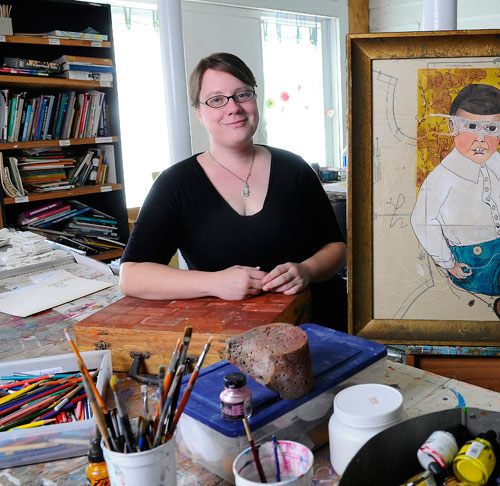
“I always knew that if I personally wanted to make it as a ‘professional artist,’ I would need a supplementary income,” says Daisy Winfrey, a 2007 UAB graduate. “Ideally, this would be a job that existed in the realm of the art world, but I also knew it was possible it would be a job that I hated.”
As it turns out, Winfrey found a job that she loves. After completing her B.A., Winfrey became art director of Studio By The Tracks, a nonprofit organization in Irondale that provides free art classes to children and adults with autism, Asperger’s syndrome, or mental illness.
“I coordinate all the curricula and supplies for the adults and children who attend our art classes,” Winfrey explains. “It helps to be creative and it helps to be a problem-solver. I’d say that having an art degree facilitates this kind of flexibility and quick thinking.”
Click the arrow buttons below to see a slideshow of Winfrey's work. (Having trouble seeing the slideshow? Click here)
Story continues below slideshow.
