-
Adaptability & Agility in the Workplace

Build the skills to navigate change with confidence. Here are a few strategies to help you respond quickly, think flexibly, and lead effectively in today’s evolving work environment.
In today’s rapidly changing work environment, adaptability and agility have become core capabilities for leaders and employees at every level. Adaptability refers to an individual’s ability to adjust thoughts, behaviors, and actions in response to new conditions. Agility expands this by emphasizing the capacity to anticipate change, pivot quickly, and take effective action in uncertain or complex situations.
Organizations that cultivate adaptability and agility benefit from improved problem-solving, stronger collaboration, and greater resilience during transitions. Research shows that adaptable employees demonstrate higher levels of learning engagement and performance, especially during periods of change (Pulakos et al., 2000). Similarly, agile teams are more innovative and better positioned to respond to evolving customer and organizational needs (Rigby, Sutherland & Takeuchi, 2016).
eveloping these skills requires a combination of self-awareness, a growth mindset, and ongoing practice. Leaders play a key role by encouraging experimentation, modeling flexibility, and creating environments where teams can learn, adjust, and move forward with confidence.
Resources to Learn More- External Article: Adaptability in the workplace: Development of a taxonomy of adaptive performance
- Embracing Agile: How to master the process that’s transforming management (Harvard Business Review)
- Video: The Power of Believing You Can Improve with Carol Dweck (TED Talk)
- Tools & Activities:
Written by Amber Anderson Grant, OD Specialist -
Focus on What Matters: How the 80/20 Rule Can Transform Your Year

Discover how a simple principle can help you prioritize the projects that deliver the biggest impact. Learn to apply the Pareto Principle to make smarter, more strategic decisions this year.
What Projects Should We Work on This Year?Every year brings a flood of ideas, initiatives, and opportunities. The challenge isn’t finding projects…it’s choosing the right ones. How do you decide where to invest your team’s time and energy for maximum impact?
Start by asking yourself:
- Which projects will create the most value for our stakeholders?
- What activities have historically driven the greatest results?
- If we could only accomplish three things this year, what would they be?
These questions set the stage for a powerful tool: the Pareto Principle, also known as the 80/20 Rule. This principle suggests that roughly 80 percent of results come from 20 percent of efforts. It was first introduced by Italian economist Vilfredo Pareto in his 1897 work Cours d’économie politique and later popularized in quality management by Joseph Juran (Interaction Design Foundation).
How to Apply the 80/20 Rule to Your Planning- List Your Options: Write down all potential projects or initiatives for the year.
- Analyze Impact: Ask, “Which of these will deliver the greatest outcomes if successful?”
- Identify the Vital Few: Highlight the top 20 percent of projects that will likely produce 80 percent of the results.
- Focus Resources: Allocate time, budget, and talent to these high-impact priorities.
This approach doesn’t mean ignoring everything else — it means being intentional. By concentrating on the “vital few,” you avoid spreading your team too thin and ensure meaningful progress.
Why It WorksThe Pareto Principle forces clarity. Instead of chasing every good idea, you double down on the best ones. Whether you’re planning academic programs, research initiatives, or operational improvements, this method helps you cut through the noise and focus on what truly matters.
Resources to Learn More- LinkedIn Learning: Use the 80/20 rule for maximum impact
- External Article: The Pareto Principle and How to Be More Effective
Written by Jerad Watson, L&D Manager
-
How Engaged is Your Staff?

Silence in meetings and waning creativity are warning signs of disengagement. Learn how purpose, psychological safety, and leadership behaviors can transform quiet compliance into energetic collaboration.
Employee engagement isn’t just a metric; it’s the heartbeat of a thriving organization. Yet, disengagement often shows up quietly.Picture this: You’re leading a meeting, you pose a question, and … silence. Crickets. No one volunteers ideas. No one steps up for assignments. Creativity feels flat, and absenteeism is creeping up. Sound familiar? These are signs your staff may not be fully engaged.
Why Engagement MattersEngaged employees fuel success. They bring:
- Lower turnover
- Higher productivity
- Improved safety
- Greater satisfaction for employees and those they serve
Gallup research reveals that managers account for 70 percent of the variance in team engagement. Leadership isn’t just influential; it’s decisive.
What Leaders Can DoOne of the strongest engagement drivers is purpose. Employees want to know their work matters. Ask yourself:
- Do staff members understand how their contributions impact the organization’s mission?
- Can they articulate the difference they make?
For some roles, this connection is obvious. For others, leaders must make it clear. When employees see the “why” behind their work, engagement rises.
Another critical factor is psychological safety; a concept introduced by Dr. Amy Edmondson of Harvard Business School. Psychological safety means employees feel safe to speak up, share ideas, and take risks without fear of embarrassment or punishment. Without it, creativity and trust suffer.
Setting the Tone for Safety and EngagementStart by communicating expectations and inviting participation. Then, ensure all responses to ideas are respectful and constructive. If employees perceive that speaking up leads to ridicule or dismissal, engagement will shut down; and future opportunities will be met with silence.
While staff may feel safe sharing ideas, leaders must also model openness to feedback. If you’re receptive, they’ll reciprocate when it’s your turn to provide input. This mutual exchange builds trust; strengthening relationships. Over time, you’ll notice your meetings transform from quiet compliance to energetic collaboration.
Call to ActionEngagement doesn’t happen by accident; it’s cultivated. Start today by:
- Connecting staff roles to organizational impact
- Creating a psychologically safe environment
- Modeling openness to feedback
When leaders set the tone, engagement follows and so does success.
Resources to Learn More- UAB L&D Programs (check Learning Calendar for upcoming sessions):
- Lean Into Leadership
- Your Check-In Strategy
- External Article: The Gallup 2025 Workplace Report Shows Engagement Is Falling and Managers Hold the Key
- External Article: Google Project Aristotle Psychological Safety Guide 2025
Written by Tammy White -
Jerad Watson Named New Executive Director

Jerad Watson has been selected as the new Executive Director of Learning & Development, effective July 1, 2026.
Since joining the Learning & Development team in 2022 as Manager, Jerad has led UAB staff's day-to-day operations training and professional development. During his tenure as manager, Jerad has made significant contributions in expanding L&D's reach and impact across campus. Last year, the unit saw a 94 percent increase in courses completed over the year before — the most highly attended of which was Jerad's AI tools program, which has already reached nearly 2,000 employees and has a 95 percent satisfaction rate. Jerad has also played a central leadership role in the planning and analysis of the UAB Campus Engagement Survey, resulting in record-breaking participation and actionable insights for UAB leadership.
Prior to joining Learning & Development, Jerad served as Senior Instructional Technologist with the Division of eLearning in the Provost Office at UAB. He holds a bachelor’s degree in business and marketing education from Auburn University and a master’s degree in instructional design and development from UAB.Regarding his new role as Executive Director of Learning and Development, Jerad expressed appreciation and gratitude for this next stage of the department: "Great organizations grow when their people grow," Jerad said. "As we begin this next chapter, I am honored to lead a team that creates meaningful opportunities for every employee to learn, lead, and thrive."
-
Leading Your Career with Intention: Building Self-Aware, Agile Leaders

Career growth doesn’t happen by accident. It’s shaped by reflection, adaptability, and intentional action. This article explores how leaders can strengthen self-awareness and agility to navigate change and lead their careers with purpose.
Effective leadership and career development begin with self-awareness, which includes understanding your strengths, values, and impact on others. Leaders who take time to reflect on feedback, experiences, and goals are better equipped to adapt in times of change and make informed career decisions. In today’s workplace, agility is no longer optional; it is a critical leadership capability that allows individuals to respond to evolving expectations, shifting priorities, and complex challenges.
Career development is not a linear path but an ongoing process of learning, experimenting, and recalibrating. Leaders who excel actively seek feedback, remain curious, and view challenges as opportunities for growth. By aligning personal values with organizational needs, individuals can build meaningful careers while contributing to stronger, more resilient teams.
Strategy: Putting it into Practice- Schedule intentional reflection time each quarter.
- Gather feedback to understand how others experience your leadership.
- Identify 1–2 agile behaviors to strengthen (e.g., openness to change, learning from setbacks).
- Create a simple action plan with measurable goals and accountability.
Resources to Learn More- External Articles: Center for Creative Leadership
- Video: The Power of Self-Awareness in Leadership
- Podcast: How Leaders Can Navigate Career Growth in Times of Change (Harvard Business Review)
Written by Amber AndersonReferences: Center for Creative Leadership (CCL). Self-Awareness and Leadership Effectiveness.
Harvard Business Review. Leadership Development and Learning Agility -
Leading Yourself

Many who are put in leadership roles don’t know how to, or have never been taught how to, lead themselves. This article will dive into what it takes to lead yourself and how it can introduce ways of leading others.
Imagine you are starting a new position or have been given the chance to manage and take on leadership opportunities. Many achieve this and gain valuable insights, diving right into learning how to lead others. This is a normal and exciting thing. Numerous individuals have been in this position and learned how to lead others in this way. What if I told you there is another piece of this puzzle missing in plain sight? One that doesn’t show up for some time.Let's start with a quick history lesson. It is well documented that in Ancient Rome, Roman soldiers were able to ask citizens to carry their gear up to a mile. What this implies is that the same soldier carried their own gear beforehand. This isn’t a second-mile service article; this is about the first mile. You may be thinking, “OK, what are you getting at? We didn’t sign up for a history lesson.” That’s fair. Your challenge is this: how can you expect to lead others AND expect them to want to follow you, if you are not able to lead yourself?
Here are five practical steps and three best practices directing you in how you can start leading yourself. Not only will you grow and develop, but others will also notice something different about you. These principles are coined by Mark Miller, who started as a Chick-fil-A team member in 1977 and went on to serve as Vice President of High Performance Leadership for two decades. He is known most recently as a co-founder of Lead Every Day.
H.E.A.R.T.Hunger for Wisdom
Best Practices:- Design a Plan
- Enlist Mentors
- Learn Daily
Expect the Best
Best Practices:- Choose Optimism
- Fail Forward
- Remember Wins
Accept Responsibility
Best Practices:- Own Your Role
- Admit Mistakes
- Give Praise
Respond with Courage
Best Practices:- Acknowledge Your Fears
- Embrace Risk
- Initiate Action
Think of Others First
Best Practices:- Add Value
- Express Gratitude
- Serve Unconditionally
Resources to Learn More
Written by Kal Keiffer, L&D SpecialistReferences: Miller, M., & Gravitt, R. (2019). The Heart of Leadership: Becoming a Leader People Want to Follow (Quick Start Guide). CFA Properties, Inc. & InteGREAT Leadership.
-
Maximize Your Time with the Eisenhower Matrix

Discover how the Eisenhower Matrix can help you prioritize your tasks based upon urgency and importance. Learn how to use the matrix to focus on what truly matters while reducing time spent on unimportant and less critical things.
Is this urgent or important? Sometimes there is so much to do at work we don’t know where to start. We can feel overwhelmed. Consider using the Eisenhower Matrix to help you sort it all out.
The Eisenhower matrix is a tool that President Dwight D. Eisenhower used to determine what tasks he should focus on. Stephen Covey, author of “The Seven Habits of Highly Effective People,” popularized the matrix. You can use it to help you determine the status of your tasks. While you may want to do everything, it is not possible. The matrix is divided into four quadrants divided by urgency and importance.
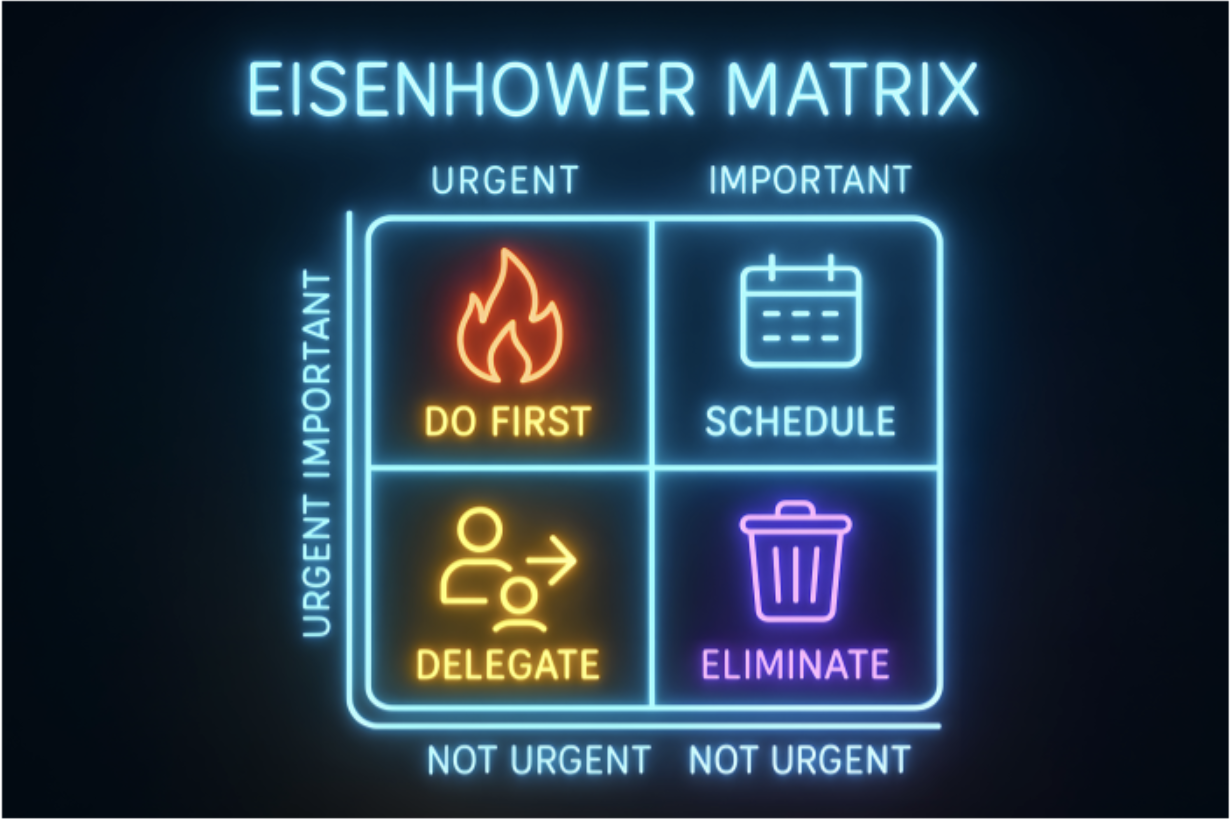
- Quadrant 1: Important & Urgent (Do)
- Tasks or responsibilities that require immediate attention.
- Quadrant 2: Important & Not Urgent (Decided/Schedule)
- Tasks or responsibilities that you plan for and schedule.
- Quadrant 3: Not Important & Urgent (Delegate)
- Tasks or responsibilities that may require your attention but can wait.
- Quadrant 4: Not Important & Not Urgent (Delete)
- Task or responsibilities that waste time and have little value.
When evaluating your tasks and placing them in one of the 4 quadrants based upon importance and urgency you are determining what is most important to you and where you will spend your time. When you take the time to schedule the important tasks and responsibilities you will find that you are less stressed.
How to Use the Eisenhower Matrix- Make a list of tasks: Write down everything you must do.
- Complete the Eisenhower Matrix: Determine what quadrant each task belongs in and write it down.
- Schedule it: Using a calendar of choice, electronic or paper write down your tasks on your schedule for the day and the week.
Why it WorksThe Eisenhower Matrix is divided into four quadrants. The ultimate goal is to spend most of your time in Quadrant 2. The idea is, if you can make Quadrant 2 larger by planning and scheduling your day, the other three quadrants become smaller and take up less of your time.
Resources to Learn More- UAB L&D Program: Mastering Your Minutes Workshop
- LinkedIn Learning: The Urgency Fallacy
- External Article: 69 Years Ago, President Eisenhower Came Up With the Best Matrix for Making Better Decisions
- External Article: How a Simple 4-Box Method Can Help You Stress Less and Get More Done
Written by Alison Kniseley, L&D SpecialistReferences: Hobson, N. (2023). 69 Years ago, President Eisenhower came up with the best matrix for making better decisions.
- Quadrant 1: Important & Urgent (Do)
-
Stop Dodging Conflict; Start Driving Results

Dodging tough conversations doesn’t just keep the peace; it drains productivity, erodes trust, and costs organizations billions. Learn practical strategies to steer conflict toward constructive dialogue that fosters trust, efficiency, collaboration and greater innovation.
How much effort do you put into sidestepping tough conversations at work? Do you hesitate before calling out uncivil behavior directed at you? Maybe you ignore the eye-rolling during the monthly staff meeting. Or perhaps a teammate let the group down, and now the water-cooler conversations happen without them. If any of this sounds familiar, you may be practicing Conflict Avoidance—and it’s more costly than you think.
A 2023 Society for Human Resource Management (SHRM) report found that nearly 57 percent of employees experience incivility at work. The ripple effect is enormous: hours wasted each week ruminating, venting, or working around problems instead of addressing them head-on. This wasted time is like a thief; stealing productivity, innovation, and collaboration. The financial toll? Billions of dollars lost annually across U.S. organizations.
The good news is you can change the story. By leaning into conflict instead of dodging it, you can reduce frustration, strengthen relationships, and protect your team’s effectiveness. Here are four practical strategies, adapted from a VitalSmarts research study that continues to be cited today:
- Clarify the Core Issue: Don’t just chase the most painful or immediate problem. Pause and ask: “What problem do I really want to resolve?” and “What do I want to make sure doesn’t happen again?”
- Manage Your Emotional Response: We often assume negative intent and spin stories that fuel frustration. Reframe the story: instead of “They’re undermining me,” try “They may be missing key information.” Speak only after you’ve calmed your emotions.
- Master Your Opening Remarks: Start with a clear, non-defensive intention. For example: “I’d like to ask about something you said earlier. It’s not my intention to upset you; I just want to understand your perspective.”
- Highlight the Impact Respectfully: Help others see the effect of their behavior in a constructive way. For instance: “I’m raising this because I think your words could erode confidence in our department’s ability to deliver services.”
Yes, addressing conflict can feel uncomfortable. But research shows that those who step up spend less time complaining, avoiding problems, or feeling defeated. The payoff is real: lower turnover, reduced absenteeism, stronger collaboration, and more innovation. In short, courage in conversation pays dividends; for you, your team, and the organization.
Resources to Learn More- UAB L&D Programs:
- External Article: The Financial Cost of Workplace Conflict and Incivility in the US
- External Article: The Cost of Avoiding Conflict: A Case Study on Workplace Dysfunction and Resolution
Written by Tammy White -
Susan Coan Retires From UAB

Susan Coan, former HR Executive Director of Learning & Development, recently retired in June.
Throughout her 12 years of distinguished service, Susan’s leadership, expertise, and passion for mentoring and developing others have had a lasting impact on the UAB community. She played a pivotal role in launching the biennial UAB Campus Engagement Survey, the results of which have been instrumental in numerous institution-wide improvements since its launch in 2017. She was also instrumental in implementing a unified performance management process for UAB employees and helped shape leadership expectations through her work on the committee for UAB's Shared Values.
Susan said she is deeply proud of what she and her team have built together during her tenure: "Working alongside such dedicated, thoughtful people has shaped my work and my learning in lasting ways, and I am grateful for the colleagues and partners who supported that journey," said Susan. "I leave with deep appreciation and strong confidence in the positive momentum the team continues to carry forward as I look ahead to what comes next.” -
Want Innovation? Start by Thinking Differently

If we want different outcomes, we need to think differently. One proven and practical approach is Edward de Bono’s Six Thinking Hats.
Most say they want innovation. New ideas. Better solutions. Smarter ways of working.
Yet when a challenge shows up, we often rely on the same thinking patterns that created the problem in the first place. We brainstorm quickly, default to opinions, or jump straight to solutions. The result is the same old ideas dressed up as innovation.
What’s wrong with the way we think?
Most team discussions are a mix of facts, opinions, emotions, risks, and ideas all at once. This creates noise, confusion, and complexity. Strong personalities dominate. Cautious voices hold back. Creative ideas get shut down too early.
Enter The Six Thinking Hats from Edward de Bono.
The Six Thinking Hats method solves this by separating thinking into clear modes. Everyone looks at the same problem from the same angle at the same time. This creates focus, balance, and better decisions. Then you progress to another angle or mode.
The Six Hats at a Glance
You can use the hats individually or as a team. Each hat represents a specific way of thinking.

White Hat = Facts and data.
What do we know? What is missing? What information do we need?Red Hat = Feelings and intuition.
What does this feel like? What are the gut reactions, without justification?Black Hat = Risks and cautions.
What could go wrong? Where might this fail?Yellow Hat = Benefits and value.
What could go right? What are the potential gains?Green Hat = Creativity and possibilities.
What are new ideas? What alternatives exist? What have we not tried?Blue Hat = Process and focus.
What is our goal? Which hat do we need next? How will we decideHow to get started
Try this in your next meeting or even on your own:
- Clearly define the problem or opportunity.
- Spend two to three minutes per hat.
- Capture insights without debating.
- Decide after all hats have been used.
For teams, the rule is simple. Everyone wears the same hat at the same time. This removes argument and encourages participation.
Why It works
The Six Thinking Hats method slows thinking just enough to make it better. It creates space for creativity without losing structure. It values emotion without letting it dominate. It allows risk without fear.
Most importantly, it helps teams move from reactive thinking to intentional thinking.
Innovation is not about having smarter people. It is about using smarter thinking.
Resources
Use this job aid to try the 6 Thinking Hats with your next problem
Citations
de Bono, E. (1985). Six thinking hats. Little, Brown and Company.
Written by:Jerad Watson, Manager | UAB Learning and Development
-
WINS Model: How to Reflect and Gain Feedback

Do you struggle and groan at the thought of reflecting on a project or completed work, or of getting feedback from others? There is a cringe-free way of reflecting and giving/receiving feedback.
At my previous workplace, I heard a leadership coach delivering a presentation on feedback that included, in my opinion, one of the greatest models for reflecting on completed or on-going work, projects, or provided feedback. And no, it was not the “feedback sandwich” method, which is where you start with positive feedback, followed by constructive criticism (or not-so positive feedback), followed by more positive feedback.
Have you experienced this type of feedback? It’s like a bad break-up tactic. I imagine a couple at a coffee shop or ice cream parlor ('cause that’s where all break-ups happen, right?), and it goes a little something like, “Hey, you’re great — this isn’t working out, but you’re still great.” Hits a little too close to home, right?
This type of feedback can, and often does, come across as insincere or insensitive. The receiver feels their interests are not being considered and may see the conversation as one-sided, instead of as an open dialogue. I think this reflects current challenges many of us experience when receiving feedback or engaging in real-time reflection.
Then there’s the challenges faced by those working independently who find it difficult to initiate meaningful self-assessment. It’s natural to say things are going great and just keep moving in the same direction, but this may cause you to miss valuable lessons and overlook growth opportunities due to a lack of knowledge or guidance.
Here is the model the leadership coach taught me — the WINS Model. Fair warning, it isn’t groundbreaking, but it offers significant value when applied to reflection and feedback processes.
W – Well
What went well?I – Improve
What would you improve?N – Needs
Are there "needs" for next time?S – Support
What support do you need?Like I said, this approach is not groundbreaking, but after introducing it at UAB, my supervisor found it valuable enough to make it our go-to method of giving and receiving feedback. I encourage you to pick a feedback method for yourself — preferably not the feedback sandwich! Feedback is important, and delivering it effectively is even more important.
Resources to Learn More
Written by Kal Keiffer, L&D Specialist