-
Focus on What Matters: How the 80/20 Rule Can Transform Your Year

Discover how a simple principle can help you prioritize the projects that deliver the biggest impact. Learn to apply the Pareto Principle to make smarter, more strategic decisions this year.
What Projects Should We Work on This Year?Every year brings a flood of ideas, initiatives, and opportunities. The challenge isn’t finding projects…it’s choosing the right ones. How do you decide where to invest your team’s time and energy for maximum impact?
Start by asking yourself:
- Which projects will create the most value for our stakeholders?
- What activities have historically driven the greatest results?
- If we could only accomplish three things this year, what would they be?
These questions set the stage for a powerful tool: the Pareto Principle, also known as the 80/20 Rule. This principle suggests that roughly 80 percent of results come from 20 percent of efforts. It was first introduced by Italian economist Vilfredo Pareto in his 1897 work Cours d’économie politique and later popularized in quality management by Joseph Juran (Interaction Design Foundation).
How to Apply the 80/20 Rule to Your Planning- List Your Options: Write down all potential projects or initiatives for the year.
- Analyze Impact: Ask, “Which of these will deliver the greatest outcomes if successful?”
- Identify the Vital Few: Highlight the top 20 percent of projects that will likely produce 80 percent of the results.
- Focus Resources: Allocate time, budget, and talent to these high-impact priorities.
This approach doesn’t mean ignoring everything else — it means being intentional. By concentrating on the “vital few,” you avoid spreading your team too thin and ensure meaningful progress.
Why It WorksThe Pareto Principle forces clarity. Instead of chasing every good idea, you double down on the best ones. Whether you’re planning academic programs, research initiatives, or operational improvements, this method helps you cut through the noise and focus on what truly matters.
Resources to Learn More- LinkedIn Learning: Use the 80/20 rule for maximum impact
- External Article: The Pareto Principle and How to Be More Effective
Written by Jerad Watson, L&D Manager
-
How the Brain Changes During Learning and Why Loving the Material Matters

We tend to think of learning as something that happens in the mind, a mental exercise of reading, practicing, and remembering. But the truth is far more visceral.
Every time you learn something new, your brain physically reshapes itself. How you feel about what you’re learning, whether you love it, tolerate it, or resent it, directly affects how well that reshaping occurs and how long those changes last.
This isn’t motivational talk. It’s neuroscience, and it has profound implications for how we approach education, professional development, and lifelong learning.
1. Your Brain Physically Rewires Itself When You Learn
Learning isn’t abstract, it’s biological. The brain’s remarkable ability to reorganize itself, known as neuroplasticity, means that every new skill or piece of knowledge triggers actual structural changes in your neural wiring. Your brain is never static; it’s constantly being sculpted by your experiences throughout your entire life (Cunnington, n.d.).
Key structural changes that happen during learning:
- Synaptic strengthening, connections between neurons become stronger
- Structural remodeling, the physical architecture of neural pathways changes
- Functional reorganization, brain regions adapt how they work together (Brain Research Review, 2025)
Brain imaging studies show that when you’re learning something new, specific regions light up initially. But as you become more skilled, those localized activity patterns give way to broader, more efficient network connections across the brain (Bertolero et al., 2018). It’s the difference between a beginner laboriously thinking through every step and an expert operating on instinct.
Dopamine’s critical role:
- Dopamine doesn’t just make you feel good, it regulates neural plasticity and motivation by signaling reward and influencing how much effort you’re willing to invest (Neuroscience News, 2015).
- Research on motor learning shows that when dopamine levels are restored, people can reorganize their neural networks and resume learning new physical skills, evidence of its central importance in forming new abilities (Technology Networks, 2025).
2. Why Your Feelings About Learning Actually Matter
Once you understand that learning involves physical changes in the brain, it becomes clear why emotion plays such a decisive role.
What happens when you’re intrinsically motivated:
- Your brain responds differently to feedback and engages memory systems more effectively (Murayama et al., 2015).
- Highly motivated learners show sharper distinctions between positive and negative feedback, helping them learn from both success and failure more efficiently.
- Curiosity activates reward circuits in the brain and strengthens memory formation.
What about external incentives?
- Even external incentives, like the promise of money, can enhance learning, primarily by sharpening attention and filtering out distractions (Gruber & Ranganath, 2020).
- Internal passion and external rewards reinforce learning simultaneously, just through different neural routes.
Dopamine also supports both reinforcement learning and behavioral activation based on anticipated rewards (Neuroscience News, 2023). When you enjoy what you’re learning, your brain releases more dopamine, which improves attention and strengthens the neural connections involved in memory consolidation (Leming, n.d.).
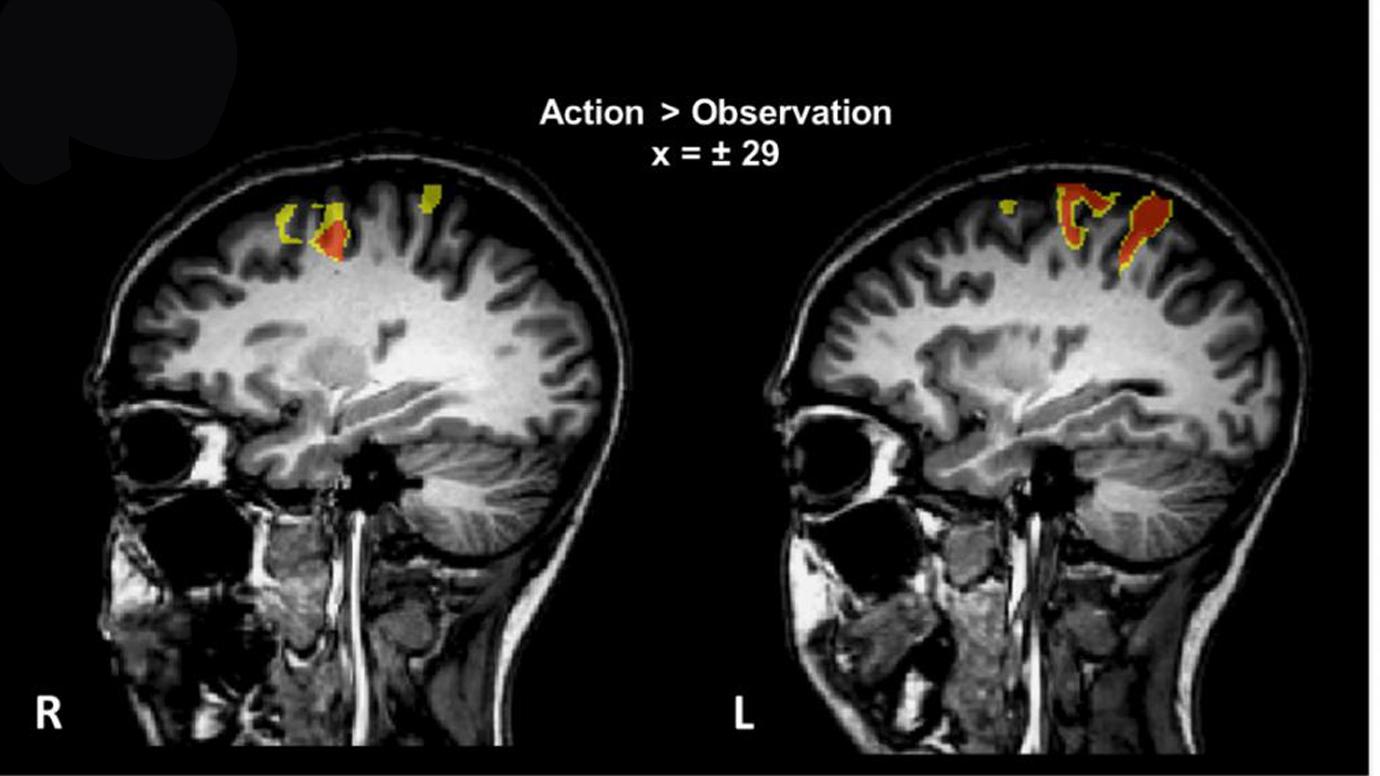
Above: "Brain scans showed that students who took a hands-on approach to learning had activation in sensory and motor-related parts of the brain when they later thought about concepts such as angular momentum and torque." (Ingmire, 2015)
3. The Difference Between Loving and Hating What You Learn
When you love what you’re learning:
- You focus better and for longer periods, which improves how much you absorb and retain (Leming, n.d.).
- Positive emotional states strengthen both encoding (the process of forming memories) and recall, making it easier to retrieve information later (Leming, n.d.).
- Interest naturally drives you to explore beyond the minimum, building richer, more interconnected knowledge networks (Leming, n.d.).
- Both immediate performance and long-term retention improve significantly compared to traditional methods when learning is enjoyable (BMC Medical Education, 2025).
When you dislike what you’re learning:
- Motivation drops.
- Feedback processing weakens.
- Attention becomes inefficient.
- Learning still happens, it just requires more effort and typically produces weaker retention because engagement and reward signaling are diminished (Murayama et al., 2015).
That said, neutral or unpleasant learning isn’t worthless. With sustained effort, you can reach flow states, those moments when engagement increases as competence builds, reinforcing cognitive control and improving how you process feedback (Lu et al., 2024). But reaching that state usually demands deliberate persistence rather than happening naturally from intrinsic attraction.
4. What This Means Over the Long Haul
The emotional relationship you have with your subject matter doesn’t just affect immediate performance, it shapes your entire learning trajectory.
The long-term impact in a nutshell:
- Loving what you learn: You engage with it repeatedly. That repetition strengthens neural connectivity patterns that persist even when you’re not actively studying (Bertolero et al., 2018). Accelerates adaptation and improves retention.
- Disliking what you learn: Disengagement reduces repetition and cognitive investment, limiting opportunities for deep consolidation. Slows things down but doesn’t make learning impossible.
- Neutral engagement: Produces functional results, but they’re often suboptimal.
The brain is designed to learn under almost any circumstances. It’s just exceptionally good at learning when reward circuits, emotional state, and cognitive effort all point in the same direction.
Final Thoughts
Learning isn’t only a mental activity, it’s a biological transformation. Neuroplasticity, synaptic modification, and network reorganization physically reshape your brain whenever you acquire new knowledge or skills. And these changes are profoundly influenced by emotion.
The Key Takeaways:
- Motivation, curiosity, and enjoyment modulate how your brain processes feedback, releases dopamine, directs attention, and consolidates memories.
- Together, they determine how effectively learning becomes durable knowledge.
- Loving what you learn doesn’t simply make the process more pleasant,it measurably improves your brain’s capacity to retain and apply that knowledge over time.
So, when people say you should be passionate about what you learn, they’re not just offering feel-good advice. They’re describing neurological leverage.
Resources
Citations
Bertolero, M. A., Bassett, D. S., & D’Esposito, M. (2018). Learning differentially reorganizes brain activity and connectivity. arXiv. https://arxiv.org/abs/1810.08840
Brain Research Review. (2025). The neuroplastic brain: Current breakthroughs and emerging frontiers. ScienceDirect. https://www.sciencedirect.com/science/article/pii/S0006899325002021
BMC Medical Education. (2025). Impact of game-based teaching on learning and retention. https://bmcmededuc.biomedcentral.com/articles/10.1186/s12909-025-07630-9
Cunnington, R. (n.d.). Neuroplasticity: How the brain changes with learning. UNESCO/IBRO Science of Learning Portal. https://solportal.ibe-unesco.org/articles/neuroplasticity-how-the-brain-changes-with-learning/
Gruber, M. J., & Ranganath, C. (2020). How curiosity enhances hippocampus-dependent memory: The intersection of motivation and cognition. Brain Structure and Function. https://link.springer.com/article/10.1007/s00429-020-02074-x
Ingmire, J. (2015, April 29). Learning by doing helps students perform better in science. University of Chicago News. https://news.uchicago.edu/story/learning-doing-helps-students-perform-better-science [news.uchicago.edu]Leming, M. (n.d.). The impact of enjoyment on learning retention. The Hun School of Princeton. https://www.hunschool.org/resources/the-impact-of-enjoyment-on-learning-retention
Lu, H., van der Linden, D., & Bakker, A. (2024). The neuroscientific basis of flow. arXiv. https://arxiv.org/abs/2409.06592
Murayama, K., et al. (2015). Neural basis of intrinsic motivation and feedback processing. NeuroImage. https://www.sciencedirect.com/science/article/pii/S1053811915005510
Neuroscience News. (2015). The role of dopamine in learning and reward. https://neurosciencenews.com/dopamine-learning-reward-3157/
Neuroscience News. (2023). Dopamine plays double duty in learning and motivation. https://neurosciencenews.com/dopamine-motivation-learning-23403/
Technology Networks. (2025). Dopamine’s role in learning new motor skills revealed. https://www.technologynetworks.com/neuroscience/news/dopamines-role-in-learning-new-motor-skills-revealed-398033
Written by:Hammond Lake, Communications Specialist
-
Maximize Your Time with the Eisenhower Matrix

Discover how the Eisenhower Matrix can help you prioritize your tasks based upon urgency and importance. Learn how to use the matrix to focus on what truly matters while reducing time spent on unimportant and less critical things.
Is this urgent or important? Sometimes there is so much to do at work we don’t know where to start. We can feel overwhelmed. Consider using the Eisenhower Matrix to help you sort it all out.
The Eisenhower matrix is a tool that President Dwight D. Eisenhower used to determine what tasks he should focus on. Stephen Covey, author of “The Seven Habits of Highly Effective People,” popularized the matrix. You can use it to help you determine the status of your tasks. While you may want to do everything, it is not possible. The matrix is divided into four quadrants divided by urgency and importance.
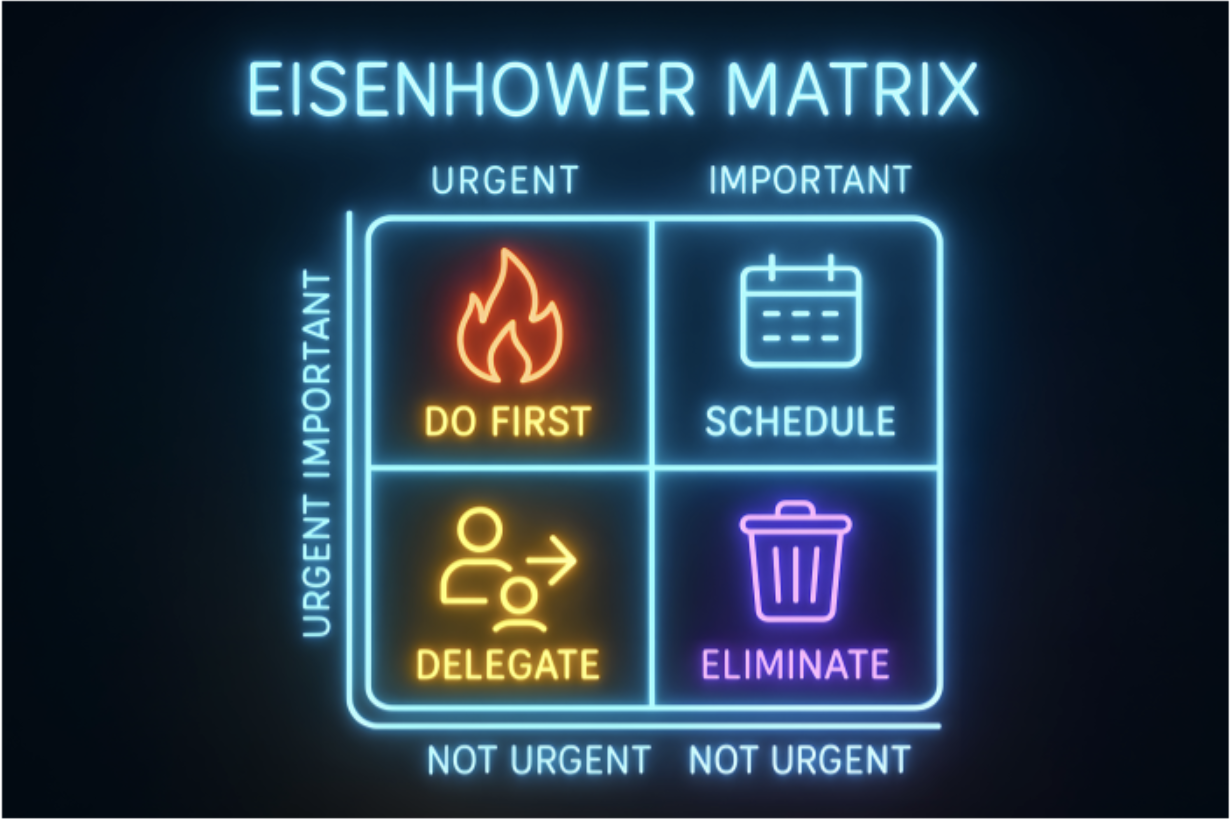
- Quadrant 1: Important & Urgent (Do)
- Tasks or responsibilities that require immediate attention.
- Quadrant 2: Important & Not Urgent (Decided/Schedule)
- Tasks or responsibilities that you plan for and schedule.
- Quadrant 3: Not Important & Urgent (Delegate)
- Tasks or responsibilities that may require your attention but can wait.
- Quadrant 4: Not Important & Not Urgent (Delete)
- Task or responsibilities that waste time and have little value.
When evaluating your tasks and placing them in one of the 4 quadrants based upon importance and urgency you are determining what is most important to you and where you will spend your time. When you take the time to schedule the important tasks and responsibilities you will find that you are less stressed.
How to Use the Eisenhower Matrix- Make a list of tasks: Write down everything you must do.
- Complete the Eisenhower Matrix: Determine what quadrant each task belongs in and write it down.
- Schedule it: Using a calendar of choice, electronic or paper write down your tasks on your schedule for the day and the week.
Why it WorksThe Eisenhower Matrix is divided into four quadrants. The ultimate goal is to spend most of your time in Quadrant 2. The idea is, if you can make Quadrant 2 larger by planning and scheduling your day, the other three quadrants become smaller and take up less of your time.
Resources to Learn More- UAB L&D Program: Mastering Your Minutes Workshop
- LinkedIn Learning: The Urgency Fallacy
- External Article: 69 Years Ago, President Eisenhower Came Up With the Best Matrix for Making Better Decisions
- External Article: How a Simple 4-Box Method Can Help You Stress Less and Get More Done
Written by Alison Kniseley, L&D SpecialistReferences: Hobson, N. (2023). 69 Years ago, President Eisenhower came up with the best matrix for making better decisions.
- Quadrant 1: Important & Urgent (Do)
-
Productivity Prompts You Can Use Today in Copilot Chat

Try these copy‑and‑paste prompts for Copilot Chat to help you write faster, prioritize work, create executive updates, and make quick data decisions. Each prompt includes clear input instructions and output formatting—plus notes where Microsoft 365 Copilot can take it further.
All faculty and staff at UAB have access to Microsoft Copilot Chat which is an approved AI tool that can enhance your productivity in day-to-day work. Learn more about accessing this tool at uab.edu/ai/tools. Below are some prompts you can copy and paste into Copilot to immediately get some results.How to use these prompts:
- Navigate to https://m365.cloud.microsoft/chat and sign in with UAB credentials
- Copy and paste the prompt
- Copy and paste your source between triple backticks: ```
- Specify audience, tone, format, and length
- Iterate: "shorter," "more direct," "bullet points," "add dates"
Prompt 1: Write & Edit FasterRewrite the message to be professional, concise, and put the main ask first.
Audience: senior managers. Tone: direct.
Output: ≤120 words + 3 action bullets.
Text: ```[paste text]```
Proofread the text for grammar, clarity, and tone.
Output: 1) corrected version, 2) change log (grammar/wording/tone) with examples.
Text: ```[paste text]```
Prompt 2: Prioritize & PlanFrom the weekly context below, list my top 3 priorities and the single highest‑impact action for each.
Output: table with Priority | Action | Owner: me | Due: this week.
Context: ```[paste calendar highlights, deadlines, notes]```
Break down the goal into steps with owners (me), target dates, risks, and mitigations.
Output: checklist I can paste into Planner.
Goal: ```[paste goal]```
Note: This is better in Microsoft 365 Copilot (paid version). The Recap/Set priorities scenario can scan Outlook/Teams/To Do automatically as context rather than you having to type them or copy and paste them.
Prompt 3: Email & Meeting EfficiencySummarize the email thread.
Output: decisions made, open questions, and action items with suggested due dates.
Thread: ```[paste thread key excerpts]```
Draft a reply that 1) confirms decisions, 2) asks concise clarifying questions, and 3) sets next steps with a proposed timeline.
Reference: ```[paste summary above]```
From these meeting notes, create a follow‑up message with decisions, owners, deadlines, and the next checkpoint date. Add a clear subject line.
Notes: ```[paste notes or transcript excerpts]```
Note: This is better in Microsoft 365 Copilot (paid). In Outlook/Teams, Copilot can summarize threads/meetings and draft replies in‑place, including attachment summaries.
Prompt 4: Executive UpdatesCreate a 3‑paragraph executive summary with headings: Wins, Risks, Next Steps. Keep it under 200 words, plain language.
Updates: ```[paste updates]``` Turn that summary into outlines for 3 slides (title + 3 bullets each + 1 KPI to display).
Audience: CHRO staff meeting.
Summary: ```[paste summary]```
Note: This is better in Microsoft 365 Copilot (paid). In Word/PowerPoint, Copilot formats summaries/slides using live content in the slides without you having to copy and paste into PowerPoint.
Prompt 5: Quick Ops (explainer/how‑to)Explain how to calculate percentage increase using a 1‑minute method and example.
Output: 5 step bullets + formula template + 3 common mistakes to avoid.
Define the concept in plain English with 5 bullet takeaways for a non‑technical audience.
Concept: ```[paste concept]```
Note: Copilot Chat provides web‑grounded explanations with citations.
Prompt 6: Data & Decisions (paste small tables)Given the data table, recommend the single best chart to tell the story and justify why. Then describe how to build it (title, axes, labels).
Data: ```[paste a small table or CSV snippet]```
Generate the Excel formula(s) to perform this calculation and explain each part. Provide a short worked example with sample values.
Calculation: ```[describe calculation]```
Identify trends and outliers in the dataset and recommend 2 actions for this week.
Output: 5 bullets (3 trends + 2 actions), ≤120 words.
Data: ```[paste a small summary table]```
Note This is better in Microsoft 365 Copilot. In Excel, Copilot suggests formulas/builds charts; the Analyst agent performs deeper reasoning and Python‑backed analysis.
Resources to Learn More- External Article: Copilot Search in Bing (AI overviews & citations)
- External Article: Copilot in apps for work (Word/Excel/Outlook/PowerPoint/OneNote)
- External Article: Recap Your Week/Set Priorities with Copilot
- Copilot in Excel + Analyst Module
Written by Jerad Watson, L&D Manager
-
Want Innovation? Start by Thinking Differently

If we want different outcomes, we need to think differently. One proven and practical approach is Edward de Bono’s Six Thinking Hats.
Most say they want innovation. New ideas. Better solutions. Smarter ways of working.
Yet when a challenge shows up, we often rely on the same thinking patterns that created the problem in the first place. We brainstorm quickly, default to opinions, or jump straight to solutions. The result is the same old ideas dressed up as innovation.
What’s wrong with the way we think?
Most team discussions are a mix of facts, opinions, emotions, risks, and ideas all at once. This creates noise, confusion, and complexity. Strong personalities dominate. Cautious voices hold back. Creative ideas get shut down too early.
Enter The Six Thinking Hats from Edward de Bono.
The Six Thinking Hats method solves this by separating thinking into clear modes. Everyone looks at the same problem from the same angle at the same time. This creates focus, balance, and better decisions. Then you progress to another angle or mode.
The Six Hats at a Glance
You can use the hats individually or as a team. Each hat represents a specific way of thinking.
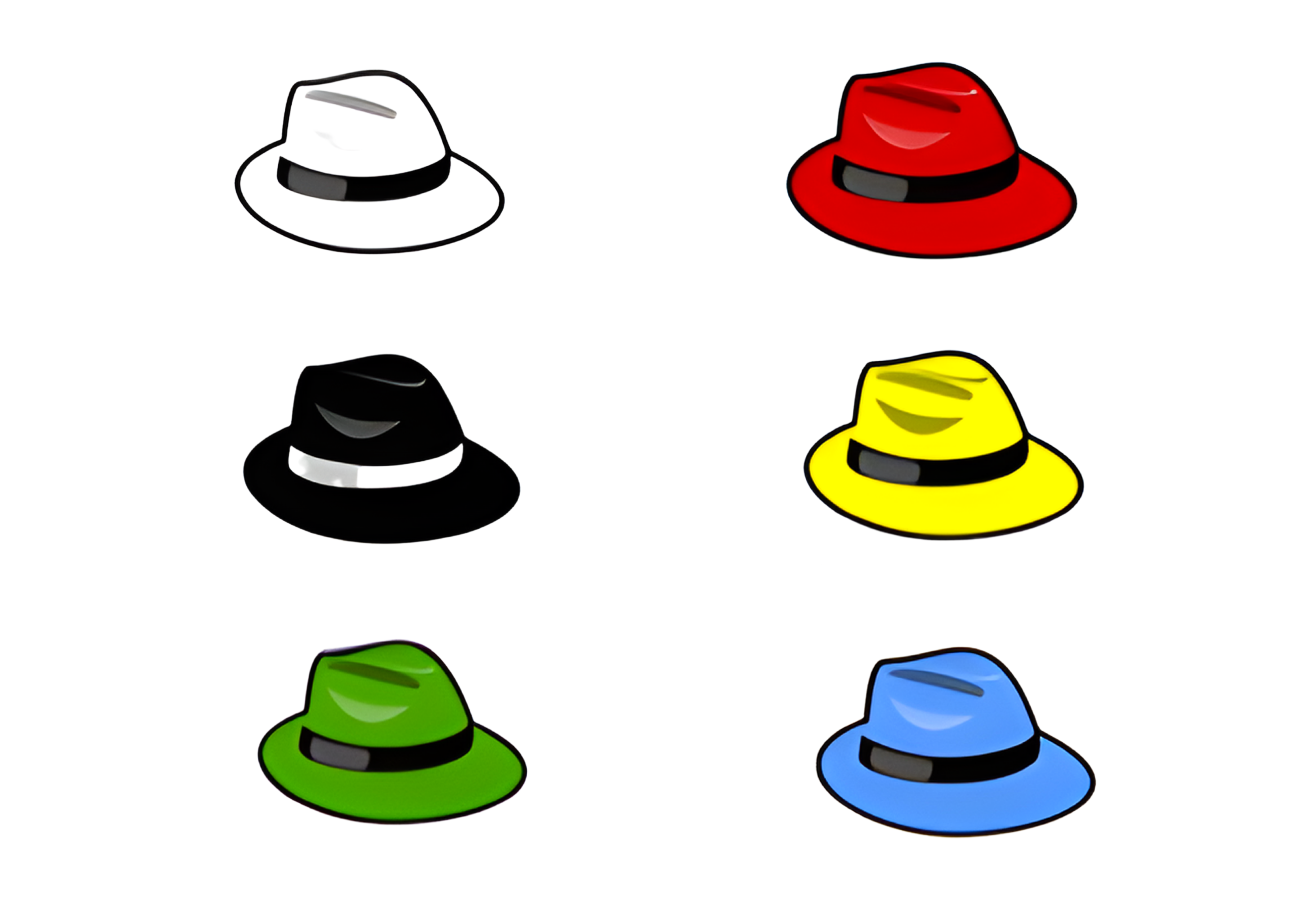
White Hat = Facts and data.
What do we know? What is missing? What information do we need?Red Hat = Feelings and intuition.
What does this feel like? What are the gut reactions, without justification?Black Hat = Risks and cautions.
What could go wrong? Where might this fail?Yellow Hat = Benefits and value.
What could go right? What are the potential gains?Green Hat = Creativity and possibilities.
What are new ideas? What alternatives exist? What have we not tried?Blue Hat = Process and focus.
What is our goal? Which hat do we need next? How will we decideHow to get started
Try this in your next meeting or even on your own:
- Clearly define the problem or opportunity.
- Spend two to three minutes per hat.
- Capture insights without debating.
- Decide after all hats have been used.
For teams, the rule is simple. Everyone wears the same hat at the same time. This removes argument and encourages participation.
Why It works
The Six Thinking Hats method slows thinking just enough to make it better. It creates space for creativity without losing structure. It values emotion without letting it dominate. It allows risk without fear.
Most importantly, it helps teams move from reactive thinking to intentional thinking.
Innovation is not about having smarter people. It is about using smarter thinking.
Resources
Use this job aid to try the 6 Thinking Hats with your next problem
Citations
de Bono, E. (1985). Six thinking hats. Little, Brown and Company.
Written by:Jerad Watson, Manager | UAB Learning and Development