Now in its second year, the Comprehensive Urban Underserved and Rural Experience, or CU2RE, program has expanded rapidly, earning $5.2 million in supplemental funding and attracting a growing number of students committed to serving the people of Alabama through primary care.
The CU2RE program welcomed its second cohort at the end of 2021, accepting 16 MS1 students. They join an inaugural cohort of eight MS2 students who began the program in 2020 after the department was awarded a $7 million grant from the Health Resources and Services Administration. Supported by the grant, CU2RE aims to enhance the recruitment, training and retention of medical students dedicated to serving urban underserved and rural populations through family medicine and primary care.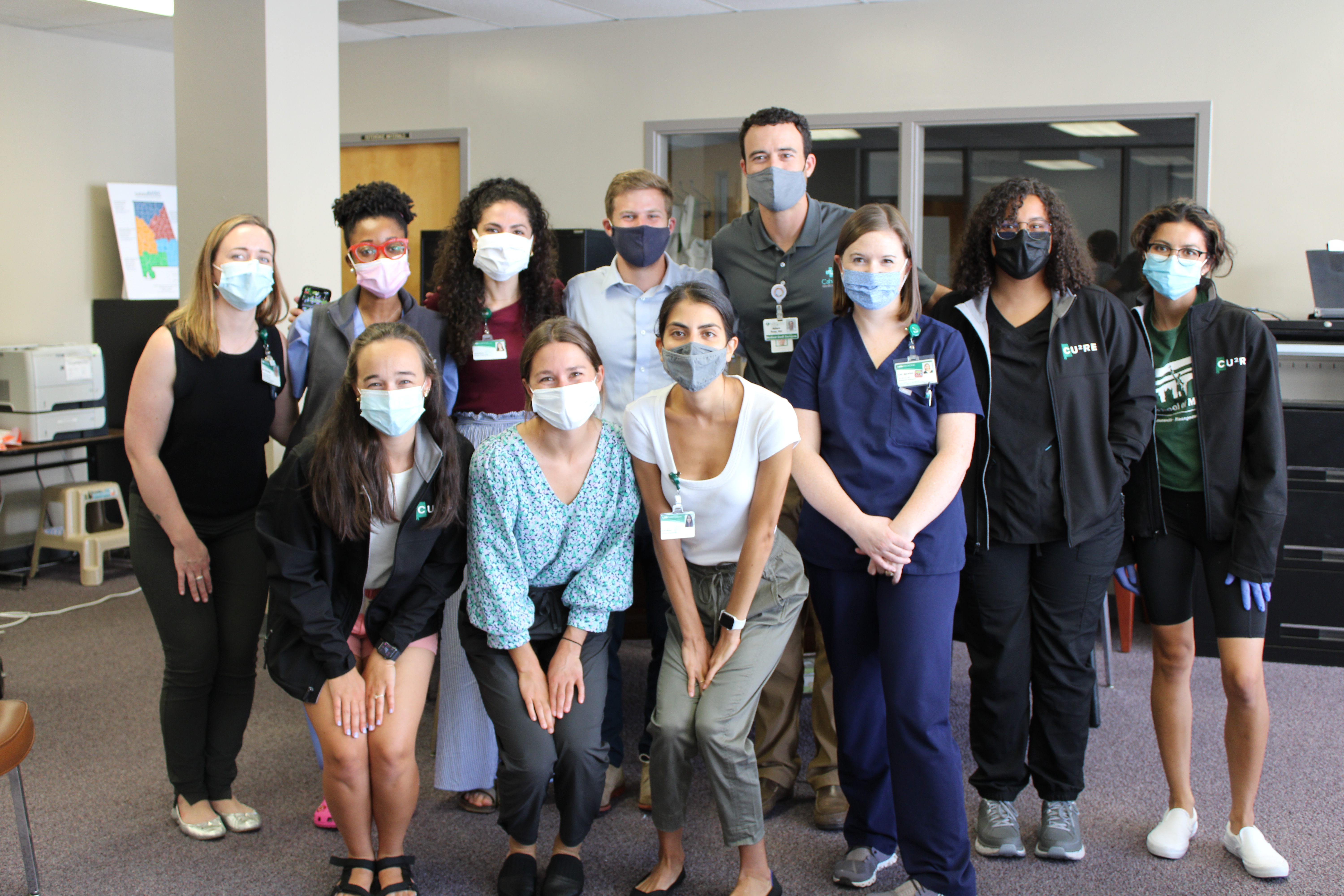 CU2RE students and faculty during a summer dermatology workshop.
While the first cohort focused on the Urban Underserved Pathway, or U2P, emphasizing primary care and health equity in urban areas, the second cohort also welcomed students to a new Rural Pathway, which will emphasize primary care in rural areas of the state, providing hands-on experience and training in the unique challenges facing rural patient populations.
As this pathway expands placement of students around the state, the $5.2 million in supplemental funding, awarded by HRSA in August, is providing resources to support them. The funding is being used to increase educational activities for medical students, redesign the family medicine clerkship curriculum across all UAB regional campuses, provide CU2RE students with stipends to offset medical education costs and implement new faculty, staff and student development initiatives.
To allocate the funding, Irfan Asif, M.D., department chair and associate dean for primary care and rural health, asked campuses and family medicine residency programs throughout the state, including those in Huntsville, Tuscaloosa, Montgomery and Selma, to submit requests for resources needed to fulfill the goals of the HRSA grant. CU2RE leaders went through every request and, working within the parameters of the HRSA grant, allocated funding for several new initiatives aimed at increasing the number of students who will enter family medicine and primary care. These include:
- Pipeline programming designed to support the Huntsville Pre-Medical Internship for college students interested in rural medicine, create a new Tuscaloosa Pre-Medical Internship, and create an Early Assurance Program with Alabama A&M and Oakwood University, allowing students to obtain resources for MCAT preparation and registration.
- Simulation training labs and equipment, which will give students the space and equipment needed to practice skills they will use every day as a physician.
- Point-of-care ultrasound (POCUS) technology and training, allowing family medicine and primary care physicians to use ultrasound technology in-clinic, reducing costs and improving access for patients while allowing for rapid, real-time care.
- Faculty development courses for point-of-care ultrasound, simulation and courses with the Society of Teachers of Family Medicine.
- Housing, transportation, materials and equipment support for the Huntsville Rural Pre-Medical Internship
- Scholarship and stipend support for Integrated Residency and CU2RE students
With those allocations, the HRSA supplemental funding will provide tangible support to both students and faculty and expand the CU2RE program’s reach around Alabama
“In many ways, the supplemental funding has allowed us to accelerate some of the work that I originally saw as 3-5 years away in the CU2RE program,” Asif said. “Growing the program from eight to 16 students is fantastic and that growth, along with the resources from the supplemental funding, is giving us many opportunities for collaboration around the state.”
What’s Next
As part of the work related to the new supplemental funding, the department will assemble a task force of leaders from all Heersink School of Medicine campuses to create new clerkship objectives, experiences, and educational offerings. This group will form the Family Medicine Clerkship Redesign Task Force. The task force will focus on implementing educational curricula for medical students related to POCUS, simulation training, gamification of family medicine educational content and more.
“We have invited people from around the state to come together to think about curriculum design, faculty development and how we want to teach our curriculum,” Asif said. “That is really the next phase of the use of this funding.”
More broadly, leaders also hope to continue to expand the CU2RE program’s reach by developing partnerships throughout the state and building up pipeline programs, designed for high school and college students interested in primary care and health equity, with a passion for serving underserved communities.
Building a Pipeline
Pipeline programs, designed to educate and encourage students to pursue a career in medicine, are a major part of the CU2RE program and the department’s goals. During the 2020-21 academic year, the department participated in several pipeline programs aimed at high school and college students, including:
The UAB Heersink School of Medicine Virtual Immersion Pre-Med Program: The department provided curriculum content for the VIPMed program, which connects pre-med students, particularly those from underrepresented populations, to UAB medical education leaders, hands-on training and other resources.
The UAB Summer Health Professions Education Program (SHPEP): CU2RE students participated in a session of the summer 2021 program, discussing the medical school application process and answering questions from undergraduate students. Assistant professor Sameera Davuluri, M.D., medical director of UAB Family and Community Medicine – Hoover, also participated in a longitudinal case study during the program.
These programs helped to introduce more than 60 undergraduate and pre-medical students to the UAB Heersink School of Medicine, previewed topics, including health disparities, that students will focus on in medical school, and provided resources for the application process.