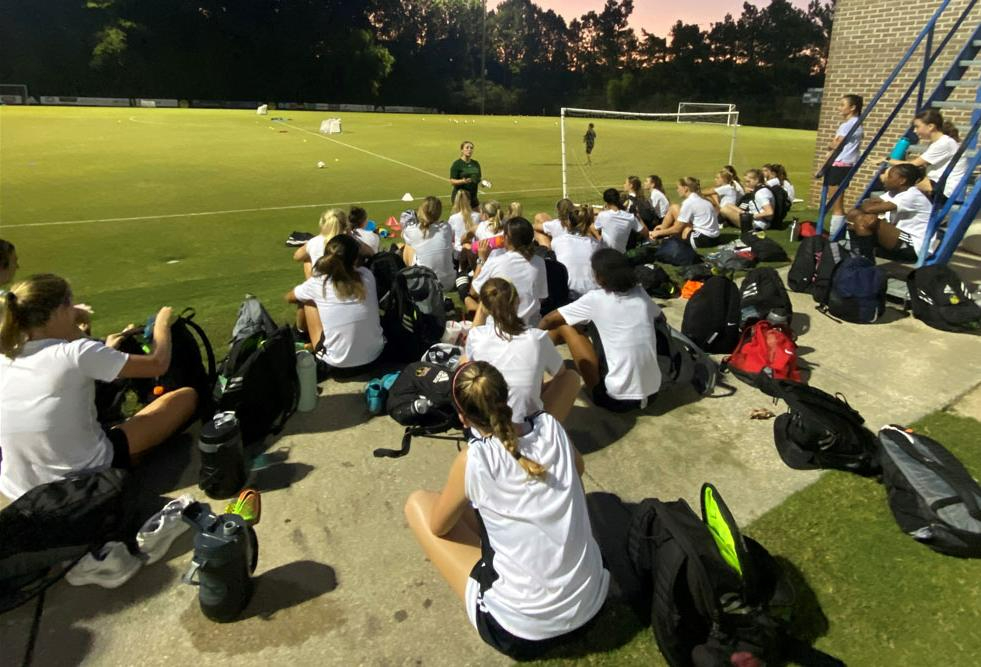
 Faught, center, leads a nutrition discussion with players after practice.
The team at UAB Sports and Exercise Medicine, a partnership between the departments of Family and Community Medicine and Orthopaedics, is setting up student athletes for a lifetime of healthy habits with a new, nutrition-centered educational program for teens and young adults.
Dietitian and recent UAB addition, Tori Faught MS, RDN, LD teamed up with Hoover-Vestavia Soccer Club (HVS) to launch the pilot program in August.
Executive Director of Vestavia Hills Soccer Club Rocky Harmon says he is always looking for ways to improve the program. Boasting more than three decades of club soccer experience, including 15 years in his current position, Harmon is confident in his expertise; but he is also aware of his limitations.
“I know what I don’t know,” said Harmon.
That is why Harmon looked to outside professionals to elevate his soccer program-- professionals like Faught. UAB Sports and Exercise Medicine already provides care for the club’s athletes, sponsors jerseys and, since October 2021, holds weekly health checks. Trainer Kenny Davis is on-site Mondays, when any HVS player with injuries or issues can seek rehab or treatment.
Harmon tells us the program’s success precipitated the new nutrition program.
“Kenny was the conduit,” he said.
Every other week, young adults take home key lessons in performance nutrition, including how to stay hydrated and what to eat to help sore muscles recover.
“Once athletes reach the college or professional level, they’ve already been exposed to basic performance nutrition principles from a credible source using evidence-based recommendations and have started to form better fueling and hydration habits,” said Faught. “It’s all about protecting the athlete from false nutrition advice. Starting sports nutrition education in this age group is good because they are already being exposed to false nutrition advice from uncredible, ill-informed sources and are forming habits and beliefs based off this information."
Faught says teens, ages 14-18, are “responsive.” She says the team talks allow her to address a number of topics and to build a rapport with the athletes.
Faught explains younger students may not be able to grasp all of the concepts she currently covers. She tells us older students not only pay better attention, but they also face greater challenges. For example, in one of her most recent talks, Faught introduced the topic of dietary supplements to students, in an effort to warn them of the risks.
“You cannot out-supplement a bad diet,” she said.
Faught says there is increased pressure to subscribe to the purported benefits of popular supplements. According to an article in American Journal of Health Education, young people are “one of the largest target audience groups” for performance-enhancing dietary supplements because of their interest. In turn, the market has responded by “[enticing] this vulnerable population and [making] it easy for them to engage in unregulated consumption.”
 Tori Faught, M.S., RDN, LD
What’s more, many supplements that claim to boost performance or speed up muscle recovery are not allowed in collegiate athletics. Celsius and Alani energy drinks, for instance, are sold in many grocery stores, but if you drink one as a college athlete, you are risking your eligibility. Both contain Guarana, a form of caffeine currently banned by the NCAA.
“You don’t want them to get hooked on a supplement now that would put them at a high risk for testing positive for banned substances in the professional or collegiate setting,” Faught explained.
Aside from dietary supplements, research reveals student athletes are also at greater risk for malnutrition. According to the National Library of Medicine this is because “their bodies are attempting to balance their increased needs for growth and training at the same time.” In addition, those studies show these competitive high schoolers are at greater risk for disordered eating than their peers. The article, “Nutritional Risks Among Adolescent Athletes with Disordered Eating,” reveals, “despite their high nutritional requirements, athletes often engage in inappropriate dietary strategies in their attempt to regulate their body weight and/or body shape, for the purpose of reaching optimal sports performance or ideal physical standards for their sport.”
“The smallest change in diet or hydration can make a big difference in performance,” said Faught.
Faught hopes the simple and informative meetings with the boys and girls soccer teams will give student athletes the practical tools they need to improve their performance and to reduce sports-related injuries. Her goal is to, eventually, expand the program to also include younger HVS athletes, and Harmon is on board. He calls these nutritional talks a success, so far.
From Faught’s educational discussions to the care provided during tournaments and games, Harmon tells us the support UAB Sports and Exercise Medicine offers HVS teams gives them an advantage on and off the field.