-
Mr. & Mrs. Elbert H. Purser Endowed Scholarship
Established in 1979 and subsequently endowed in 1983 through a gift from the Elbert H. Purser Trust. Applicants must be admitted to or enrolled in the UAB Physician Associate Studies Program and must be natives or permanent residents of the state of Alabama. Selection is made by a committee of PA program faculty and annual awards are determined based on the availability of funds.
-
Bill Parker Endowed Scholarship
Established in 2018. Mr. Parker is a 1972 graduate of the Physician Associate Studies program who worked as an orthopaedic PA for over 40 years. Applicants must be admitted to or enrolled in the UAB Physician Associate Studies Program and will be chosen by the faculty.
-
Comer Foundation Scholarship
Established in 2021. Applicants must be permanent Alabama residents who are admitted to or enrolled in the UAB Physician Associate Studies Program and must demonstrate the following: financial need as determined by the Office of financial aid, good academic standing, and plans to live in and practice within Alabama upon completion of their studies.
-
William John Gill PA-C Sponsored Scholarship
Established in 2021. Applicants must be admitted to or enrolled in the UAB Physician Associate Studies Program and must demonstrate an interest in practicing in a rural/underserved or health professional shortage area upon completion of their studies.

The coordinated Master of Science in Physician Associate Studies and Master of Public Health (MSPAS/MPH) dual degree program will prepare physician associate students for leadership roles that address community health care needs. The MSPAS/MPH program aims to increase the number primary care clinicians with public health expertise and thus improve access, quality, and cost of care.
In addition to developing clinical competencies and skills as a physician associate, this plan of study provides students with opportunities for interdisciplinary collaboration and a public health practice experience with rural primary care clinical community partners. This innovative program enhances physician associate education with integrated training in public health and primary care and thereby provides students with the information and skills needed to monitor and assess community health, develop and analyze programs and policies, coordinate and integrate care, and utilize appropriate population health measures in quality improvement strategies.
Curriculum
Students enrolled in the MSPAS/MPH program can complete up to 25 credit hours of online public health coursework in the spring and summer terms prior to fall matriculation into the PA program. Courses available for completion during these two terms include the required MPH Core courses based on the Evidence-Based Public Health framework, along with public health elective courses of particular interest to MSPAS/MPH students.
Students then begin the PA program didactic year in the fall after completing the first two semesters in the UAB School of Public Health (SOPH). Ten credit hours of coursework in the PA program curriculum, such as research methods, health administration, and health behavior accrue credit toward both degrees. MSPAS/MPH students complete a specially designed integrated public health /primary care internship and tailor their master’s research project topic to address the public health needs of medically underserved communities.
View the sample curriculum sequence. The curriculum is subject to change.
Why should you pursue a dual MSPAS/MPH degree at UAB?
There are multiple reasons. Among these are a wider choice of career opportunities, broader perspective on caring for patients within their communities, increased ability to provide evidence-based medical care, and expansion of practice capability to tackle international health challenges especially in the developing world.
The UAB School of Public Health and the UAB Physician Associate Studies Program are recognized leaders in education. The School of Public Health and the Physician Associate Studies Program are nationally ranked by US News & World Report. The University of Alabama at Birmingham is the second oldest PA program in the nation, and it has a rich history of community collaboration and support. Housed within the School of Health Professions on the campus of the world class UAB Medical Center complex, a student in the dual MSPAS/MPH program will have access to the region’s medical communities with diverse clinical experiences and opportunities. Students at UAB will have outstanding opportunities to learn both the medical and public health perspectives of providing care while serving in underserved areas.

Admission Requirements
Students must meet the admissions requirements for both the MSPAS degree program as well as the MPH degree program. View the MSPAS admission requirements. View the UAB School of Public Health admission requirements.
In addition to meeting the stated requirements for each degree separately, applicants for the dual degree must also have completed a bachelor degree and all prerequisites before December 30 in order to start the program in January of the following spring term.
Application Procedures
In order to be considered for admission to the UAB MSPAS/MPH dual degree program, candidates will need to complete and submit the following materials by the stated deadlines:
- August 1 - The Central Application Service for Physician Assistants (CASPA) Application
- August 7 - The UAB PA Supplemental Application
The Central Application Service for Physician Assistants (CASPA) Application: The UAB PA program participates in the Central Application Service for Physician Assistants (CASPA). Please consult the CASPA website for more information regarding specific CASPA application requirements, procedures, and fees. Applicants should use GRE Code 0570 when sending GRE scores to CASPA. CASPA will verify the application information and send completed applications to the program.
The UAB PA Supplemental Application: The PA program supplemental application is an opportunity for PA program applicants to provide details regarding completion of the program’s prerequisite courses and to express their specific interest in the UAB program. On this form, MSPAS/MPH dual degree program applicants should also be sure to complete the information required for consideration of dual degree admission.
Completed applications are reviewed by members of the admissions committee. Interviews typically occur in October and November. Decisions regarding acceptance to the MSPAS/MPH program will occur in November and December for matriculation in January.
Students who are accepted into the dual degree program will also need to complete the a UAB Graduate School applications. One application is for the MPH program and the other application is for the UAB PA program. Instructions for completing these applications will be provided to students upon acceptance to the MSPSAS/MPH program.
If you have any questions regarding the dual degree program, please contact
Accreditation
The UAB PA program is fully accredited by the Accreditation Review Commission on Education for the Physician Assistant (ARC-PA). The UAB MPH program is accredited by the Council on Education for Public Health (CEPH).
Fees and Financial Aid
All tuition and fees are billed to the student by the corresponding school during matriculation. Information about tuition and fees can be found on the Office of Student Financial Aid website. If you have questions about tuition, fees, and financial aid options, please email us at
Program Learning Objectives, Competencies and Goals
The UAB PA program faculty have established performance indicators, learning outcomes, and goals for the program. The faculty regularly monitors and evaluates progress towards meeting its stated outcomes and goals, and continually assesses student's acquisition of knowledge, skills, and professional behaviors. Student, faculty, and graduate surveys are conducted to determine satisfaction in the following areas: admissions and orientation; student services and resources; policies and procedures; and the didactic and clinical curriculum.
Didactic-Year Learning Outcomes
Upon completion of the didactic year curriculum, students will be able to perform the following tasks:
- Demonstrate an understanding of human anatomy, physiology, and pathology of disease and their application in clinical practice.
- Demonstrate the ability to evaluate and manage common diseases encountered in general medicine, emergency medicine, surgery, pediatrics, women’s health, and behavioral medicine.
- Demonstrate proficiency in performing a complete and problem-focused history and physical examination.
- Demonstrate competency in the technical skills needed to perform as a surgical and primary care PA.
- Demonstrate an ability to order and interpret laboratory tests, imaging, electrocardiograms, and other diagnostic studies utilized in primary care and surgery.
- Demonstrate proficiency in CPR and ACLS management of acutely ill patients.
- Demonstrate knowledge of medical literature databases, literature review, clinical research designs, basic medical statistics, and interpretation of medical literature.
- Demonstrate knowledge of the history of the PA profession, medical malpractice, medical practice guidelines, and medical ethics.
- Consider cultural and human rights issues, including religion, ethnicity/race, disability, special healthcare needs, socioeconomic level, social determinants of health, gender identity, and human sexuality, as students provide medical care to patients in clinical practice.
- Demonstrate knowledge of legal and regulatory requirements in the PA profession.
- Develop clinical reasoning and problem-solving abilities.
Clinical-Year Learning Outcomes
Upon completion of the clinical year curriculum, students will be able to perform the following tasks at the level of an entry-level physician associate in clinical practice:
- Demonstrate proficiency in obtaining and documenting patient encounters in various clinical settings, across the lifespan.
- Demonstrate proficiency in the technical and surgical skills required of an entry-level PA in clinical practice.
- Demonstrate an appropriate level of professional behaviors, including a respectful and caring attitude toward patients and a willingness to function as a cooperative member of the healthcare team.
- Demonstrate the ability to utilize subjective and objective findings to formulate an appropriate differential diagnosis.
- Demonstrate the ability to select and interpret appropriate diagnostic studies to formulate a working diagnosis.
- Demonstrate the ability to develop a patient-centered treatment plan for common medical and surgical disorders, based on current guidelines and standard of care.
- Develop clinical reasoning and problem-solving abilities.
- Demonstrate an ability to interpret scientific literature and apply findings to the practice of evidence-based medicine.
Program Competencies
- Medical Knowledge
- Appropriately diagnose common medical and surgical disease states.
- Appropriately manage common medical and surgical disease states.
- Order and interpret diagnostic studies utilized in medicine and surgery.
- Demonstrate critical thinking and problem-solving abilities.
- Interpersonal and Communication Skills
- Effectively communicate information to patients and members of the healthcare team.
- Patient-Centered Care
- Provide age-appropriate, patient-centered care, in a safe and effective manner.
- Demonstrate mastery of knowledge and technical skills needed for an entry-level PA.
- Appropriately apply medical literature to evidence-based decisions for patient care.
- Professionalism
- Demonstrate a high-level of professionalism, accountability, and integrity.
Program Goals
Goal 1: Admit high-quality applicants who successfully complete the program within 27 months.
Goal 2: Recruit, admit, and train a diverse cohort of students.
Goal 3: Foster a culture of service and leadership.
Goal 4: Utilizing applied learning principles incorporated through Team-based Learning (TBL) and Case-based Learning (CBL) activities, the curriculum will immerse students in practical clinical cases throughout the didactic and clinical-year, to develop clinical reasoning skills and create self-directed learners.
Goal 5: The curriculum will incorporate both academic and non-academic resources and experiential learning opportunities to cultivate interpersonal skills and behaviors that align with our program mission. Incorporating the additional resources listed below will help to ensure students are not only intellectually sound, technically proficient, and PANCE prepared, but also demonstrate superior character with a high-level of professionalism, communication, responsibility, accountability, ethical practices, and sensitivity to diverse populations, which are needed to provide compassionate healthcare to all.
- Professionalism rubrics.
- Professionalism section of student performance evaluations.
- PA 617 Applied Behavioral Medicine.
- PA 635 Special Populations in Medicine.
- Poverty simulation.
- Community service hours.
- Develop clinical reasoning and problem-solving abilities.
- Experiential learning opportunities (Sight Savers of America, Firehouse Shelter Interdisciplinary Screening Clinic).
Goal 6: Graduates will demonstrate mastery of knowledge and technical skills needed for an entry-level PA.
Goal 7: Graduates will indicate satisfaction with the program’s ability to prepare students for clinical practice and the quality of education offered by the UAB MSPAS Program.
Goal 8: Upon completion of the program, students will feel prepared to transition into clinical practice.
Goal 9: Alumni agree that the UAB MSPAS program prepared them to transition into clinical practice.
Program goals and outcome data can be found in the 2025 UAB MSPAS Outcomes and Goals Report.
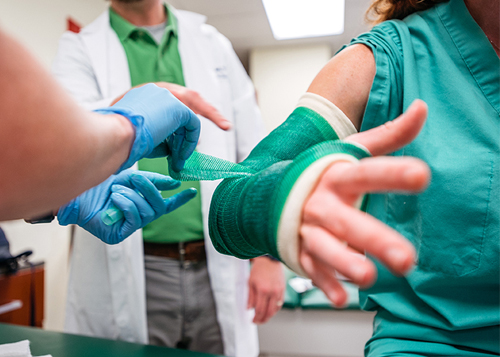 The Physician Associate (PA) profession was established in 1965 to help physicians provide healthcare services to underserved and rural populations. While the profession remains committed to its historical mission, PAs are now employed in almost all health care settings and are valuable members of a multidisciplinary health care team.
PAs are health care professionals licensed to practice medicine under the supervision of a licensed physician. Individual state laws define the scope of practice and prescribing authority of Physician Associates. In general, most states authorize PAs to prescribe non-controlled and controlled substances and perform any task delegated to them by their supervising physician.
To be eligible for licensure, PAs must graduate from a program accredited by the Accreditation Review Commission on Education for the Physician Assistant (ARC-PA) and pass the Physician Assistant National Certification Examination (PANCE). Although Physician Associates will always remain under the guidance and counsel of a licensed physician, PAs are expected to perform appropriately delegated tasks autonomously.
The PA field is growing, and employment is projected to increase by 28 percent from 2023-2033 (per the United States Department of Labor, Bureau of Labor Statistics).
Learn more about the UAB PA Program from our Frequently Asked Questions. We provide information sessions, open to anyone interested, to discuss our application process, mission, curriculum, costs, and outcomes throughout the year. A seat may be reserved by calling 205-934-3209 or emailing us at
-
What is a PA?
Physician Associates are healthcare professional who work under the supervision of a physician, providing a wide range of medical services, including diagnosing, and treating illnesses, prescribing medication, and assisting in surgeries. They are licensed clinicians who practice medicine through a patient-centered, team-based approach in various specialties and settings. While complementing and extending physician services, PA’s increase access to care, particularly in rural and underserved areas where healthcare professionals are limited. Watch the short video from AAPA.
-
What are the typical PA student characteristics?
PA students typically demonstrate a combination of strong academic skills and interpersonal abilities, exhibit a commitment to empathetic and compassionate patient care, are self-directed learners, and work well under pressure. They are often described as empathetic, compassionate, driven, persevering, and detail-oriented. PA students should possess strong communication and problem-solving skills and demonstrate the ability to adapt to challenging situations. Additionally, they are eager and willing to learn, are respectful and demonstrate respect for others, and are dedicated to lifelong learning.
-
How do I get health related experience?
Although the program does not require a specific number of clinical hours, applicants are strongly encouraged to obtain clinical experiences in the form of direct (hands-on) or indirect patient care. Additionally, shadowing a PA is also strongly recommended.
It should be noted that hands-on, direct patient experiences are highly preferred by the program. Examples of direct patient care includes working as a certified nursing assistant (CNA), medical assistant (MA), ultrasonographer, patient care technician (PCT), paramedic, dietician, basic/advance emergency medical technician (EMT), nurse, surgical/ER/respiratory/telemetry technician, x-ray technologists, athletic trainer, etc. Examples of indirect patient care includes working as a dental hygienist, PT assistant, pharmacy assistant, administrative medical assistant, scribe, etc. Applicants may also consider volunteering their time in a wide range of clinical settings.
-
What if I cannot complete all of the prerequisites by the application deadline?
All applicants with nine or fewer semester hours of prerequisite courses to complete on Jan 1 of the year of admission will be considered for admission so long as a clearly articulated plan of completion is specified on the supplemental application.
-
When do I apply to the UAB Graduate School?
Applicants who are accepted to the UAB PA program will need to complete the UAB Graduate School application immediately.
-
Does the PA Program allow students to work while attending the program?
Students have the right to engage in part-time employment during the program’s didactic phase. However, given the rigorous academic requirements of the didactic curriculum, program faculty strongly advises against outside employment. Student employment during the clinical phase of the program is strictly forbidden. It should be noted that no academic concessions will be made for working students. It should also be noted that students are not allowed to substitute for faculty or staff during the didactic phase of the program, nor as clinical staff during the clinical phase of the program.
-
Do you offer advance placement or credit for prior experience?
The UAB Physician Associate Studies Program does not offer advance placement or credit for prior experience.
-
Can I make an appointment to talk to an advisor or someone in person?
Individual counselling sessions may be arranged but please note the PA program provides information sessions, open to anyone interested, to discuss our application process, mission, curriculum, cost, and outcomes throughout the year. A seat may be reserved by calling 205-934-3209 or emailing us at
This email address is being protected from spambots. You need JavaScript enabled to view it. . -
How much does it cost to attend UAB's PA program?
For more information, see: Tuition and Scholarships
-
What is the PA program's tuition refund policy?
UAB has an Institutional Refund Policy.
-
What are the program goals and outcomes for UAB's PA program?
Program goals and outcome data can be found in the 2025 UAB MSPAS Outcomes and Goals Report.
-
How can I obtain feedback from the program if I was not admitted after being granted an interview?
Applicants who were not admitted after being interviewed may request feedback regarding their CASPA Application submission or interview by emailing a request to
This email address is being protected from spambots. You need JavaScript enabled to view it. . Please note the program will not provide feedback to students after April 1st of each year, as we approach the start of the new application cycle. -
Does the PA program provide advisement to applicants?
The PA program does not routinely advise applicants prior to submitting their CASPA Application. We do, however, schedule information sessions to assist applicants as we approach the start of the new application cycle. Information sessions are scheduled monthly from March to July of each year. Specific dates, including virtual or in-person options can be found by clicking here.
- Still have a question?
The following deadlines refer to the year prior to matriculation:
- August 1 of the year prior to matriculation: Last day to take the GRE
- April 29: CASPA opens. e-submit the CASPA Application
- August 1: Deadline to e-submit the CASPA application (11:59 PM EST)
- August 7: Deadline to submit the UAB PA Supplemental Application (11:59 PM EST)
- October 1: Deadline for application to be reviewed and verified by CASPA (11:59 PM EST)
Application Instructions
The UAB PA program participates in the Central Application Service for Physician Assistants (CASPA). Please consult CASPA for more information regarding specific CASPA application requirements, procedures, and fees. The CASPA application needs to be submitted by August 1 of the year prior to matriculation. Applicants should send all application materials directly to CASPA. Applicants should use GRE Code 0570 when sending GRE scores to CASPA. CASPA will verify the application information and send completed applications to the program.
After completing the CASPA application, the applicant should complete the UAB PA Supplemental Application.
Taking a break from, and returning to your PA Supplemental Application submission:
- The application must be completed in one sitting.
- Edits are permitted after submission. Should you need to resubmit your supplemental application, do not pay the $75 application fee a second time. After resubmitting, email
This email address is being protected from spambots. You need JavaScript enabled to view it. with your full name, original submission date, and the date of your resubmission so that the most accurate version of your application can be reviewed.
Following the program’s receipt of the CASPA application, official GRE scores, and UAB PA Supplemental Application, the UAB PA program will review the packet.
Completed applications are reviewed by members of the Admissions Committee. Interviews are held in November and admissions decisions are finalized in December. Students who are accepted to the Physician Associate Studies program will need to complete the UAB Graduate School Application.
Application Fees
- CASPA application fee of $177 for first designation and a fee of $51 for each additional designation.
- UAB PA Supplemental Application fee of $75. This may be paid electronically. Payment must be made to process the Supplemental Application. This is a non-refundable fee.
- UAB Graduate School Application fee of $50 for domestic students and $60 for international students. This fee only applies to students accepted into the program.
- UAB PA program seat deposit of $1,000 that is applied towards tuition in the first semester of the program. The deposit only applies to students who are accepted into the program. The deposit is non-refundable and will be forfeited by the applicant if he/she does not enroll and attend the UAB PA program.
- Other expenses to anticipate:
- GRE preparation and examination
- The cost of sending transcripts to CASPA
Requirements
-
Prerequisite Requirements
The following prerequisites: All prerequisite courses must be completed at a regionally accredited institution in the United States:
- 8 semester hours of biology for science majors
- 3-4 semester hours of microbiology (lab preferred)
- 3-4 semester hours of human anatomy
- 3-4 semester hours human physiology
- 8-9 semester hours of general chemistry (labs preferred)
- 3-4 semester hours of statistics
- 6 semester hours of psychology (general AND developmental or abnormal psychology)
- 2-3 semester hours of medical terminology
To confirm your prerequisite equivalencies, you can use the UAB Transfer Credit Equivalency Database.
Prerequisites UAB Equivalency Biology for majors BY123 and BY124 Statistics Any statistics will satisfy this prerequisite Psychology - You must have a General Psychology
- You have either a Developmental or Abnormal Psychology
General: PY101
Developmental: PY212
Abnormal: PY218
General Chemistry CH105/106, CH107/108, CH115/116, or CH117/118 Human Anatomy and Physiology or A&P I and II Sequence BY115 and BY116 Microbiology BY261, BY271 Medical Terminology Any medical terminology will satisfy this prerequisite -
Admission Requirements
- Baccalaureate degree from a regionally-accredited college/university.
- Graduate Record Examination (GRE) scores from the verbal, quantitative and analytic sections. Applicants with advanced degrees whose GRE scores are older than 5 years (i.e. the time limit that ETS will send scores) can request the PA program to consider dated scores if the applicant can provide documentation of their GRE scores directly from the institution they attended. The documentation should be sent directly from the student's graduate degree institution to the
This email address is being protected from spambots. You need JavaScript enabled to view it. prior to the August 1st deadline for application evaluation. Please note that recent GRE scores often make applicants with an advanced degree more competitive than applicants with an advanced degree that do not have recent GRE scores. Furthermore, as with all applicants, the UAB admissions review committee could still determine that the applicant should retake the GRE and reapply the next application cycle. - A minimum cumulative grade point average of at least 3.0 (A = 4.0).
- A minimum overall science grade point average of at least 3.0 (A = 4.0).
- A minimum cumulative grade point average of 3.0 in the program prerequisite courses, with a minimum grade of C in each.
- All applicants with 9 or fewer semester hours of prerequisite courses to complete on Jan 1st of the year of admission will be considered for admission. All prerequisite courses must be completed before the program begins in the fall semester.
- Technical ability to complete the program (see PAEA Required Competencies and Minimum Technical (Performance) Standards).
- Interview with faculty.
- Medical clearance: UAB physician assistant students must be medically cleared for enrollment if accepted to program. Detailed information is available via UAB Student Health Services.
- Undergo a criminal background check and consent to drug testing if accepted into the program.
-
International Requirements
Please visit the Graduate School's International Admissions page for information about deadlines, requirements, English proficiency exams, and the application process.
Credit for Prior Learning or Experience
Credit is not offered for prior experiential learning or prior course work (the Program does not offer advanced placement). Furthermore, credit is not offered for courses provided by another physician assistant program. No student may omit or waive any of the required clinical year rotations.
Evaluation Criteria
Program-specific rubrics are utilized to assess students during an initial review of the CASPA and Supplemental Applications, as well as during the interview. Initial review of applicants includes an evaluation of the student’s academic record, clinical experience, personal statement, letters of reference, and attributes that align with the program’s mission. Upon completion of the initial review, cumulative performance of all applicants is utilized to identify students selected for an interview.
Program-specific measures that are evaluated on each rubric are categorized below. To assess competitiveness of the program from a historical perspective, students are encouraged to review the admission data summaries below.
Academics
- Cumulative GPA, overall science GPA, prerequisite GPA, final course grades of “D,” “F,” and “W,” completion of all prerequisite course at time of application submission, and GRE percentage scores.
- Credit hour demand, outside commitments while enrolled in courses, and course work completed in a graduate-level program in a health-related field of study are considered in the application score.
Clinical Experience
- Although not required for admission, experience in a healthcare setting (providing direct or indirect patient care) is preferred.
- Applicants are evaluated on the extent (hours completed), duration of experience (months, years), and scope of clinical experience.
- Leadership experience and exposure to the PA profession, in the form of shadowing or working alongside a PA, are considered in the application score.
Personal Statement
- Applicants are evaluated on the content and quality of their personal statement.
- Also utilized to perform a second review of applicants prior to finalizing invitations for interview.
Reference Letters
- Three letters of reference are evaluated and considered in the application score.
Supplemental Application
- Applicants are evaluated on the content and quality of responses to the supplemental questions.
- Utilized to identify attributes and characteristics that meet the program’s mission, and to perform a second review of applicants prior to finalizing invitations for interview.
Admissions Process Timeline
- May – October: Application review.
- October – November: Interviews.
- December – Admissions decisions finalized.
- January – March: Admitted students complete the UAB Graduate School Application.
- April – August: Complete orientation requirements.
Summary of Patient Care and Shadowing Hours
Admission Data Summary
| Cohort Year | Number Enrolled | Male | Female | Alabama Resident | Average Age |
|---|---|---|---|---|---|
| 2025-2027 | 60 | 10 | 50 | 31 | 23 |
| 2024-2026 | 56 | 6 | 50 | 29 | 23 |
| 2023-2025 | 59 | 8 | 51 | 28 | 22 |
| 2022-2024 | 60 | 11 | 49 | 26 | 23 |
| 2021-2023 | 59 | 12 | 47 | 36 | 25 |
| Cohort Year | Number Enrolled | Average Science GPA | Average Overall GPA | Average Verbal GRE% | Average Quant GRE% |
|---|---|---|---|---|---|
| 2025-2027 | 60 | 3.6 | 3.7 | 51% | 33% |
| 2024-2026 | 56 | 3.7 | 3.7 | 54% | 36% |
| 2023-2025 | 59 | 3.7 | 3.7 | 53% | 40% |
| 2022-2024 | 60 | 3.7 | 3.7 | 52% | 41% |
| 2021-2023 | 59 | 3.6 | 3.7 | 58% | 41% |
Veteran Applicant Data Summary
| Cohort Year | Veteran Applicants | Qualified for Admission | Invited for Interview | Interviewed | Admitted | Accepted Admission Offer | Waitlisted |
|---|---|---|---|---|---|---|---|
| 2025-2027 | 22 | 12 | 4 | 2 | 2 | 2 | 0 |
| 2024-2026 | 6 | 3 | 2 | 1 | 1 | 1 | 0 |
| 2023-2025 | 10 | 5 | 2 | 1 | 1 | 1 | 0 |
| 2022-2024 | 13 | 7 | 5 | 5 | 3 | 3 | 0 |
| 2021-2023 | 8 | 8 | 4 | 4 | 3 | 3 | 0 |
Summary of Patient Care and Shadowing Hours
| Cohort Year | Number Enrolled | Average Patient Care Experience Hours | Average Shadowing Hours |
|---|---|---|---|
| 2025-2027 | 60 | 3225 | 110 |
| 2024-2026 | 56 | 2847 | 134 |
| 2023-2025 | 59 | 2460 | 117 |
| 2022-2024 | 60 | 3526 | 97 |
| 2021-2023 | 59 | 2630 | 112 |
Additional Information
In order to ensure patients receive the best medical care possible, faculty of the program have identified certain skills and professional behaviors that are required for successful completion of the program. These skills and behaviors are required to perform a variety of activities within the curriculum and also to function clinically as a physician assistant. Therefore, all students in the PA program must be able to demonstrate these skills and professional behaviors, including students with disabilities when reasonable accommodations are made by the program.