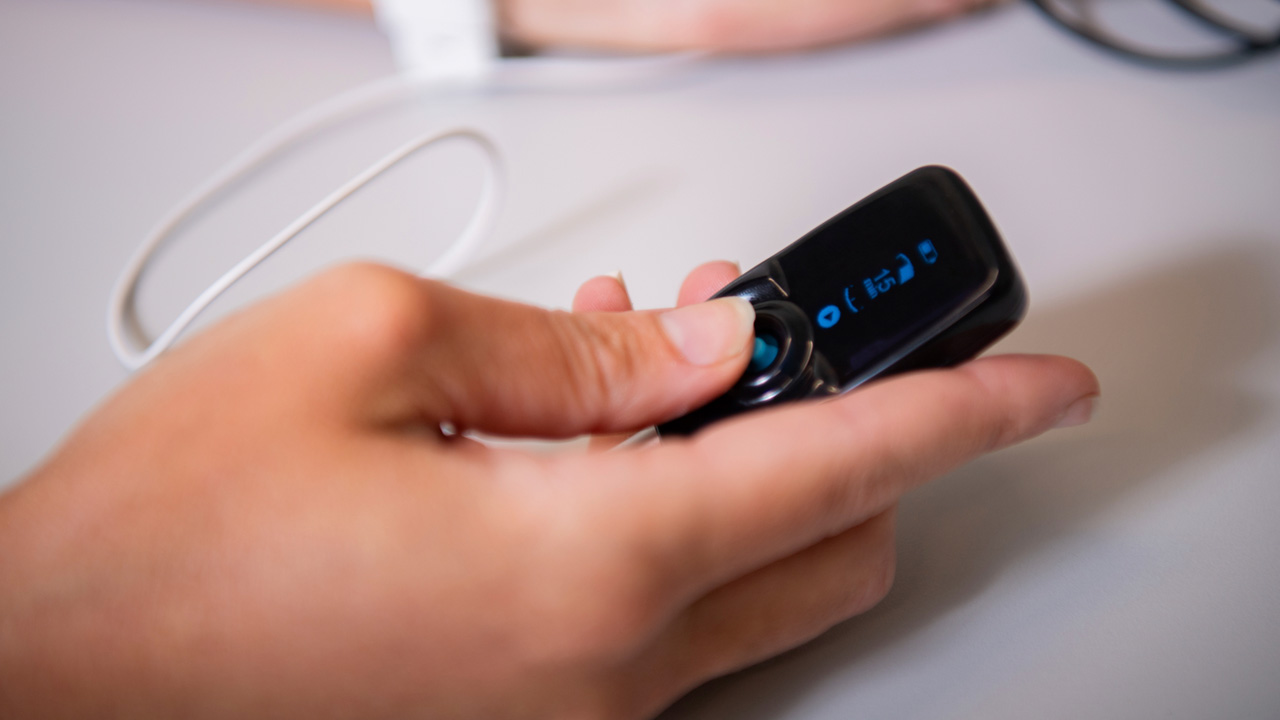
Most of us are comfortable going through life with a pair of earbuds in our ears and with the idea that these little devices can shape our mood. But what if instead of helping you drift off to sleep with a podcast, or psyching you up for a run with some AC/DC, those earbuds were providing a little more direct stimulation? Not much, mind you—say, 4 milliamps at 30 hertz for 15 minutes per night, which is so low it is on the very threshold of being unnoticeable.
According to a recent study at UAB, that is enough to produce better sleep, and lower daytime fatigue, in breast cancer survivors with insomnia. In another new UAB study, 15 minutes of stimulation before a 45-minute session with a physical therapist made lasting improvements in symptoms for patients with Parkinson’s disease.
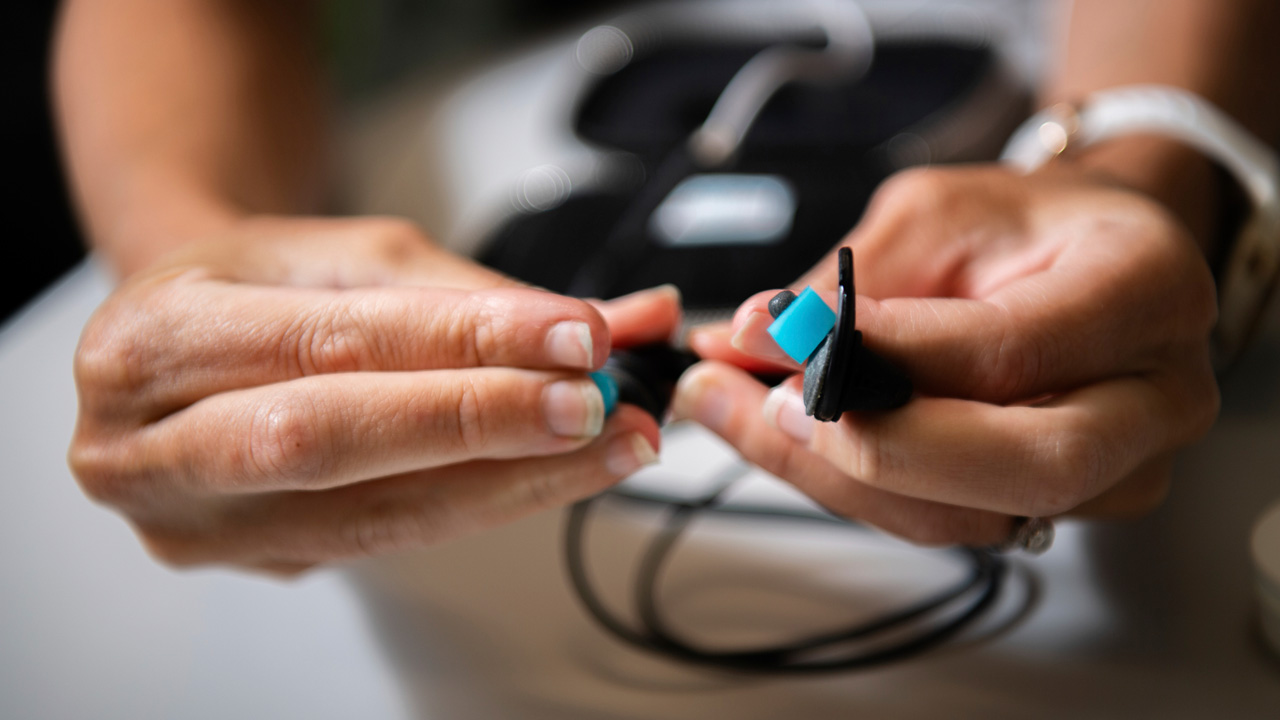
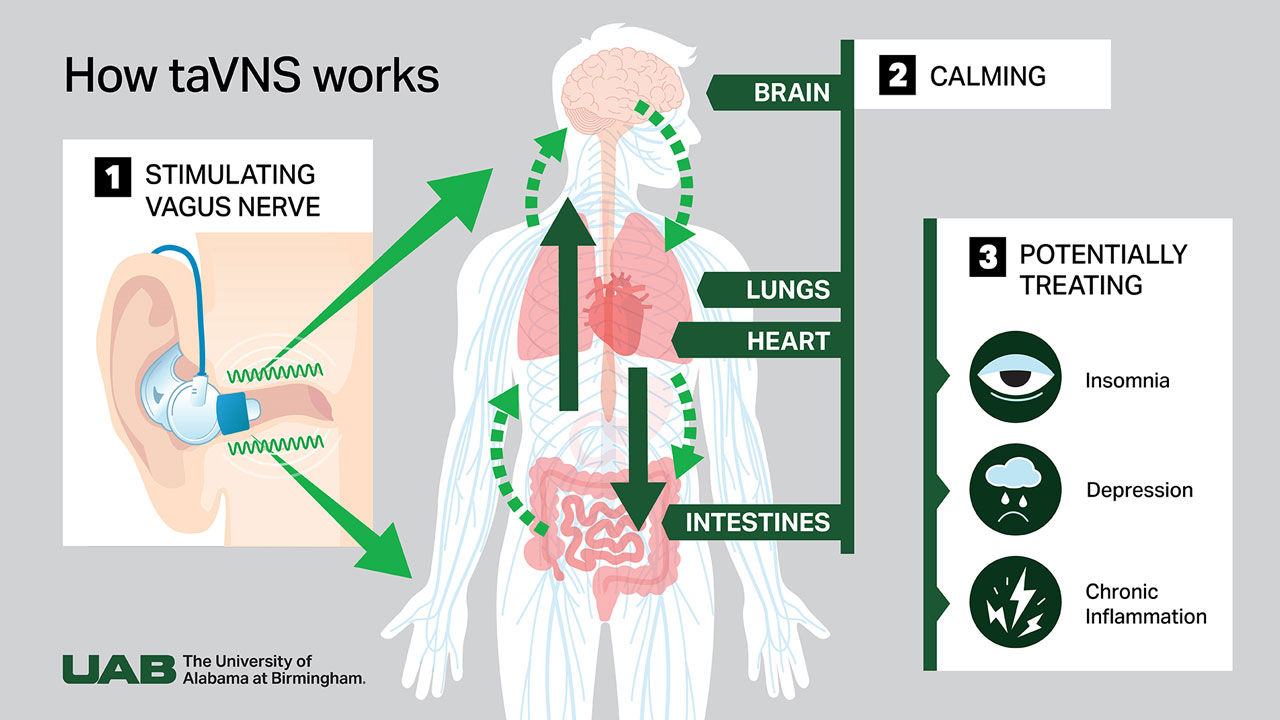
In both studies, participants used a pair of hydrogel earbuds connected to a small black device that looks a bit like a digital music player. The device generates an electrical current that travels through the earbuds and into the body through the ear canal, which is packed with fibers from the vagus nerve. This is a big deal, because the vagus nerve is the information superhighway of the parasympathetic nervous system. The sympathetic nervous system is the one that winds us up; it is responsible for the well-known “fight or flight” reflex. The parasympathetic system does the opposite, sending a calming signal that lets the body know it is time to “rest and digest.”
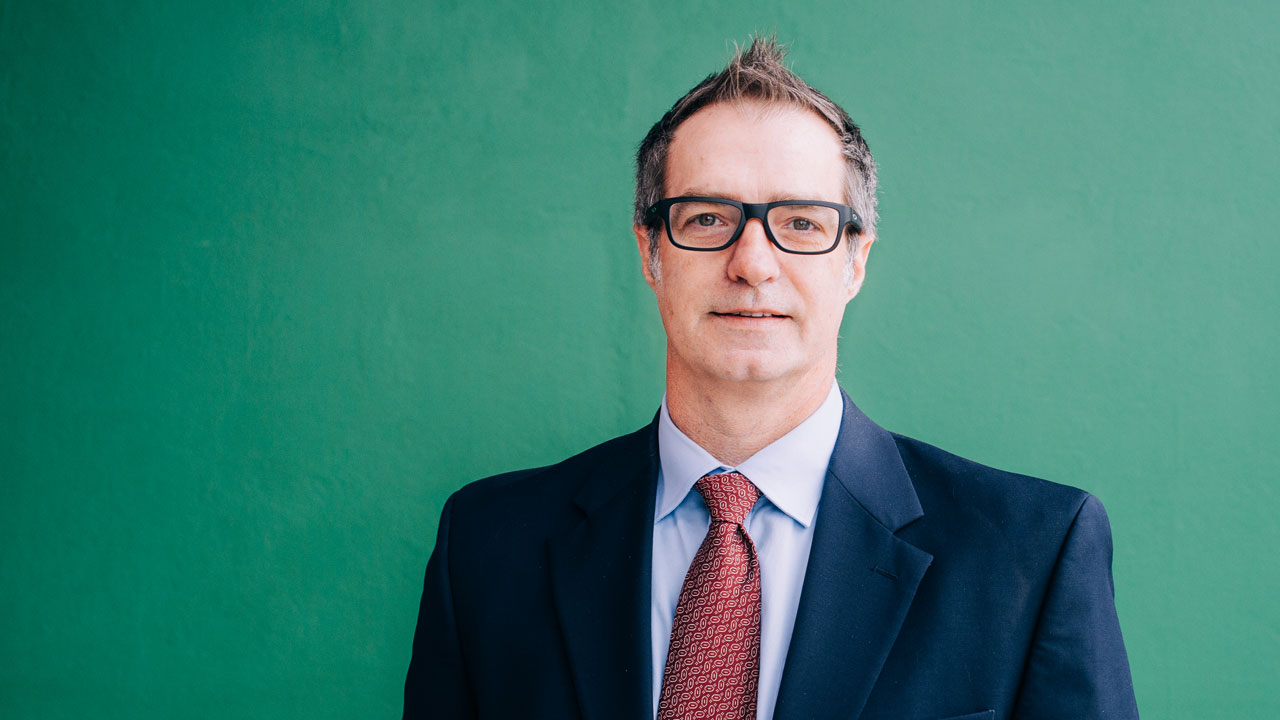
The earbuds were developed and patented by UAB researcher William “Jamie” Tyler, Ph.D., a professor in the UAB Department of Biomedical Engineering and a leader in the UAB Center for Neuroengineering and Brain Computer Interfaces.
For nearly 15 years, Tyler has been demonstrating that stimulating the vagus nerve through the ear — a process known as transcutaneous auricular vagus nerve stimulation, or taVNS — can have wide-ranging effects. He and his collaborators have demonstrated that taVNS can improve learning rates, boost attention, reduce anxiety, enhance athletic performance and tamp down inflammation. In 2017, Tyler launched a small business, IST, LLC, to develop a device that combines his special earbuds with a new, proprietary stimulator. This one generates pulses at such high frequencies that they cannot be felt at all. The name captures its multi-faceted uses: BRAIN Buds, which stands for Bolstering Resilience, Adaptability and Intelligence with Neurotechnology.
In February 2026, Tyler showed off his BRAIN Buds at a technology expo hosted by the Center for Brain Health at the University of Texas at Dallas. “It was the first time that I shared BRAIN Buds with the public and the reception was amazing,” he said.
The excitement is due in part to results such as the 2025 UAB study in 20 breast cancer survivors. After two weeks of home use, 30 minutes before bedtime, participants reported a 25 percent drop in insomnia severity index scores. They went to sleep 37 percent faster and had a significant decrease in nightly awakenings. These self-reported results were validated by analyzing activity trackers the women wore to monitor their sleep unobtrusively. “But the most important result for our participants,” Tyler said, “was the 27 percent reduction in cancer fatigue. That is clinically meaningful relief achieved in two weeks, compared to four- to eight weeks for legacy devices.”
Here is a closer look at how, and why, taVNS works — along with some of the promising studies underway at UAB.
How and why taVNS works
The vagus nerve collects messages about current conditions, including the strength of pro-inflammatory signals known as cytokines, from the heart, lungs, intestines and other organs. These signals are carried to the brain stem, which passes them on to other brain regions, particularly the locus coereuleus-norepinephrine system, which is involved in regulating alertness, attention and motor learning. Commands from the brain travel back down the vagus nerve, where they can make rapid adjustments to heart rate and breathing rate, promote digestion and reduce inflammation by clamping down on cytokine production.
Ideally, the sympathetic and parasympathetic systems maintain a balance, promoting enough alertness, muscle tension and inflammation to handle threats while still allowing us the rest and energy reserves to focus on everything else we need to do to survive. But many conditions, including depression, anxiety, insomnia, and chronic inflammation, are linked to an overactive sympathetic system.
Tyler, who earned a doctorate from UAB in behavioral neuroscience in 2003, is a big fan of the Yerkes-Dodson curve, which plots performance quality against arousal level. A bored student does not perform well on an exam, and neither does an unmotivated sprinter in a race. But a stressed-out senior, fearing that her ACT scores will determine the entire course of her life, will suffer in performance as well, as will an Olympic skater feeling the weight of a nation on his ability to land tough jumps. There is a sweet spot, at the peak of the traditional bell curve, where an optimum level of performance can be reached with the right amount of stress or arousal.
Tyler theorized that sending electrical signals into the vagus nerve could help athletes and other elite performers find that sweet spot. This was not a leap in the dark. For nearly 150 years, doctors have known that massaging the neck can suppress seizures. The reason, it turns out, is that this manipulates the vagus nerve as it runs up from the organs to the brain. That insight helped inspire vagus nerve stimulation (VNS) devices, which are FDA-approved for seizure control and, as of 2025, for treatment-resistant depression. These devices attach wiring directly to the vagus nerve in the neck and include a battery pack and stimulator implanted in the chest. They are effective but expensive, with the procedure costing tens of thousands of dollars and bringing the risks of any major surgery.
In contrast to surgical devices, Tyler has been advancing the state-of-the-art in noninvasive vagal nerve stimulation. With funding from the Air Force Research Laboratory and DARPA, the government’s agency focused on cutting-edge tech, Tyler created a taVNS device that helped defense department employees learn languages more quickly and drone pilots maintain focus across long duty shifts. The next step was to focus on the “human factors” that distinguish a lab prototype from a viable clinical product.
Most taVNS devices, including one approved by European medical regulators for treating depression, clip on to one of the folds of the outer ear. That narrow metal-to-skin connection is responsible for the uncomfortable “biting” sensation of what Tyler calls “gen 1” or “legacy” taVNS devices and approaches.
Tyler’s patented hydrogel earbuds are “gen 2.” They provide a wide contact area for electrical conduction to avoid biting. And because they reach into the ear canal, they sit in an area more highly enriched with vagus nerve fibers than the outer ear. They also send signals through both ears at once. All of this contributes to better stimulation at lower power, Tyler says.
Coming next are larger trials in three focus areas: insomnia, depression and chronic inflammation. This “triple threat” affects tens of millions of Americans, and many researchers suspect that inflammation is a key component of insomnia and depression.
“This is going to take several studies to show, but I think if we can treat the inflammation with vagal nerve stimulation some of these other things will be corrected," Tyler said.
Right now, taVNS and BRAIN Buds are in the clinical validation phase. They are working towards submitting a de novo 510(k) application to the FDA to establish a new clinical indication for taVNS. “Our clinical efforts have been focused on establishing a new standard of care for treatment of nervous system dysfunction by making taVNS scalable,” Tyler said. “We are excited about unlocking new therapeutic options.”
“This is going to take several studies to show, but I think if we can treat the inflammation with vagal nerve stimulation some of these other things will be corrected.”
—William “Jamie” Tyler, Ph.D.
taVNS for Parkinson’s disease
Alex Evancho, DPT, director of the Adaptive Human Performance Lab within UAB’s Center for Engagement in Disability Health and Rehabilitation Sciences (CEDHARS), is a licensed physical therapist and assistant professor in the Department of Physical Therapy. She also is pursuing a doctorate in rehabilitation science, with Tyler as her Ph.D. advisor.
Last year, Evancho and Tyler published the results of an intriguing trial of taVNS in patients with Parkinson’s disease. “We know that exercise is neuroprotective,” Evancho said. “But people with Parkinson’s often have abnormal cardiovascular responses to exercise.” Even when they work out, their heart rate does not go up as high as it would in a healthy person of the same age. And raising the heart rate is thought to be one major reason why exercise helps the brain. “We wanted to know if we could improve the heart’s response to exercise in this subset of patients who can’t get the benefits,” Evancho said.
In the study, 11 participants used a taVNS device for 15 minutes of stimulation, followed by a 45-minute session of physical therapy using the popular Power Moves exercises, which are designed specifically for Parkinson’s patients. Another group of 11 participants did the same thing, although their taVNS devices were set to not deliver stimulation. (Participants did not know which group they were in.) Participants kept up this routine for 12 visits over six weeks.
Both groups showed improvement in balance and motor scores, which measure the severity of Parkinson’s symptoms, including tremors, muscle stiffness and postural stability. But the active taVNS group showed more improvement, registering a nearly 30 percent increase in heart rate during exercise sessions, compared with an increase of under 12 percent in participants who did not receive stimulation. The active group also had kept up their gains when they came back for a follow-up visit after a month, unlike the control group. Patients who had received taVNS stimulation before exercise sustained gains in motor scores of more than 15 percent.
The hypothesis, born out in this early study, is that “neuromodulation may ‘prime’ the brain to make the benefits of exercise stick,” Evancho said.
“Neuromodulation may ‘prime’ the brain to make the benefits of exercise stick.”
—Alex Evancho, DPT
Evancho is now working toward a larger trial in Parkinson’s patients. She also has partnered with Rachel Cowan, Ph.D., an associate professor in the UAB Department of Physical Medicine and Rehabilitation, on a pilot trial of taVNS in patients with spinal cord injury. Patients will take part in a widely used therapeutic intervention called high-intensity gait training. “We are planning to use the stimulation to regulate the autonomic nervous system before patients do this training,” Evancho said.
Evancho adds that taVNS and physical therapy are a good match, partly because practitioners are already familiar with a slightly different electrical stimulation approach, transcutaneous electrical nerve stimulation, or TENS, which many PTs use to help patients with muscle pain. “It would not be a huge leap, from an understanding and from a reimbursement perspective,” from TENS to taVNS, Evancho said.
“I would like to apply taVNS to other conditions as well,” Evancho said. “I think any patients with a neurological condition that can affect the nervous system may be able to benefit.”
Under investigation: taVNS for subarachnoid hemorrhage
The anti-inflammatory effects of taVNS are of interest to Tyler’s collaborators Marshall Holland, M.D., M.S., and Jesse Jones, M.D., both faculty members in the Department of Neurosurgery.
Holland, an assistant professor, specializes in functional neurosurgery, including implantation of spinal cord stimulators, vagal nerve stimulators and deep brain stimulators, all of which “essentially use electricity to modify how the nervous system works,” he said. Holland has a strong research interest in neuromodulation for restless legs syndrome, based on an intriguing case during his residency. A patient who had had a spinal cord stimulator implanted for spinal cord pain, on a return visit, mentioned that the pain was a little better, “but he said, ‘I’m super excited that my restless legs syndrome is so much better,’” Holland recalled. The surgeons initially thought this was a placebo effect, but after many follow-up visits, they became convinced that it was a real response, and that the stimulation was decreasing the activity of the sympathetic nervous system. “This is now the primary focus of my research,” Holland said.
At a meeting, Holland presented data on the short-term effects of spinal cord stimulation on autonomics and blood flow — for about a month after insertion, the blood vessels open more fully and blood pressure goes down, before returning to a person’s normal baseline. This sparked an idea for Jones, an associate professor specializing in treating vascular disease. Interventional neuroradiologists such as Jones are often called upon to repair burst blood vessels in the brain, a type of stroke known as a subarachnoid hemorrhage. Fixing the blood vessel, using clips or coils, solves one problem. But when blood penetrates the space between brain and skull, it provokes a strong inflammatory response. And for about 30 percent of patients, that response gets out of control, provoking another crisis called vasospasm — blood vessels clamp down, severely restricting oxygen flow to the brain and causing strokes.
“Vasospasm is devastating,” Holland said. “Forty to 50 percent of people who go into it will be left with permanent neurological deficits. You will be walking by a patient room one day and they are alert and talking to their family, and the next they can be on life support.” Holland and Jones are interested in studying whether spinal cord stimulation, or taVNS, could decrease the sympathetic nervous system response and neuroinflammatory factors. “Vasospasm is like a runaway freight train by the time we recognize it,” Holland said. “Our hypothesis is that stimulation could prevent the train from leaving the station.”
“Vasospasm is like a runaway freight train by the time we recognize it. Our hypothesis is that stimulation could prevent the train from leaving the station.”
—Marshall Holland, M.D., M.S.
Holland and Jones are working with Tyler and his graduate student Christian Lopez Blanco on a small clinical trial that will look at taVNS and spinal cord stimulation in patients at risk for vasospasm after subarachnoid hemorrhage versus the current standard of care. Because taVNS is non-invasive, “it is easy to deploy and that could open this up to be a treatment used almost anywhere, as opposed to a specialized center such as UAB,” Holland said. “Spinal cord stimulators are a little more involved, but we don’t know if they could be more effective. Either way, the results of this study could lead to practice-changing trials, especially for patients who have prior risk factors.”
This initial study, which has begun enrolling participants, is designed mainly to gather the data that would be necessary for a larger trial. “We are collecting blood and cerebrospinal fluid and what we are hoping to see is a decrease in the neuroinflammatory cascade” for patients who have had stimulation, Holland said. “We are at the very beginning, but if we see this signal in the blood, we will have evidence that we can do something about this problem where the need is clear and the consequences on patients can be devastating.”
More taVNS studies at UAB
Researchers across campus are collaborating with Tyler to study taVNS in a wide range of projects:
Jillian Hamilton, Ph.D., an assistant professor in the Department of Pediatrics, has received a grant from the Kaul Pediatric Research Institute of the Alabama Children’s Hospital Foundation to test whether giving parents a session with taVNS before they hold their babies in UAB’s Newborn Intensive Care Unit can reduce stress and enhance pair bonding.
Gitendra Uswatte, Ph.D., professor in the Department of Psychology, is using taVNS in ongoing studies to treat chronic fatigue syndrome and long COVID.
Victor Mark, M.D., associate professor in the Department of Physical Medicine and Rehabilitation, is working with Tyler’s graduate student Alibek Sartayev to examine the use of taVNS methods in patients with functional neurological disorder.
Anusha Adavikottu, Ph.D., a postdoctoral fellow in the Department of Civil, Construction and Environmental Engineering received a Civitan Emerging Scholar Award grant from UAB’s Civitan International Research Center to study the effects of taVNS on enhancing driving safety in adults with autism spectrum disorder.