July 14, 2025
While strokes are widely recognized as a major cause of long-term disability in the United States, their quieter cousin, the mini stroke, or transient ischemic attack (TIA), often flies under the radar. These brief episodes of disrupted brain function may seem harmless, but could they be warning signs of something more serious?
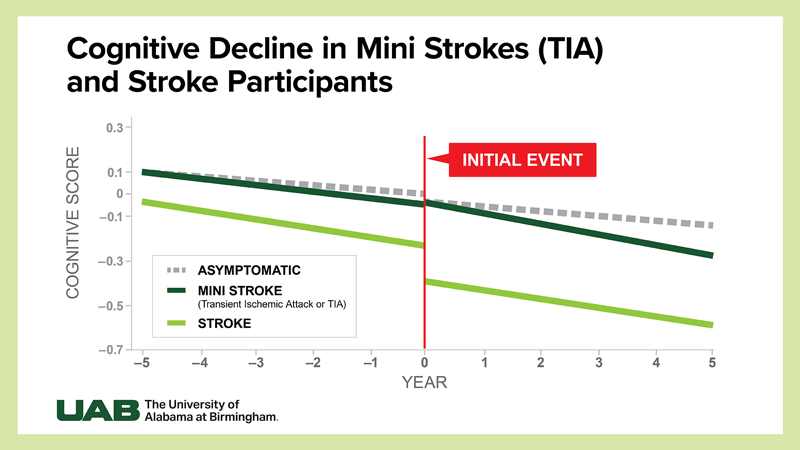
Researchers at the University of Alabama at Birmingham evaluated TIAs’ effect on cognitive function and found a correlation between TIAs and future cognitive decline. While TIA participants were less impaired than stroke participants, results showed the two groups have the same rate of cognitive decline after their cerebrovascular event. Results were published in JAMA Neurology.
“Mini strokes are often viewed as relatively benign cognitive events that have minimal impact on long-term health besides an increased risk of a full stroke,” said Victor Del Bene, Ph.D., assistant professor in the UAB Department of Neurology and lead author. “Our study suggests that TIAs are important medical events that affect long-term cognitive outcomes.”
Mini strokes are events during which a brain region is temporarily deprived of oxygen, most often for only few minutes, and are without a lesion on brain MRI scans. Around 240,000 people a year experience a mini stroke, and one-third later sustain a full stroke.
 Previous research showed reduced cognitive function following a TIA. However, the studies did not have measurements of cognition before the TIA, and additional vascular risk factors were not adjusted or excluded. In the absence of the pre-TIA cognitive baseline, this created uncertainty about whether cognitive decline after the TIA was related to the actual TIA event.
Using data from the UAB School of Public Health’s REGARDS study, researchers obtained the pre-TIA cognitive baseline. They excluded participants with a previous TIA or stroke event at the time of enrollment, followed the remaining participants over time to identify when they had their first TIA or stroke, and adjusted for additional cognitive risk factors.
“It was the first time a study established a pre-TIA cognitive baseline to compare the post-TIA cognitive levels,” said Ronald Lazar, Ph.D., Endowed Chair and director of the Evelyn F. McKnight Brain Institute at UAB. “The baseline made the correlation between TIAs and cognitive decline clearer.”