From Yemen to Jordan and eventually the United States, Abdulaziz (Aziz) Ahmed, PhD, has built an academic career around a simple but far-reaching question: How can data and technology help improve the way health care is delivered?
Today, Ahmed serves as an Associate Professor of Health Informatics and Director of the Graduate Certificate in AI in Health Services in the UAB School of Health Professions. He also holds a secondary appointment in the Department of Biomedical Informatics and Data Science in the Heersink School of Medicine. His research integrates artificial intelligence, health informatics, systems engineering, and operations research to address complex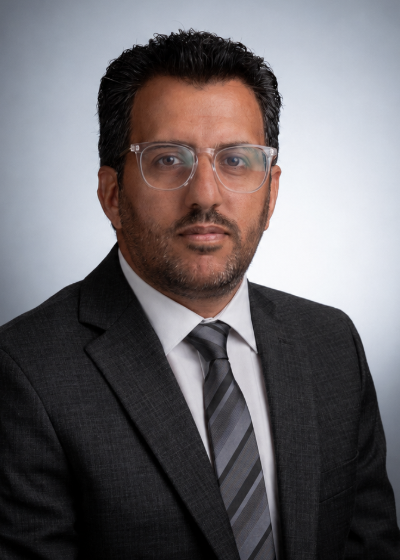 challenges in health care.
Ahmed’s academic journey began in industrial engineering at Jordan University of Science and Technology, where he earned his bachelor’s and master’s degrees. He later moved to the United States to earn his PhD in Industrial and Systems Engineering from Binghamton University in New York.
During his doctoral studies, Ahmed became increasingly interested in applying engineering and data analytics to health care. That interest ultimately led him to health informatics and to UAB, where he has developed an interdisciplinary research program focused on turning data into actionable solutions.
“I was drawn to research and academia because they provide the opportunity not only to study important problems, but also to develop solutions, test them, translate them into practice, and train the next generation of researchers,” Ahmed said.
Advancing AI in Health Care
Ahmed’s research explores how artificial intelligence and predictive analytics can help health care professionals and leaders make better decisions.
Rather than simply using AI to predict what might happen, Ahmed is particularly interested in developing tools that can help explain why problems occur and identify actions that could address them.
His work recently reached a significant milestone when he received a five-year, approximately $4 million NIH R01 award from the National Institute of Mental Health. The project focuses on developing an AI-based decision-support system to better understand and address emergency department return visits among patients with mental health conditions.
The research will bring together an interdisciplinary team to develop and evaluate AI methods in real-world clinical environments and across multiple health care systems.
“My hope is that this award serves as a foundation for a broader research program focused on developing AI-enabled decision-support systems that can meaningfully improve healthcare processes and patient outcomes,” Ahmed said.
His research also examines emergency department overcrowding and patient flow. In AHRQ-supported research, Ahmed and his team investigated whether predictive models could help hospitals anticipate overcrowding and take action before conditions become severe.
The findings showed that using predictive models to trigger proactive interventions could help create more stable patient flow and reduce the amount of time emergency departments experience severe crowding.
For Ahmed, the work represents the larger potential of AI in health care.
“Ultimately, the goal is not AI for its own sake but using these technologies as tools to help clinicians and healthcare leaders make more informed decisions and improve patient care,” he said.
A Global Perspective on Research
Ahmed’s international journey has also shaped the way he approaches research, teaching, and collaboration. Growing up in Yemen, studying in Jordan, and continuing his education and academic career in the United States exposed him to different cultures, educational systems, and approaches to solving problems.
Those experiences have reinforced the importance of adaptability and understanding that solutions may need to be tailored to different environments and communities.
“I recognize that students and researchers may arrive with very different backgrounds and experiences, and I try to create opportunities for them to contribute their perspectives and develop their strengths,” Ahmed said.
That same perspective informs his research collaborations. His work brings together clinicians, engineers, data scientists, informaticians, health services researchers, and other specialists to address problems that cannot be solved by one discipline alone.
Ahmed sees his international background as an asset, both in his research and in his role as a mentor.
“Finally, remember that an international background is not simply something to overcome. It can be a real strength,” Ahmed said. “The perspectives, adaptability, resilience, and experiences you bring can enrich your research, teaching, collaborations, and the academic community around you.”
At UAB, Ahmed continues to build connections across disciplines while mentoring the next generation of researchers. Through his research and mentorship, he is helping advance the use of AI and data science in health care while demonstrating the value of global perspectives, interdisciplinary collaboration, and research with real-world impact.