
Sribhaavita Nekkalapudi
Abstract
Generative Artificial Intelligence (GenAI) tools such as ChatGPT, Grammarly, Microsoft Copilot, etc., have rapidly become embedded in students’ academic lives. Research consistently reports widespread adoption of GenAI for time-saving academic tasks such as summarizing, drafting, and clarifying assignments. At the same time, long-standing research in student development demonstrates that financial strain, a cause for time poverty, increased work hours, and chronic stress, strongly shapes academic behavior and outcomes. Yet, no research to date directly tests whether financially strained students may be more likely to rely on GenAI for academic automation, despite significant conceptual links. This review synthesizes GenAI adoption, financial strain and time poverty, and institutional responses to identify a link and uncover an urgent, unexamined question for higher education research. It concludes with an outline for a research agenda for scholars in college student development.
Across U.S. campuses, college students are turning to generative AI (GenAI) tools at accelerating rates for writing, summarizing readings, and managing academic workloads. These uses range from augmentation, such as grammar support, clarification of concepts, and organization of ideas, to automation, including drafting text and generating academic content. While national debates tend to frame AI use as an issue of academic integrity or technological overreach, emerging research suggests that student motivations may be far more structural, including financial stress, work obligations, and the limited time resources available to undergraduates (Al Zaidy, 2024; Bittle and El Gayar, 2025; Contractor and Reyes, 2025).
This review synthesizes current research on financial stress, time scarcity, and student AI use to examine how financial stress may influence college students’ likelihood of relying on generative AI tools for academic work. Drawing on research from higher-education studies, generative AI literature, and social-behavioral inquiry, this review argues that financially burdened students may be structurally positioned to rely more heavily on generative AI because financial pressures often create time scarcity and competing demands. Understanding this relationship may have important implications for equity, student success, and institutional policy.
The literature reviewed for this paper was identified through searches on Google Scholar and higher-education databases using combinations of terms such as “generative AI,” “college students,” “AI adoption,” “financial stress,” “financial strain,” “time poverty,” and “student employment.” Numerous studies examined student adoption of GenAI, while others examined the academic effects of financial stress; however, no studies were identified that directly tested financial stress, work obligations, or time poverty as predictors of GenAI adoption among college students. This absence forms the basis of the research gap examined in this review.
GenAI Adoption, Trust, and Academic Integrity
Throughout higher-education research, GenAI use is described as widespread, normalized, and primarily efficiency-driven. Al Zaidy (2024) documents high use of AI for “information retrieval, grammar checking, summarization, and content generation,” with students reporting that these tools help them “keep up” with academic demands (Johnston et al., 2024). Contractor and Reyes (2025) complement Al Zaidy’s (2024) research by studying an elite U.S. college. They similarly found that GenAI is seen as “improving [students’] learning process and workflow,” particularly among those balancing multiple deadlines or demanding course loads (Contractor and Reyes 2025).
Aldreabi et al. (2025) add a more structural perspective, showing that adoption is strongest when GenAI is viewed as “supplemental resource and effort expectancy,” meaning it is useful, easy to use, and socially normative, which are findings reflective of classic technology-acceptance models. They provide one of the most comprehensive models of student GenAI adoption, identifying several factors that predict a student’s intention to use GenAI.
Figure 1: Structural Model of Factors Predicting Students’ Intention to Use GenAI
Note. The model illustrates the relationships between supplemental resources, information accuracy, effort expectancy, hedonic motivation, perceived cost, intention to use GenAI, and actual GenAI usage. Solid arrows represent statistically significant relationships whereas dashed arrows indicate nonsignificant relationships. Adapted from Determinants of Student Adoption of Generative AI in Higher Education by H. Aldreabi, N. K. Dahdoul, M. Alhur, N. Alzboun, & N. R. Alsalhi, 2025, Electronic Journal of E-Learning, 23(1), pp. 15-33
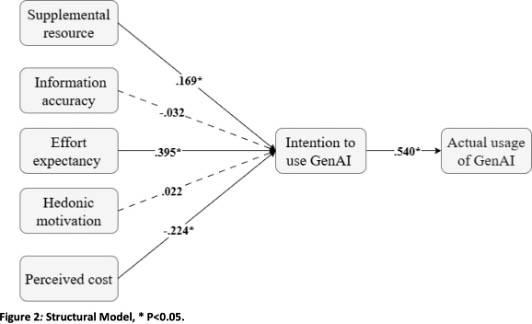
Figure 1 shows that effort expectancy (β = 0.395, p < 0.05) and perceptions of GenAI as a supplemental resource (β = 0.169, p < 0.05) positively predict intention to use GenAI, while perceived cost negatively predicts adoption (β = -0.224, p < 0.05). Intention to use GenAI strongly predicts actual use (β = 0.540, p < 0.05). These findings suggest that students gravitate toward GenAI when it reduces effort or saves time, which, as discussed later, may both be factors directly relevant to students who face financial stress.
Additionally, Johnston et al. (2024) provide insight into students’ ethical rationale, finding that while many students can differentiate between “appropriate” and “inappropriate” AI uses, they still view GenAI as a critical support mechanism for managing academic loads. Their participants described AI as a way to “stay afloat,” language that aligns closely with how financially strained students describe time-saving strategies.
Bittle and El-Gayar’s (2025) systematic review shows that academic integrity concerns dominate institution-level responses. It is observed that this focus often overlooks students’ practical motivations and the potential for GenAI to reduce inequities in academic support, which shows that the significant missing piece across all GenAI adoption studies is any attention to socioeconomic status, work hours, or financial pressure. Students are treated as one undifferentiated population, despite substantial evidence that their time availability, stress levels, and academic circumstances drastically vary. This omission leaves open the possibility that the heaviest GenAI users may be those who simply have the least time.
Financial Stress, Time Poverty, and Academic Behavior
Research on financial stress paints a clear and consistent picture of how resource scarcity can shape a student’s behavior. Joo et al. (2008) reports that students “who experienced financial strain reported that their financial issues interfered with their performance in school.” One of their most striking findings is the strong association between financial strain and employment hours with students spending “almost 30 hours working per week,” reinforcing the idea that financial stress often presents as severe time constraints (Joo et al. 2008). Britt et al. (2016) expand on this view by showing financial stress and a lack of coping strategies as a predictor of academic outcomes: students under financial stress “suffer psychologically, earn poorer grades, and drop out of school as a result of excessive debt.” These works highlight how financial strain may create a multifaceted burden that combines emotional fatigue, cognitive overload, and practical time limitations. More recently, Williams-York et al. (2024) show that underrepresented and first-generation students in health professions “experience additional stressors that may lead to burnout and exhaustion.” Although their study does not focus on finances specifically, it emphasizes how structurally marginalized students can shoulder disproportionate burdens, which may often interact with economic constraints.
Collectively, these studies suggest that financial stress contributes to time poverty due to increased employment hours, reduced study bandwidth due to emotional load, higher stakes for academic survival, and a possible need for efficiency-maximizing tools. These dynamics closely mirror the reasons students say they use GenAI. Yet, none of the financial stress studies mention AI at all, nor do they consider how students under strain might adopt academic technologies differently from their peers. Therefore, the gap between the financial-stress literature and the GenAI-adoption literature is not just empirical, but conceptual. Both fields are describing the same underlying pressures, yet neither acknowledges the other.
Taken together, the literature suggests a link between financial strain and GenAI adoption. Financial stress increases time scarcity, while GenAI is valued primarily for its ability to reduce effort and improve efficiency. This conceptual overlap provides a foundation for future empirical investigation.
Equity, Policy, and Institutional Responses
Institutional approaches to GenAI tend to center on academic integrity rather than student equity or differential need. Al Zaidy (2024) reports that while AI use is nearly universal with 86% of students indicating their use of AI, only 5% understand their campus’s AI policies and guidelines, and 72% strongly desire AI literacy instruction. This lack of clarity and understanding creates a space for students to make decisions based on personal necessity rather than institutional guidance.
Johnston et al. (2024) highlight that many students perceive restrictive AI policies as inequitable, arguing that students with stronger academic backgrounds or greater access to support services will fare better under these policies than their peers who may rely on AI for basic academic functioning. Their participants explicitly raised concerns about fairness, noting that “banning the technologies may disadvantage certain groups [and] would be a backward step.” Through a systematic review conducted by Bittle and El-Gayar (2025) it can be seen that ethical and policy conversations rarely consider questions of access or equity.
AI policy should account for the fact that different students have different resource constraints, support networks, and time pressures. Yet, none of these policy-oriented studies mention financial strain. Equity concerns are framed primarily around ability and academic preparation, not socioeconomic conditions. This omission is notable, given the fact that financial stress is one of the most well-documented forms of structural inequality in today’s higher education system with college students.
Discussion: Connecting Two Unrelated Conversations
While this review proposes a connection between financial strain and GenAI adoption, the relationship should be viewed as a theoretically informed hypothesis rather than an established empirical finding. Existing literature demonstrates that financial stress contributes to time scarcity, increased employment commitments, and academic pressure. Separate research shows that students can adopt GenAI because it reduces effort and improves efficiency. However, future empirical studies are necessary to determine whether financial strain independently predicts GenAI adoption when other factors, such as technological confidence, academic preparedness, institutional policy, and access to AI tools is taken into account.
The GenAI literature emphasizes efficiency and workload management. The financial stress literature emphasizes time scarcity and academic pressure. These two narratives describe different strands of the same underlying reality: students are overwhelmed, time-poor, and searching for tools that make academic survival manageable. Yet, neither body of literature acknowledges the other. This disconnect conceals what may be a critical equity issue. A potential concern is that students carrying the heaviest financial burdens may also be those most likely to rely on AI, and may therefore be the most vulnerable to restrictive institutional AI policies.
It is important to consider that although financial strain may increase reliance on GenAI, there may be other explanations. Students may adopt GenAI because of technological curiosity, prior familiarity with digital tools, disciplinary expectations, peer influence, or institutional encouragement. Access barriers may also shape adoption patterns. Some students may lack reliable internet access, premium AI subscriptions, or awareness of available tools. Furthermore, institutional policies vary considerably across campuses, potentially influencing whether students feel comfortable using GenAI regardless of financial circumstances. Future research should therefore examine financial stress alongside these competing predictors rather than assuming a direct causal relationship.
At institutions like The University of Alabama at Birmingham where students come from diverse socioeconomic backgrounds and likely struggle with time poverty, this gap represents both an oversight and an opportunity. AI policies that do not account for differential needs potentially risk inadvertently reproducing or amplifying structural inequities on campus.
Research Agenda and Implications
Future research should measure financial stress and other factors alongside AI use. Researchers should ask students why they use GenAI, and particularly identify whether time scarcity is a major driver. However, these studies should also distinguish between augmentation uses (grammar, clarity) and automation uses (brainstorming, drafting). Future studies should also examine the equity implications of institutional AI policies. Implications for practice can include institutions providing campus-wide access to vetted AI tools to reduce inequity, while implementing GenAI literacy programs possibly in first-year seminars with trained academic advisors discussing responsible AI use. Institutions can also reflect on previously implemented AI policies through different perspectives to understand how certain populations might be affected differently.
Conclusion
This review reveals an urgent call to action on a significant research gap. GenAI adoption is widespread and financial strain is consistently documented as a driver of time poverty; however, no research examines financial stress as a predictor of GenAI use. As Generative AI becomes an integral part of academic life, understanding how different structural inequities can shape adoption of the tool is essential for creating fair, well-informed policies. For scholars in college student development, this gap offers an opportunity to lead interdisciplinary and equity based research that aligns with institutions’ longstanding commitment to equal access and student success.
References
- Al Zaidy, A. (2024). The impact of Generative AI on student engagement and ethics in higher education opens a new website. Journal of Information Technology, Cybersecurity, and Artificial Intelligence, 1(1), 30–38.
- Aldreabi, H., Dahdoul, N. K., Alhur, M., Alzboun, N., & Alsalhi, N. R. (2025). Determinants of student adoption of Generative AI in higher education opens a new website. Electronic Journal of E-Learning, 23(1), 15–33.
- Bittle, K., & El-Gayar, O. (2025). Generative AI and Academic Integrity in Higher Education: A systematic review and Research Agenda opens a new website. Information, 16(4), 296.
- Britt, S. L., Mendiola, M. R., Schink, G. H., Tibbetts, R. H., & Jones, S. H. (2016). Financial stress, coping strategy, and academic achievement of college students opens a new website. Journal of Financial Counseling and Planning, 27(2), 172–183.
- Contractor, Z., & Reyes, G. (2025). Generative AI in higher education: Evidence from an Elite College opens a new website. SSRN Electronic Journal.
- Johnston, H., Wells, R. F., Shanks, E. M., Boey, T., & Parsons, B. N. (2024). Student perspectives on the use of Generative Artificial Intelligence Technologies in higher education opens a new website. International Journal for Educational Integrity, 20(1).
- Joo, S.-H., Durband, D. B., & Grable, J. (2008). The academic impact of financial stress on college students opens a new website. Journal of College Student Retention: Research, Theory & Practice, 10(3), 287–305.
- Williams-York, B., Guenther, G. A., Patterson, D. G., Mohammed, S. A., Kett, P. M., Dahal, A., & Frogner, B. K. (2024). Burnout, exhaustion, experiences of discrimination, and stress among underrepresented and first-generation college students in Graduate Health Profession Education opens a new website. Physical Therapy, 104(9).