
Jahan Fatima
Introduction
Childbirth is a complex physiological process that demands careful management of maternal health, particularly when complications arise. A review study from Indonesia conducted by Hartinah et al. (2021) describes that childbirth-related injuries, including perineal tears, affect a substantial proportion of women worldwide, with approximately 85% experiencing some degree of tearing during vaginal delivery (p. 1). Perineal tears vary in their degree and severity, from spontaneous tears to surgically induced tears (episiotomy), requiring different technical approaches to maximize maternal recovery. While the occurrence of perineal injuries during delivery is a global phenomenon, the techniques used for repair and their subsequent impact on maternal outcomes differ significantly across countries, reflecting disparities in healthcare systems, resources, and cultural norms. Advancements in suturing techniques have improved maternal outcomes in high-income countries, yet disparities persist in low- and middle-income countries (LMICs) where access to resources and trained practitioners is often limited. Addressing these differences is essential to improving maternal health globally. This essay examines the variations in suturing techniques for perineal repairs worldwide, focusing on differences in materials, methods, training, and healthcare infrastructure. It also explores the consequences of these variations on maternal recovery and outcomes, drawing insights from global research.
Background
Perineal repairs after childbirth are essential for promoting recovery and preventing long-term complications, but approaches to the procedure vary across global healthcare systems. A randomized open trial from Brazil led by Caroci-Becker et al. (2023) compared the use of surgical glue with subcuticular sutures for skin closure, highlighting the potential for the glue to reduce pain and scarring during recovery. Verberkt et al.’s (2016) multicenter, double blind, randomized controlled trial (RCT) conducted in the Netherlands investigated the effectiveness of single-layer versus double-layer uterine closure, providing insights into how different repair techniques, possibly suitable for perineal suturing, likely influence long-term healing outcomes. Additionally, a randomized trial in the UK conducted by Glazener et al. (2016) focused on advanced suturing devices for pelvic organ prolapse, a common injury of the pelvic bones post-labor, demonstrating the potential impact of innovative tools on surgical precision in most deliveries. These studies collectively emphasize the developing influence of technique, material availability, and training on maternal outcomes, highlighting the need for standardized, evidence-based practices tailored to diverse healthcare backgrounds when possible.
Suturing Techniques
Suturing techniques used for perineal repairs can broadly be classified as continuous or interrupted suturing. A RCT by Martinez-Galiano et al. (2019) in Spain highlighted the advantages of continuous suturing, noting reduced pain levels and faster recovery among first-time mothers compared to discontinuous methods (p. 4). Martinez-Galiano et al. establish a methodology of randomizing 134 women into two “interventions: continuous sutures and discontinuous sutures” (p. 3). Ultimately, after these sutures were applied, researchers analyzed participant on four outcome factors: pain and comfort, wound healing and complications, patient satisfaction, and efficiency. Martinez-Galiano et al. found that continuous sutures may consistently be associated with reduced pain scores compared to interrupted sutures, resulting in fewer wound complications and lower infection rates. Continuous suturing also required less suture material and time to complete repairs which participants stated less discomfort and improved healing experiences (pp. 4-6). Martinez-Galiano et al.’s findings support continuous sutures as a possible pain management technique in clinical settings. This surgical technique may become the preferred method of perineal repair among primiparous women (given birth once) and healthcare providers.
Materials also play a critical role in outcomes. The debate between monofilament and braided sutures is ongoing. For instance, the C-STICH RCT by Morton et al. (2015) in the UK demonstrated that monofilament sutures for a cervical closure (cerclage) resulted in better healing outcomes, likely due to reduced tissue trauma and a lower risk of infection. Comparatively, barbed sutures, used in randomized clinical trials by Maki et al. (2020) from Japan and Peleg et al. (2016) from Israel, have emerged as an innovative technique, offering secure closure, potentially without the need for knotting, which shortens operation time and enhances accuracy. Techniques found in these studies are likely applicable in improving perineal repairs for primiparous women. However, these sutures require advanced training and are often unavailable in low-resource settings.
Geographic and Socioeconomic Variations in Techniques
The availability and choice of suturing techniques for varied labor and delivery procedures, including perineal repairs, are heavily influenced by a country’s healthcare infrastructure and resources. High-income countries such as Israel and the UK often have access to cutting-edge materials, including absorbable monofilament sutures and barbed sutures, supported by advanced training programs for obstetricians and midwives, as illustrated by RCTs from Daykan et al. (2017) and Morton et al. (2015), respectively. By contrast, LMICs may rely on more traditional methods, such as braided sutures, due to cost constraints and limited access to training, as found by Morton et al.
Cultural factors also shape labor practices. In Brazil, for example, some practitioners favor surgical glue over sutures for minor perineal tears, reflecting a preference for non-invasive approaches in certain cases. However, this method’s application is limited to superficial repairs as described by Caroci-Becker et al. (2023). Additionally, healthcare access disparities within countries heighten these differences. Rural or marginalized communities often receive care from undertrained practitioners, leading to inconsistent application of safe and beneficial practices. Therefore, regional, socioeconomical, and cultural norms likely hinder the execution of safe or advanced perineal repairs in LMICs as compared to high-income countries. Overall, reducing healthy maternal recovery.
Impact on Maternal Outcomes
The choice of suturing technique may directly affect postpartum pain levels, infection rates, and wound healing. Studies from Spain (Martínez-Galiano et al., 2019) and Israel (Peleg et al., 2016) emphasize that continuous suturing and the use of advanced materials such as barbed sutures result in lower pain scores and faster recovery. In contrast, techniques dependent on interrupted sutures or less advanced materials may increase discomfort and lengthen healing times for primiparous and multiparous women (given birth more than once).
Long-term maternal health outcomes are equally influenced by suturing methods in a variety of delivery procedures. Improper repairs can lead to complications such as wound dehiscence, fistulas, or chronic pelvic pain. Additionally, the type of suture materials used likely affects scarring and subsequent pregnancies. For instance, absorbable sutures potentially minimize the risk of long-term scarring compared to non-absorbable alternatives, as found by Maki et al. (2020). Their study was conducted by utilizing pregnant patients who had no histories of C-sections and no prior uterine complications, placing them into two interventions: “barbed sutures and conventional sutures” (pp. 2-3). Maki et al. assessed operative time, postoperative complications, pain and recovery, and healing outcomes. Through statistical analysis and collections of operative reports and follow-up examinations, Maki et al. concluded that barbed sutures reduced “operative time” due to the absence of knot tying as shown in Figure 1. Additionally, barbed sutures increased healing outcomes compared to conventional sutures through “improved tissue approximation and uniform tension” (pp. 5-13). Barbed suture’s postoperative recovery may improve efficiency for surgical teams during high-stress deliveries. Even though barbed sutures are the expensive alternative, surgical and postpartum units should familiarize themselves with this technique as it likely improves cesarean delivery and is possibly applicable in advancing perineal suturing for primiparous and multiparous women.
Figure 1
Barbed sutures can be used for continuous closure of the first and second uterine layers. Compared with conventional sutures, this technique may support improved postoperative care.
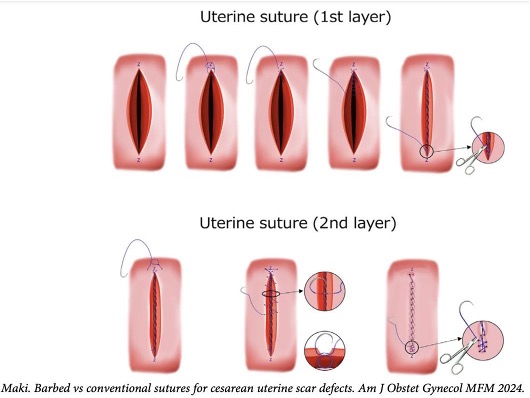
Source: Maki. Barbed vs conventional sutures for cesarean uterine scar defects. Am J Obstet Gynecol MFM 2024.
Training and Standardization Challenges
A critical factor influencing the variation in perineal suturing techniques is possibly the disparity in training and standardization among obstetricians, midwives, and nurse practitioners globally, particularly in general labor and delivery emergencies. Brocklehurst et al.’s (2016) CORONIS trial was designed as an applicable, multi-country RCT conducted across 19 sites in Argentina, Chile, Ghana, India, Kenya, Pakistan, and Sudan. The study utilized a 2 x 2 x 2 x 2 x 2 non-regular fractional factorial design, allowing the simultaneous comparison of five pairs of surgical techniques: blunt versus sharp abdominal entry, exteriorization of the uterus for repair versus intra-abdominal repair, single versus double-layer uterine closure, closure versus non-closure of the peritoneum, and chromic catgut versus polyglactin-910 sutures for uterine repair (pp. 63-67). Participants included 15,935 women undergoing their first or second cesarean section via a transverse abdominal incision. There was an 80% follow-up rate through data collection of medical history, consisting of reproductive outcomes and subsequent surgeries via telephone contact, telephone interviews, and in-person assessments. The trial measured pre-pregnancy, pregnancy, and neonatal outcomes after assessing the participants’ follow-ups. Brocklehurst et al. found better outcomes in subsequent pregnancies with double-layer uterine closure, reduced risks of uterine rupture and scar dehiscence, slightly higher adhesion rates for non-closure of the peritoneum, no effect on long-term maternal or neonatal outcomes by uterine exteriorization, and similar results between chromic catgut and polyglactin sutures in terms of infection rates and healing (pp. 68-71). The multi-regional CORONIS trial highlighted that limited access to formal training programs in LMICs often results in the inconsistent usage of evidence-based practices, possibly reducing successful perineal repairs. Practitioners in these regions frequently rely on traditional methods due to resource restrictions and gaps in continuing education.
In contrast, high-income countries like the UK have incorporated advanced materials such as monofilament sutures for emergency cervical closure, as shown in the C-STICH trial by Morton et al. (2015), emphasizing the importance of specialized training for effective implementation. Additionally, the VUE study conducted by Glazener et al. (2016), which evaluated innovative surgical approaches, including sutures and procedures, for pelvic organ prolapse, indicates the potential need for practitioners to undergo rigorous training to adopt new techniques successfully. These findings collectively reveal the critical role of standardized education and access to advanced training in pre- and post-labor injuries, likely contributing to improved perineal suturing techniques and, consequently, better maternal outcomes globally for primiparous and multiparous women.
Methods
This review essay integrates findings from research articles, prioritizing randomized controlled trials (RCTs) due to their high level of evidence. Articles were selected based on their relevance to perineal repair techniques, potential applications and advancements for perineal repairs, geographic diversity, and focus on primary research outcomes. The majority of these studies were found in peer-reviewed medical journals, examining the success of suturing techniques, materials used, and impacts on maternal recovery. The remaining articles provided contextual insights into demographic and healthcare system influences on perineal repair practices.
Criteria for Inclusion
- Studies were conducted in countries with varied healthcare resources in both high and low-income areas.
- Research focused on short- and long-term maternal outcomes, such as pain levels, infection rates, wound healing, and pelvic health.
- Analyses compared suturing methods and materials, particularly continuous versus interrupted sutures and advanced materials like barbed sutures.
Database Searches
First, I conducted my research through the Academic Search Premier database. I placed several filters on my search, including peer-reviewed academic journals, advanced search, primary sources, and a ten-year time range. I conducted five searches on this database, the latest being on November 13, 2024, where I utilized search terms such as technologies, surgery, outcomes, and pregnancy. I found approximately ten results, choosing to work with two studies. As my research continued, I transferred to PubMed, a healthcare-specific database where I placed similar filters with additions of randomized controlled and clinical trials. I conducted six additional searches, the latest being on November 26, 2024, with search terms including demographics, surgical outcomes, complications, suturing, and obstetrics. I found approximately thirty results, choosing to work with eight studies.
Discussion
Strengths and Limitations
The ten studies included in this review exhibit notable strengths, including the use of randomized controlled trial designs in many cases, which ensure reliable results. Some studies, such as the CORONIS trial, provide valuable data regarding geographic diversity, offering insights into practices across varied healthcare settings. By focusing on specific interventions, like barbed sutures, surgical glue, and single-layer versus double-layer closures, these studies generate evidence that can directly inform clinical practice. Additionally, their extensive assessment of outcomes, including pain, healing, and operative efficiency, can contribute to a clear understanding of maternal recovery. Together, these studies form a solid foundation for improving maternal care techniques globally.
Nonetheless, these studies contain significant limitations, affecting their generalizability across diverse healthcare settings. One limitation is their geographic and healthcare system, with many studies being conducted in high-resource settings that do not reflect the challenges faced by LMICs. This gap limits the relevance of their findings, where access to advanced suturing materials, skilled practitioners, and postoperative care is often limited. Additionally, many studies focus on short-term outcomes, such as operative time, pain, and early wound healing, while neglecting long-term impacts on maternal health, such as pelvic floor dysfunction, scar integrity, and upcoming pregnancy outcomes. Small sample sizes in several trials further reduce statistical significance, making it difficult to detect subtle or rare complications. Furthermore, inconsistency in practitioner skill levels, varied follow-up protocols, and cultural differences in childbirth practices introduce factors that could bias results through confounding variables. These limitations demonstrate the need for larger, multicenter trials with diverse populations, longer follow-up periods, and a broader range of outcome measures to improve the applicability and strength of findings.
Recommendations for Future Practices
To address global disparities in perineal repair techniques and outcomes, several steps can be taken:
- Promoting Evidence-Based Guidelines: International organizations such as the World Health Organization (WHO) can play a critical role in publicizing guidelines tailored to resource levels.
- Investing in Training: Expanding access to training programs, particularly in LMICs, may bridge skill gaps among healthcare providers and practitioners.
- Improving Access to Resources: Subsidizing advanced materials, such as absorbable and barbed sutures, in resource-limited settings can possibly improve outcomes.
- Fostering Research: More comparative studies are needed to assess the long-term impacts of different techniques and materials, especially in underrepresented regions such as Sub-Saharan Africa.
The choice of suturing technique for perineal repairs is not merely a clinical decision but a reflection of broader healthcare inequities. While high-income countries continue to innovate with advanced materials and methods, LMICs face persistent challenges due to limited resources and training. Addressing these disparities requires a concentrated effort from the global health community to ensure that all women, regardless of geography or socioeconomic status, receive optimal care during childbirth. Standardizing practices, enhancing training, and improving resource availability can collectively bridge these gaps, potentially leading to better maternal health outcomes worldwide with patient-centered treatments.
References
- Brocklehurst, P., Abalos, E., Addo, V., Sheikh, M., Mathews, J.E., Naz Masood, S., Oyarzun, E., Oyieke, J., Sharma, J.B. (2016). Caesarean section surgical techniques: 3 year follow-up of the Coronis fractional, factorial, unmasked, Randomised Controlled Trial opens a new website. The Lancet, 388(10039), 62–72.
- Caroci-Becker, A., Brunelli, W. S., de Oliveira Pimentel Lima, M., Ochiai, A. M., Oliveira, S. G., & Riesco, M. L. (2023). Use of surgical glue versus suture to repair perineal tears: A randomised controlled trial opens a new website. BMC Pregnancy and Childbirth, 23(1).
- Daykan, Y., Sharon-Weiner, M., Pasternak, Y., Tzadikevitch-Geffen, K., Markovitch, O., Sukenik-Halevy, R., & Biron-Shental, T. (2017). Skin closure at cesarean delivery, Glue vs subcuticular sutures: A randomized controlled trial opens a new website. American Journal of Obstetrics and Gynecology, 216(4).
- Glazener, C., Constable, L., Hemming, C., Breeman, S., Elders, A., Cooper, K., Freeman, R., Smith, A. R., Hagen, S., McDonald, A., McPherson, G., Montgomery, I., Kilonzo, M., Boyers, D., Goulao, B., & Norrie, J. (2016). Two parallel, pragmatic, UK multicentre, randomised controlled trials comparing surgical options for upper compartment (vault or uterine) pelvic organ prolapse (the Vue Study): Study protocol for a randomised controlled trial opens a new website. Trials, 17(1).
- Hartinah, A., Usman, A. N., Sartini, Jafar, N., Arsyad, M. A., Yulianty, R., Sirenden, H., & Nurung, J. (2021). Care for perineal tears in vaginal delivery: An update for midwife opens a new website. Gaceta sanitaria, 35 Suppl 2, S216–S220.
- Martínez-Galiano, J. M., Arredondo-López, B., Molina-Garcia, L., Cámara-Jurado, A. M., Cocera-Ruiz, E., & Rodríguez-Delgado, M. (2019). Continuous versus discontinuous suture in perineal injuries produced during delivery in primiparous women: A randomized controlled trial opens a new website. BMC Pregnancy and Childbirth, 19(1).
- Maki, J. (2024). Barbed vs conventional sutures for cesarean uterine scar defects opens a new website [Photograph]. American Journal of Obstetrics and Gynecology MFM.
- Maki, J., Mitoma, T., Ooba, H., Nakato, H., Mishima, S., Tani, K., Eto, E., Yamamoto, D., Yamamoto, R., Kai, K., Tamada, T., Akamatsu, K., Kawanishi, K., & Masuyama, H. (2024). Barbed vs conventional sutures for cesarean uterine scar defects: A randomized clinical trial opens a new website. American Journal of Obstetrics & Gynecology MFM, 6(9), 101431.
- Morton, V. H., Toozs-Hobson, P., Moakes, C. A., Middleton, L., Daniels, J., Simpson, N. A., Shennan, A., Israfil-Bayli, F., Ewer, A. K., Gray, J., Slack, M., Norman, J. E., Lees, C., Tryposkiadis, K., Hughes, M., Brocklehurst, P., & Morris, R. K. (2023). Monofilament suture versus braided suture thread to improve pregnancy outcomes after vaginal cervical cerclage (C-stich): A pragmatic randomized, controlled, phase 3, Superiority Trial opens a new website. Obstetrical & Gynecological Survey, 78(4), 199–200.
- Peleg, D., Ahmad, R. S., Warsof, S. L., Marcus-Braun, N., Sciaky-Tamir, Y., & Ben Shachar, I. (2018). A randomized clinical trial of knotless barbed suture vs conventional suture for closure of the uterine incision at cesarean delivery opens a new website. American Journal of Obstetrics and Gynecology, 218(3).
- Verberkt, C., Stegwee, S. I., Van der Voet, L. F., Van Baal, W. M., Kapiteijn, K., Geomini, P. M. A. J., Van Eekelen, R., de Groot, C. J. M., de Leeuw, R. A., Huirne, J. A. F., van Baal, M., Klerkx, W., Bekker, M. N., de Boer, K., Boormans, E. M. A., van Eijndhoven, H. W. F., Feitsma, H., Hehenkamp, W. J. K., Hemelaar, M., … de Vleeschouwer, M. (2024). Single-layer vs double-layer uterine closure during cesarean delivery: 3-year follow-up of a randomized controlled trial (2Close study) opens a new website. American Journal of Obstetrics and Gynecology, 231(3).