
Darrius Bushe
Methodology
This paper is a narrative literature review synthesizing neurobiological and psychosocial mechanisms. A literature search was conducted using PubMed, PsycINFO, and Google Scholar for peer-reviewed articles published between 2000 and 2025. Search terms included “HIV,” “chronic pain,” “sleep disturbance,” “insomnia,” “quantitative sensory testing,” “actigraphy,” and “sex differences.” Articles were included if they examined pain or sleep outcomes in adults living with HIV or investigated neurobiological mechanisms related to pain and sleep regulation. Both primary research studies and review articles were included.
Introduction
Human immunodeficiency virus (HIV) targets and damages CD4 cells, which help the body fight infection and without treatment, HIV can progress to acquired immunodeficiency syndrome, or AIDS, leaving individuals vulnerable to opportunistic infections. A central therapeutic goal for people living with HIV is viral suppression through antiretroviral therapy, which allows many individuals to live long and healthy lives. However, even when viral replication is well controlled, people living with HIV often continue to face a wide range of health challenges that affect quality of life. Among these challenges, chronic pain and sleep disturbances are particularly prevalent and can significantly impair daily functioning, emotional well-being, and overall health (Aggarwal, 2020).
People living with HIV frequently report both chronic pain and sleep disturbances, making these issues an important area of study. Globally, an estimated 39 million people are currently living with HIV, and research suggests that 30–85% of individuals with HIV report chronic pain, while 40–70% experience some form of sleep disturbance, including insomnia or fragmented sleep (World Health Organization, 2024). These symptoms do not occur in all individuals living with HIV, but they appear at much higher rates than in the general population. Because both conditions significantly affect quality of life and daily functioning, understanding how pain and sleep interact in this population is important for improving clinical care and long-term health outcomes.
Since sleep and pain influence each other, treatments that improve sleep might also help reduce chronic pain. Understanding these connections is important for developing effective care strategies. Dysregulation in these pathways, whether due to immune-mediated inflammation, neuroplastic changes in central circuits, or disrupted sleep, can result in heightened pain sensitivity and chronic discomfort (O’Brien et al., 2022).
Pain signals originate from peripheral nociceptors and travel through the spinal cord to central brain regions, including the thalamus, insula, and anterior cingulate cortex, where sensory perception and emotional processing occur. Dysregulation in these nociceptive pathways, such as central sensitization, can amplify the experience of pain and contribute to chronic discomfort (Sun et al., 2025). Sleep regulation, by contrast, involves hypothalamic nuclei such as the suprachiasmatic nucleus, brainstem arousal centers, and cortical networks that coordinate circadian rhythms and maintain homeostatic sleep cycles (O’Brien et al., 2022; Sun et al., 2025). Poor sleep can further dysregulate nociceptive processing, creating a bidirectional cycle in which pain disrupts sleep and fragmented sleep amplifies pain (Goodin & Finan, 2013). Behavioral models of insomnia, such as Spielman’s 3-P model, which includes predisposing, precipitating, and perpetuating factors, help explain how these patterns become chronic.
Assessment of pain and sleep commonly relies on self-report measures, which are inherently limited by subjectivity and recall bias. Objective tools, such as Quantitative Sensory Testing and Actigraphy, provide more precise insight into the neural and behavioral mechanisms underlying these conditions (Roldan & Abdi, 2015). Quantitative Sensory Testing uses controlled thermal, mechanical, or pressure stimuli to evaluate peripheral and central sensory processing, allowing researchers to quantify nociceptive sensitivity and detect potential central sensitization. Actigraphy continuously monitors activity and rest over days or weeks, providing objective data on sleep latency, total sleep time, fragmentation, and circadian rhythm disruptions, which reflect the functional state of neural circuits governing sleep-wake regulation.
Biological, psychosocial, and gender-related factors further influence the interplay between pain and sleep. Age-related increases in inflammatory cytokines, particularly interleukin-6 (IL-6), can amplify central sensitization and potentiate nociceptive signaling (Slawek et al., 2020). Psychosocial stressors, including perceived stigma, discrimination, and chronic stress, modulate limbic system activity and can disrupt both sleep and pain regulation (Hobson et al., 2022; Penn et al., 2019). Gender differences are also prominent. Some studies suggest that women may experience higher pain sensitivity and poorer sleep quality due to hormonal influences, whereas men may be more susceptible to circadian rhythm disruptions, indirectly intensifying pain perception.
This literature review specifically examines nociceptive processing and sleep latency in adults living with HIV, with attention to gender differences. While prior studies have examined pain or sleep separately, fewer reviews have explored how these two conditions interact through shared neurobiological and psychosocial mechanisms in people living with HIV. By emphasizing objective assessment measures such as Quantitative Sensory Testing and actigraphy, this review aims to better integrate these areas of research and highlight potential directions for future clinical and research efforts.
Background
Chronic pain is highly prevalent and multifaceted among adults living with HIV. It can arise from immune dysregulation, peripheral neuropathy, antiretroviral therapy side effects, idiopathic mechanisms, and the sustained stress associated with psychosocial challenges (Addis et al., 2020; Sandoval et al., 2014).
In clinical and research settings, sleep quality is most commonly assessed through self-report questionnaires, sleep diaries, or polysomnography, the gold standard laboratory-based sleep study. However, polysomnography can be expensive and difficult to implement in long-term studies. As a result, wearable monitoring tools such as actigraphy are increasingly used to measure sleep patterns over extended periods in natural environments. While Quantitative Sensory Testing (QST) is not typically used to measure sleep directly, it provides valuable insight into sensory processing and pain sensitivity that may interact with sleep disruption in people living with HIV.
Pain processing involves peripheral nociceptors, spinal dorsal horn neurons, and ascending pathways that transmit signals to the thalamus and somatosensory cortex. Central sensitization, sometimes referred to as “wind-up,” occurs when repeated or sustained nociceptive input exaggerates the response to minimal stimuli, including normally nonpainful stimuli, a phenomenon known as allodynia. This mechanism is frequently observed in HIV-related chronic pain, though it may also occur independently of HIV (Sun et al., 2025). Inflammatory cytokines, particularly interleukin-6, can enhance excitatory signaling in spinal and cortical neurons, resulting in heightened pain perception (Slawek et al., 2020). Although elevated IL-6 levels are commonly observed in individuals living with HIV due to chronic immune activation, IL-6 elevation is not unique to HIV and is also present in other chronic inflammatory conditions. However, persistent immune activation in HIV may uniquely contribute to sustained neuroinflammation and central sensitization (Slawek et al., 2020). Neuropathic pain arising from HIV-related peripheral nerve damage can disrupt dorsal horn and thalamic processing, while musculoskeletal and inflammatory pain may emerge from prolonged stress and immune activation (Addis et al., 2020). Psychosocial factors, including stress, social isolation, and perceived stigma, further influence pain perception by modulating activity in limbic system regions (Hobson et al., 2022; Penn et al., 2019). These interactions highlight the complex relationship between biological and psychosocial determinants of pain.
Table 1 summarizes key biological and psychosocial modulators that jointly influence pain and sleep outcomes in adults living with HIV. This synthesis highlights how inflammatory, ART-related, and psychosocial processes converge to shape central sensitization and sleep disturbance patterns.
Table 1
Biological and Psychosocial Modulators of Pain and Sleep in Adults Living with HIV
| Category | Example Factors | Mechanisms | Impact on Pain/Sleep |
|---|---|---|---|
| Biological | IL-6, TNF-α, neuroinflammation | Enhances central sensitization and disrupts neurotransmission | Greater pain and sleep latency |
| ART-Related | Efavirenz, neurotoxicity | Alters circadian rhythm and neurotransmitter balance | Lower sleep quality |
| Psychosocial | Stigma, stress, isolation | Activates limbic and HPA axis responses | Greater pain perception |
| Gender-related | Estrogen, circadian disruption | Modulates nociceptor and arousal networks | Sex-specific vulnerability patterns |
Table 1 highlights how biological, psychosocial, and gender-related factors interact to shape pain perception and sleep regulation in adults living with HIV. Elevated proinflammatory cytokines and neurotoxic effects of certain antiretroviral therapies may amplify central sensitization, while psychosocial stressors such as stigma and isolation further exacerbate pain and sleep disturbances through heightened hypothalamic pituitary adrenal axis activity. Conversely, protective factors like social support and adaptive coping can mitigate these effects by enhancing emotional regulation and reducing hyperarousal. These multidimensional influences emphasize the need for integrative assessment approaches that consider both physiological and psychosocial determinants of pain and sleep.
Sleep disturbances are also highly prevalent among adults living with HIV and were among the first recognized complications in this population. Early studies documented insomnia and disrupted sleep patterns in HIV-infected men, even before the onset of symptomatic disease (Norman et al., 1990; Norman et al., 1992). Sleep abnormalities have since been linked to circadian rhythm disruption, neurotransmitter imbalances, neuroinflammation, psychosocial stress, and antiretroviral therapy side effects, particularly medications such as efavirenz, which have been associated with insomnia and altered sleep architecture (Gallego et al., 2004; Núñez et al., 2001). The suprachiasmatic nucleus functions as the central circadian pacemaker, coordinating signals from brainstem and cortical regions. Dysregulated melatonin secretion, altered cortisol rhythms, and reduced GABAergic signaling further disrupt sleep patterns (O’Brien et al., 2022; Sun et al., 2025). Poor sleep can worsen pain by affecting activity in regions such as the anterior cingulate cortex and insula, creating a feedback loop in which chronic pain and sleep disturbances mutually reinforce one another (Cody et al., 2022; Roldan & Abdi, 2015). Behavioral models of insomnia, such as Spielman’s 3-P model, which considers predisposing, precipitating, and perpetuating factors, provide a useful framework for understanding how sleep disturbances become chronic in this population.
Gender differences further complicate the relationships between pain and sleep. Women often report higher pain intensity and poorer sleep quality, potentially due to hormonal influences as well as socialized patterns of pain expression (Weaver et al., 2022; Strath et al., 2020). Men, in contrast, may experience more pronounced circadian rhythm disruptions and sleep fragmentation, indirectly amplifying pain experiences. Standardized frameworks such as the ICD-11 provide classifications for chronic pain, which can guide the development of more targeted interventions. A comprehensive approach that integrates neurobiological and psychosocial factors, as well as gender-specific considerations, is essential for designing effective and personalized strategies (Treede et al., 2015; Chan et al., 2023).
Quantitative Sensory Testing and Gender Differences
Quantitative Sensory Testing (QST) is a rigorous and objective methodology for assessing pain sensitivity and processing in adults living with HIV by applying controlled thermal, mechanical, or pressure stimuli to peripheral nerves. QST allows precise measurement of sensory detection thresholds, pain tolerance, and response patterns, enabling differentiation between peripheral and central nervous system contributions to chronic pain (Sandoval et al., 2014; Weaver et al., 2022). Unlike self-report measures, QST objectively quantifies nociceptive sensitivity, identifies central sensitization, and can detect hyperalgesia, all of which are key to understanding HIV-associated chronic pain (Zakumumpa et al., 2021). QST measures are often categorized as either static, such as sensory threshold and pain tolerance, or dynamic, such as temporal summation and conditioned pain modulation, providing insight into both baseline sensitivity and the capacity for central pain amplification.
QST methodologies employ a range of stimuli, each targeting distinct sensory pathways. Thermal testing involves controlled heat or cold applied to the skin to assess temperature detection thresholds and pain responses mediated by small-diameter Aδ and C fibers (DelRosso et al., 2024). Mechanical testing uses von Frey filaments or pinprick stimulators to examine mechanoreceptor sensitivity, evaluating both touch and nociceptive mechanical pathways. Pressure pain testing, typically with an algometer, measures the force required to elicit discomfort, reflecting deep tissue and musculoskeletal sensitivity (Roldan & Abdi, 2015). By combining these modalities, researchers can map the contributions of peripheral nerve damage, such as HIV-associated neuropathy, versus central amplification mechanisms in chronic pain.
Although QST provides valuable objective information about sensory processing, it also has several limitations. The procedure requires specialized equipment and trained personnel, which can limit its availability in many clinical settings. In addition, QST measures responses to controlled laboratory stimuli, which may not fully capture the complexity of chronic pain experienced in everyday life. Individual differences in attention, anxiety, or expectation may also influence responses during testing. As a result, QST is often most informative when used alongside self-report measures and clinical assessment.
Table 2 summarizes commonly used Quantitative Sensory Testing measures, the types of stimuli applied, the sensory responses they assess, the underlying neural mechanisms, and whether they are considered static or dynamic measures of pain processing.
Table 2
Quantitative Sensory Testing Measures, Stimuli, and Neural Mechanisms
| QST Measure | Stimulus Type | Measurement | Neural Mechanism | Category |
|---|---|---|---|---|
| Thermal Threshold | Heat or cold applied to skin | Minimum temperature detected | Small-diameter Aδ and C fibers | Static |
| Thermal Pain Tolerance | Heat or cold applied to skin | Maximum tolerable temperature | Peripheral nociceptors and central processing | Static |
| Mechanical Threshold | Von Frey filament or pinprick | Minimum force detected | Mechanoreceptors, Aβ fibers | Static |
| Pressure Pain | Algometer applied to muscle or tissue | Force needed to elicit pain | Deep tissue nociceptors, central amplification | Static |
| Conditioned Pain Modulation (CPM) | Painful conditioning stimulus applied to separate body site | Inhibition of pain at test site | Descending pain inhibitory pathways, central nervous system | Dynamic |
Table 2 shows that static measures assess baseline sensitivity while dynamic measures capture central pain modulation. These distinctions are important for understanding chronic pain mechanisms in adults living with HIV, as dynamic measures may reveal central sensitization contributing to heightened pain and disrupted sleep. Biological and psychosocial factors further influence these outcomes, highlighting the need for personalized assessment and intervention.
Biological variables, including age, inflammation, and antiretroviral therapy exposure, significantly influence QST outcomes. Older adults frequently exhibit elevated proinflammatory cytokines, particularly interleukin-6, which enhances excitatory signaling in spinal and cortical neurons and increases temporal summation, reflecting central hyperexcitability (Slawek et al., 2020).
Older adults frequently exhibit elevated proinflammatory cytokines, particularly interleukin-6, which enhances excitatory signaling in spinal and cortical neurons and increases temporal summation, reflecting central hyperexcitability (Baechle et al., 2023). These age-related increases in inflammatory signaling are most commonly observed in middle-aged and older adults, typically beginning around the fifth decade of life.
Biopsychological Mechanisms Influencing QST
Chronic HIV infection and long-term ART use may also contribute to neuroinflammation, peripheral neuropathy, and central nervous system sensitization, further modifying QST responses. Genetic differences in pain receptors and neurotransmitter metabolism may contribute to individual variability, highlighting the need for personalized interpretation of QST findings (Idramsyah Idramsyah et al., 2023).
Psychosocial factors, including perceived stigma, social support, and emotional distress, interact with biological pathways to influence pain perception and QST outcomes. Activation of limbic regions such as the amygdala and prefrontal cortex during stress can heighten sensitivity to nociceptive stimuli, creating a feedback loop between psychological stressors and physiological pain responses (Hobson et al., 2022; Penn et al., 2019). Social support may mitigate these effects, engaging regulatory prefrontal circuits and reducing pain amplification. These psychosocial interactions highlight the complex nature of pain processing in adults living with HIV.
Gender Based Variability in Pain and Sleep Processing
Gender differences are consistently observed in both QST and sleep measures. Women generally exhibit lower pain thresholds and greater sensitivity across thermal, mechanical, and pressure modalities, potentially due to estrogen-mediated modulation of nociceptors and central pathways. Hormonal fluctuations across the menstrual cycle may further exacerbate these differences, influencing both central sensitization and peripheral nociceptive responses (Weaver et al., 2022; Hening Pujasari & Umar, 2023). Women also frequently experience more fragmented sleep and longer sleep latency, which can amplify pain perception through increased central sensitization and dysregulated nociceptive processing. Men, in contrast, may demonstrate higher pain thresholds but are more susceptible to circadian rhythm disruptions and sleep fragmentation, indirectly enhancing nociceptive signaling through dysregulated arousal pathways and increased sympathetic activity (O’Brien et al., 2022; Pain Management in Vulnerable Populations, 2024). These gender-specific differences highlight the need for interventions that are sensitive to distinct neurobiological and psychosocial profiles rather than a one-size-fits-all approach.
Clinical Integration and Implications
Integrating QST with actigraphy provides a comprehensive method for evaluating the bidirectional relationship between pain and sleep. Actigraphy offers longitudinal data on sleep patterns, including latency, total sleep time, fragmentation, and circadian rhythm stability, which can be correlated with QST findings to reveal how neural sensitivity interacts with real-world sleep disruptions. Heightened central sensitization identified via QST may predict prolonged sleep latency or frequent nocturnal awakenings, while fragmented sleep may exacerbate pain sensitivity, particularly in women (O’Connor, 2025). By combining these modalities, researchers can identify gender-specific vulnerabilities and inform interventions that simultaneously target pain modulation and sleep regulation.
Expanded understanding of QST findings has direct clinical relevance. Objective measures can help clinicians identify patients at higher risk of persistent pain or sleep disturbances and tailor interventions accordingly (Henderson et al., 2025). Gender-specific considerations are essential. Women may benefit more from strategies targeting heightened pain sensitivity and central sensitization, whereas men may require interventions that stabilize sleep architecture and circadian rhythms. Integrating psychosocial assessment with QST allows for a holistic, biopsychosocial approach, optimizing intervention efficacy in adults living with HIV (Petrakis et al., 2022).
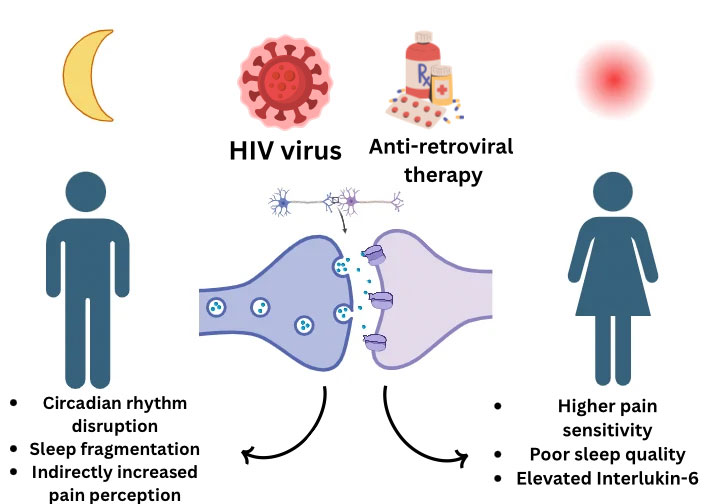
Figure 1. Pain and Sleep Dysregulation in Adults with HIV. This figure illustrates the interconnected neurobiological and psychosocial mechanisms linking HIV infection, antiretroviral therapy (ART), and psychosocial stressors with neuroinflammation, central sensitization, and sleep disturbances. Created with BioRender.com. HIV and ART elevate IL-6 levels, promoting neuropathic pain and central sensitization. Sleep disturbances further amplify pain, and psychosocial stressors modulate limbic and prefrontal circuits, influencing both pain and sleep. Gender-specific pathways highlight hormonal effects in women and circadian vulnerabilities in men.
Discussion
Adults living with HIV often exhibit heightened pain sensitivity and prolonged sleep latency compared with HIV-negative populations (Dong et al., 2025). These conditions interact in a bidirectional manner, with each influencing neural circuits associated with the other. Pain can disrupt thalamocortical and limbic networks, increasing arousal and sleep fragmentation, while sleep disturbances can exacerbate central sensitization and amplify nociceptive signaling (Taylor et al., 2022).
Behavioral Interventions
Behavioral approaches, including Brief Behavioral Treatment for Insomnia (BBTI) and Cognitive Behavioral Therapy for Insomnia (CBT-I), have demonstrated efficacy in improving sleep quality and may indirectly reduce pain intensity by modulating thalamocortical, limbic, and prefrontal pathways (Grebenciucova & VanHaerents, 2023). These interventions incorporate sleep hygiene, stimulus control, relaxation techniques, and cognitive restructuring to address both behavioral and cognitive contributors to sleep disruption.
Brief Behavioral Treatment for Insomnia (BBTI) is a shorter, protocol-driven intervention that focuses primarily on behavioral strategies such as stimulus control and sleep restriction and is often delivered in fewer sessions. Cognitive Behavioral Therapy for Insomnia (CBT-I) is a more comprehensive intervention that includes cognitive restructuring in addition to behavioral techniques. CBT-I has demonstrated stronger long-term efficacy across diverse populations, whereas BBTI may be more feasible in clinical settings with limited resources (Cody et al., 2024).
These interventions have shown moderate improvements in sleep outcomes in several populations, although evidence in adults living with HIV remains limited (Cody et al., 2024).
In adults living with HIV, emerging evidence suggests these interventions improve sleep quality and may indirectly reduce pain intensity, although large-scale randomized controlled trials in this population remain limited.
Biological and Psychosocial Mechanisms
Elevated IL-6 and other proinflammatory cytokines can sustain hyperexcitability in pain pathways even after improvements in sleep, highlighting the need for multimodal interventions that target both neural and immune mechanisms (Slawek et al., 2020). Medications that inhibit IL-6 signaling already exist and are currently used to treat certain inflammatory diseases such as rheumatoid arthritis. Although these therapies are not currently standard treatments for HIV-related chronic pain, understanding IL-6 pathways may eventually help inform future pharmacological approaches.
Gender-Specific Considerations
Gender-specific responses to interventions are also evident. Women may derive greater benefit from strategies targeting heightened pain sensitivity and central sensitization, whereas men may respond more favorably to interventions designed to stabilize circadian rhythms and sleep architecture (Weaver et al., 2022; Strath et al., 2020). Incorporating ICD-11 classifications of chronic pain subtypes allows for mechanism-based interventions that integrate neurobiological, psychosocial, and gender-specific considerations (Treede et al., 2015).
Future Research Directions
Despite growing research in this area, several gaps remain. First, relatively few studies have examined the combined interaction between chronic pain and sleep disturbances in people living with HIV, particularly using objective measures such as QST and actigraphy together. Future research could benefit from larger longitudinal studies that track both pain sensitivity and sleep patterns over time. In addition, more work is needed to understand how gender, age, and psychosocial stressors interact with neurobiological mechanisms such as inflammation and central sensitization. Expanding research in these areas could help inform more personalized and targeted interventions for individuals living with HIV.
Clinical Implications
These findings highlight the importance of a comprehensive, multimodal approach to managing chronic pain and sleep disturbances in adults living with HIV (Povshedna et al., 2023). Combining objective measures like QST and actigraphy with behavioral and social interventions allows clinicians to customize treatment based on each patient’s age, inflammation levels, social environment, and gender-specific vulnerabilities.
Conclusion
Chronic pain and sleep disturbances are prevalent, interrelated, and multifactorial in adults living with HIV. These conditions are mediated by complex neurobiological pathways, including peripheral nociceptors, spinal circuits, thalamic and cortical processing centers, hypothalamic circadian regulators, and limbic networks. Objective assessments such as QST and actigraphy provide critical insights into these mechanisms, revealing important gender-specific differences.
Behavioral interventions, particularly CBT-I and BBTI, that address both neurobiological and psychosocial contributors are likely to produce the greatest improvement in sleep and pain outcomes. Interventions that also account for inflammatory status, psychosocial stressors, and gender-specific patterns can further optimize efficacy.
Future research should continue to integrate objective measures, mechanistic insights, and psychosocial determinants to refine intervention strategies. Longitudinal studies are particularly important to examine the durability of improvements in pain and sleep, identify causal mechanisms, and inform evidence-based, individualized care approaches. By advancing understanding of the complex interactions between pain, sleep, and psychosocial factors, clinicians and researchers can develop interventions that enhance both quality of life and daily functioning for adults living with HIV.
References
- Addis, D. R., DeBerry, J. J., & Aggarwal, S. (2020). Chronic pain in HIV opens a new website. Molecular Pain, 16, 1744806920927276.
- Baechle, J. J., Chen, N., Makhijani, P., Winer, S., Furman, D., & Winer, D. A. (2023). Chronic inflammation and the hallmarks of aging opens a new website. Molecular Metabolism, 74, 101755.
- BioRender. (2025). BioRender. Www.biorender.com opens a new website; Biorender.
- Cody, S. L., Kusko, D. A., Gonzalez, C. E., Owens, M. A., Hobson, J. M., Gilstrap, S. R., Thomas, S. J., & Goodin, B. R. (2024). Improving sleep in people with HIV and chronic pain: A pilot study of brief behavioral treatment for insomnia opens a new website. Behavioral Sleep Medicine, 1–11.
- Dong, L., Bogart, L. M., Klein, D. J., Phaladze, N., Kgotlaetsile, K., Goggin, K. J., & Mosepele, M. (2025). Internalized HIV Stigma, Sleep Problems, and Depressive Symptoms in People with HIV in Botswana opens a new website. Behavioral Medicine, 1–5.
- Gallego, L., Barreiro, P., del Río, R., González de Requena, D., Rodríguez-Albariño, A., González-Lahoz, J., & Soriano, V. (2004). Analyzing sleep abnormalities in HIV-infected patients treated with Efavirenz opens a new website. Clinical infectious diseases: an official publication of the Infectious Diseases Society of America, 38(3), 430–432.
- Grebenciucova, E., & VanHaerents, S. (2023). Interleukin 6: at the interface of human health and disease opens a new website. Frontiers in Immunology, 14.
- Henderson, M., Alford, K., Bouyagoub, S., Doyle, N., Sriram Vundavalli, Vicente, P., Busza, A., Winston, A., & Vera, J. H. (2025). Changes in cerebral function parameters in persons with HIV with symptoms of insomnia switching from dolutegravir- to bictegravir-based antiretroviral therapy opens a new website. Journal of NeuroVirology.
- Hening Pujasari, & Umar, E. (2023). Insomnia and quality of life of adults living with HIV: a moderated mediation analysis opens a new website. Journal of Public Health, 32(5), 749–757.
- Hobson, J. M., Gilstrap, S. R., Owens, M. A., Gloston, G. F., Ho, M. D., Gathright, J. M., Dotson, H. F., White, D. M., Cody, S. L., Justin Thomas, S., & Goodin, B. R. (2022). Intersectional HIV and Chronic Pain Stigma: Implications for Mood, Sleep, and Pain Severity opens a new website. Journal of the International Association of Providers of AIDS Care, 21, 23259582221077941.
- Idramsyah Idramsyah, None Anditha Ratnadhiyani, & Sahran Sahran. (2023). Adverse Physical Effects of Antiretroviral Therapy and Methadone on People Living with HIV/AIDS (PLWHA) Using Injection Drugs (IDUS) opens a new website. International Journal of Social Science, 2(4), 2045–2050.
- Keng Seng Chan, Poller, W. C., Świrski, F. K., & Russo, S. J. (2023). Central regulation of stress-evoked peripheral immune responses opens a new website. Nature Reviews Neuroscience, 24(10), 591–604.
- Norman, S. E., Chediak, A. D., Kiel, M., & Cohn, M. A. (1990). Sleep disturbances in HIV-infected homosexual men opens a new website. AIDS (London, England), 4(8), 775–781.
- Norman, S. E., Chediak, A. D., Freeman, C., Kiel, M., Mendez, A., Duncan, R., Simoneau, J., & Nolan, B. (1992). Sleep disturbances in men with asymptomatic human immunodeficiency (HIV) infection opens a new website. Sleep, 15(2), 150–155.
- O’Brien, K. E., Riddell, N. E., Gómez-Olivé, F. X., Rae, D. E., Scheuermaier, K., & von Schantz, M. (2022). Sleep disturbances in HIV infection and their biological basis opens a new website. Sleep Medicine Reviews, 65, 101571.
- O’Connor, D. B. (2025). Registered Reports in Biopsychosocial Science and Medicine: To Infinity and Beyond opens a new website. Psychosomatic Medicine, 87(1), 57–58.
- Owens, M. A., Thomas, P. A., Crowe, C., Goodin, B. R., & Overstreet, D. S. (2025). Quantitative sensory testing for pain: What exactly are we measuring? opens a new website Current Opinion in Psychology, 62, 101988.
- Pain Management in Vulnerable Populations opens a new website. (2024). In Oxford University Press eBooks. Oxford University Press.
- Penn, T. M., Trost, Z., Parker, R., Wagner, W. P., Owens, M. A., Gonzalez, C. E., White, D. M., Merlin, J. S., & Goodin, B. R. (2019). Social support buffers the negative influence of perceived injustice on pain interference in people living with HIV and chronic pain opens a new website. PAIN Reports, 4(2), e710.
- Petrakis, V., Paschalis Steiropoulos, Nikolaos Papanas, Grigorios Trypsianis, Papazoglou, D., & Panagopoulos, P. (2022). Quality of sleep in people living with HIV in the era of highly active antiretroviral treatment opens a new website. International Journal of STD & AIDS, 34(3), 191–202.
- Rendón, A., Núñez, M., Jiménez-Nácher, I., González de Requena, D., González-Lahoz, J., & Soriano, V. (2005). Clinical benefit of interventions driven by therapeutic drug monitoring opens a new website. HIV Medicine, 6(5), 360–365.
- Rogers, B. G., Bainter, S. A., Smith-Alvarez, R., Wohlgemuth, W. K., Antoni, M. H., Rodriguez, A. E., & Safren, S. A. (2021). Insomnia, Health, and Health-related Quality of Life in an Urban Clinic Sample of People Living with HIV/AIDS opens a new website. Behavioral sleep medicine, 19(4), 516–532.
- Roldan, C. J., & Abdi, S. (2015). Quantitative sensory testing in pain management opens a new website. Pain Management, 5(6), 483–491.
- Sandoval, R., Roddey, T., Giordano, T. P., Mitchell, K., & Kelley, C. (2014). Pain, sleep disturbances, and functional limitations in people living with HIV/AIDS-associated distal sensory peripheral neuropathy opens a new website. Journal of the International Association of Providers of AIDS Care, 13(4), 328–334.
- Slawek, D. E., Merlin, J. S., Owens, M. A., Long, D. M., Gonzalez, C. E., White, D. M., Lopez, S. A., Heath, S. L., & Goodin, B. R. (2020). Increasing age is associated with elevated circulating interleukin-6 and enhanced temporal summation of mechanical pain in people living with HIV and chronic pain opens a new website. PAIN Reports, 5(6), e859–e859.
- Strath, L. J., Sorge, R. E., Owens, M. A., Gonzalez, C. E., Okunbor, J. I., White, D. M., Merlin, J. S., & Goodin, B. R. (2020). Sex and gender are not the same: Why identity is important for people living with HIV and chronic pain opens a new website. Journal of Pain Research, 13, 829–835.
- Sun, S.-Y., Miao, X.-H., Zhou, G.-K., & Liu, T. (2025). Senescent nociceptors: A novel therapeutic target for chronic pain treatment opens a new website. Neuroscience Bulletin. Advance online publication.
- Taylor, S. W., McKetchnie, S. M., Batchelder, A. W., Justice, A., Safren, S. A., & O’Cleirigh, C. (2022). Chronic pain and substance use disorders among older sexual minority men living with HIV: Implications for HIV disease management across the HIV care continuum opens a new website. AIDS Care, 1–10.
- Tetiana Povshedna, Swann, S. A., Sofia L. A. Levy, Campbell, A. R., Manon Choinière, Durand, M., Price, C., Gill, P., Murray, M., & Hélène Côté. (2023). Global prevalence of chronic pain in women living with HIV: A systematic review and meta-analysis opens a new website. Open Forum Infectious Diseases, 10(8).
- Treede, R.-D., Rief, W., Barke, A., Aziz, Q., Bennett, M. I., Benoliel, R., Cohen, M., Evers, S., Finnerup, N. B., First, M. B., Giamberardino, M. A., Kaasa, S., Kosek, E., Lavandʼhomme, P., Nicholas, M., Perrot, S., Scholz, J., Schug, S., Smith, B. H., & Svensson, P. (2015). A classification of chronic pain for ICD-11 opens a new website. Pain, 156(6), 1.
- Weaver, K. R., Griffioen, M. A., Klinedinst, N. J., Galik, E., Duarte, A. C., Colloca, L., Resnick, B., Dorsey, S. G., & Renn, C. L. (2022). Quantitative sensory testing across chronic pain conditions and use in special populations opens a new website. Frontiers in Pain Research, 2, 779068.
- World Health Organization. (2024). HIV/AIDS opens a new website. World Health Organization.
- Winkelman, J. W., Berkowski, J. A., DelRosso, L. M., Koo, B. B., Scharf, M. T., Sharon, D., Zak, R. S., Kazmi, U., Falck-Ytter, Y., Shelgikar, A. V., Trotti, L. M., & Walters, A. S. (2025). Treatment of restless legs syndrome and periodic limb movement disorder: an American Academy of Sleep Medicine clinical practice guideline opens a new website. Journal of clinical sleep medicine: JCSM, official publication of the American Academy of Sleep Medicine, 21(1), 137–152.
- Zakumumpa, H., Paina, L., Wilhelm, J., Ssengooba, F., Ssegujja, E., Mukuru, M., & Bennett, S. (2021). The impact of loss of PEPFAR support on HIV services at health facilities in low-burden districts in Uganda opens a new website. BMC health services research, 21(1), 302.