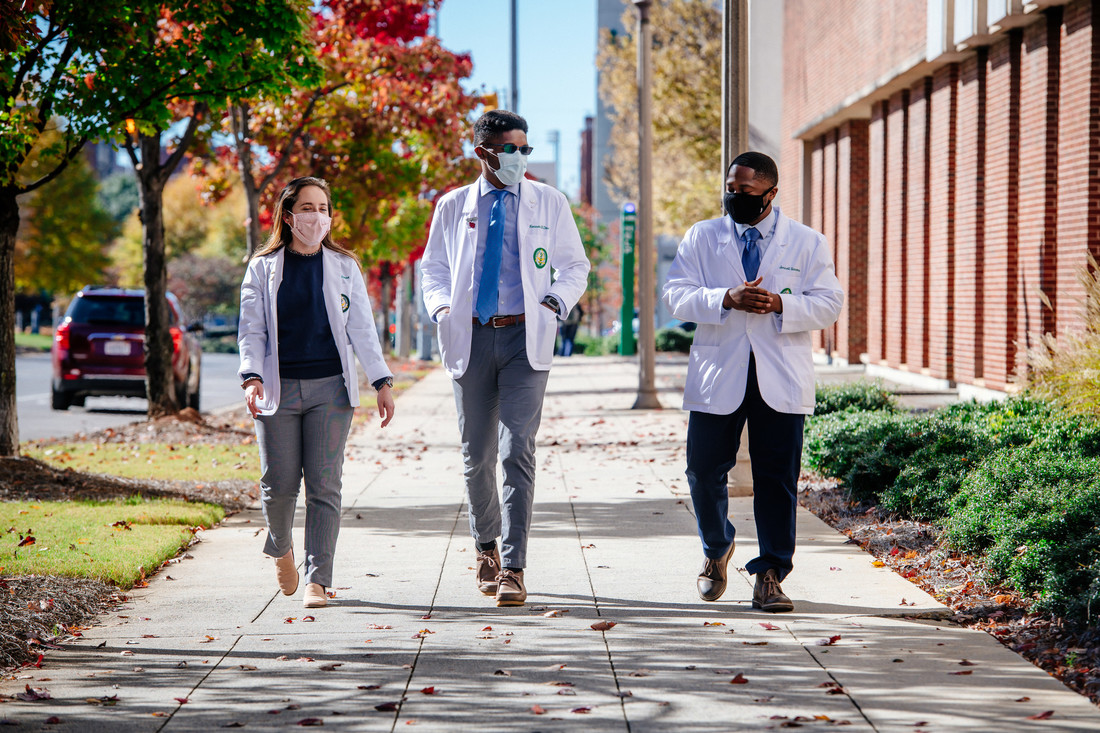
 As part of the School of Medicine’s spring 2021 curriculum offerings, faculty in the Department of Family and Community Medicine led three elective courses related to research, inclusion, and leadership. Each course allowed students to learn more about their interests and space to explore new ideas related to their future careers in medicine.
Holding Space: Power of Storytelling in Medicine
Brandi Shah, M.D., MPH, is the director of the department’s Office of Identity, Inclusion and Collective Conscience. Shah practices at the Student Health Clinic on campus and is an active community advocate for equity in healthcare. Shah led an elective course intended to help students understand the importance of storytelling and relationship-building with patients as they continue their medical training.
Shah met with four students—two MS2s and two MS3s—weekly to collaborate with them and their community storytellers. The first few classes introduced students to community engagement and story work. After these discussions, four class sessions were devoted to rapport-building with the group and activities aimed at helping the students engage with stories in an empathetic and creative way. The last five weeks of the course gave students time to complete the storytellers’ digital stories for an exhibit at Vinegar Contemporary, a local arts nonprofit.
The community storytellers shared their experiences with the students and collaborated on a digital presentation of some of their medical experiences as members of the LGBTQIA+ community.
“I offered this course because I believe that stories and storytelling/sharing are at the core of medical practice and relationship building with patients,” said Shah. “The most rewarding part of the course was witnessing the personal and group transformations that occurred between and because of the medical student and community storyteller interactions.”
Jasper Kennedy was one of the students in Shah’s class this spring. Kennedy remarked on the impact the class had on their education and future career.
“Being part of the course helped me practice one of the most valuable skills a physician can have—how to bear witness to another person’s struggles,” said Kennedy. “It was so impactful to collaborate with members of our community who are often silenced and to get their stories out into the world. I’m grateful for the vulnerability that our storytellers showed in sharing about their lives and specifically their interactions with the healthcare system. I will be taking the listening, support, and advocacy skills I gained in the process into my future interactions with patients.”
The students’ and community storytellers’ digital stories exhibition, “Holding Space: One Entity Embracing All,” is available for screenings on Saturdays from 10 a.m. until 2 p.m. or by appointment at Vinegar through May 15.
Shah plans to offer the course again in spring 2022. Interested students may reach out to her or to the Office of Identity, Inclusion, and Collective Conscience to learn more.
Health Psychology and Wellness in Primary Care
Michael Wiederman, Ph.D., director of the department’s Office of Leadership and Professional Development, held his second elective course this spring after a successful course on leadership in fall 2020. Wiederman explored the importance of psychology in primary care with his class, which was made up of 11 students in their second and third years of medical school.
“I was really impressed with the attitude of these students,” said Wiederman. “They invested in this course and took a collaborative approach to their learning and development.”
The course included pre-work reading and recorded lectures to study before virtual meetings, where Wiederman led discussions and active application exercises based on the material. Wiederman decided to offer the course to give medical students the chance to deepen their understanding of the scope of primary care and the application of psychology practices, such as motivational interviewing and intentional referring, in treating patients with mental health concerns.
Even if students do not continue into a psychology specialty, this course helped them become better physicians by exposing them to potential mental health hurdles that future patients may face, noted Wiederman.
“The course was an invaluable class during my second year,” said Paris Long, a second-year medical student in the course. “It gave me the ability to practice my motivational interviewing skills in an environment that was both comfortable and conducive to learning.”
Wiederman plans to offer a similar course in 2022. Interested students can contact him for more information.
Clinical Research Experience: COVID Pandemic
Kimberly Smith, Ph.D., director of the Alabama Practice-Based Research Network offered a course on clinical research that explored topics related to completing a clinical research project while in medical school. Fourteen medical students, representing all years of medical school, participated in the course.
Each virtual session included didactic training and time for breakout group discussion and application of the research skill discussed that week. Smith covered how to set up a research question, create a survey, analyze data sets and more. All medical students are required to complete scholarly activity before graduating, and this course offered a look at how to approach future research activities.
“It was great to feel like I was empowering the students to research topics that they were passionate about this semester,” said Smith. “Research can be perceived as boring, but we were able to get these students excited about it because they chose topics that were important to them and encouraged them to explore their interests.”
As the course title suggests, students were asked to pick topics related to the COVID-19 pandemic and worked with Smith to study topics ranging from comorbidities to related conditions and the lasting impact of the illness.
James Crenshaw, a first-year medical student in the School of Medicine, completed the course and a research project on the impact of obesity on COVID-19 symptom severity.
“The COVID-19 Clinical Research course taught by Dr. Smith provided a valuable learning experience in clinical data analytics, employing the scientific method, and writing manuscripts,” said Crenshaw. “I learned to generate impactful research questions, develop an effective REDCap questionnaire, translate and analyze survey data, and produce a poster presentation yielding my findings. The process of gathering insights on COVID-19 symptom manifestation in obese populations was a rewarding project to work on during the pandemic, bolstering my understanding of the occult mechanisms of coronavirus and enhancing clinical research skills that I will utilize throughout my medical school career."
Smith plans to offer a similar course next year and encourages students to reach out to her for ways to get involved in research within the Department of Family and Community Medicine or through the Alabama Practice-Based Research Network online.
For more information about how the Department of Family and Community Medicine is working to educate the next generation of medical leaders, visit our website.