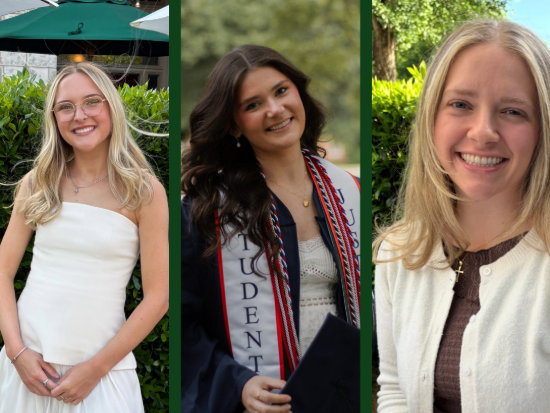
 Pictured from left to right are Isabella Cheatwood, Natalie Snow, and Hannah Sterndorf.The emergency department is constantly in motion. Monitors beep, care teams coordinate throughout the floor, and conversations overlap continually. It's exactly the kind of environment where artificial intelligence, increasingly used to transcribe patient encounters in quieter settings, still struggles to keep up. That complexity is in part why, in the UAB Department of Emergency Medicine, the job of capturing a patient's story still belongs to a person: a medical scribe.
Scribes sit alongside physicians during patient encounters, documenting the visit in real time so providers can stay focused on the person in front of them rather than the screen beside them. For emergency department providers, scribes help ensure accurate and timely documentation, allowing physicians and other healthcare professionals to focus more of their attention on direct patient care rather than administrative tasks. For patients, this translates into more efficient encounters and enables providers to spend more time engaged in diagnosis and treatment.
One of the most distinctive aspects of the UAB Department of Emergency Medicine Scribe Program is its strong emphasis on mentorship, education, and career development. Scribes work directly alongside physicians in a high-acuity setting, gaining clinical exposure that most undergraduates never see before medical school. The program was established in 2023 and is one of the few that remain at UAB.
Three of the program's recent scribes are proof of the effectiveness of this mentorship and training. Isabella Cheatwood, of Talladega, Ala., spent almost three years as a scribe while completing a bachelor's degree in immunology and a master’s degree in biomedical and health sciences at UAB. In July 2027, she started medical school at the UAB Heersink School of Medicine.
“Working as a scribe gave me insight into patient-provider interactions, clinical judgment and decision-making, and hospital operations,” Cheatwood said. “The emergency department specifically taught me to remain calm under pressure and to work efficiently even when care spaces are limited.”
Her advice to future scribes is simple: “See patients. You have something to learn from every patient encounter. Be proactive and learn from your mistakes.”
Hannah Sterndorf, of Fairhope, Ala., worked as a scribe for nearly two years after graduating from UAB in 2025 with a degree in immunology. She, too, is headed to the UAB Heersink School of Medicine this year.
“Being a scribe showed me that I want a career where I can work directly with patients and be involved in the critical thinking that goes into their care,” Sterndorf said.
She encourages new scribes to listen as closely to conversations among providers as they do to patient encounters: “There is so much to be learned from each provider's thought process and approach to patient care.”
Natalie Snow, a Samford University graduate with a degree in sports medicine, joined the program in 2024 and will attend the University of South Alabama Frederick P. Whiddon College of Medicine.
“Being a scribe at UAB prepared me for a career in medicine more than any other experience,” Snow said. “It allowed me to see high-acuity cases up close and witness the critical decision-making and teamwork that make the emergency department run smoothly.”
For Cheatwood, Sterndorf, Snow, and the scribes who will follow them, this role is proving to be more than a job—it’s a first step into medicine itself.