Lauren Walter, M.D., MSPH, FACEP, has been awarded a five-year grant from the Substance Abuse and Mental Health Services Administration (SAMHSA) for her project titled “Integrated Emergency Addiction Care: A Patient-Centered Model for Medications for Opioid Use Disorder.”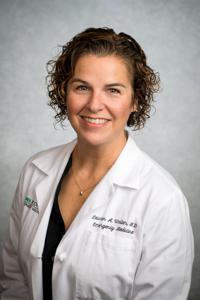 Lauren Walter, M.D.
As principal investigator and project director, Walter will collaborate with Sukhshant Atti, M.D., MPH, associate professor in the Department of Emergency Medicine, and Li Li, M.D., Ph.D., professor in the Department of Psychiatry and Behavioral Neurobiology, to develop an integrated emergency addiction care model that transforms the emergency department from an episodic point of care into an effective gateway to sustained treatment and recovery.
A central focus of the project is shared decision-making, giving patients access to a broader spectrum of evidence-based medications for opioid use disorder and a choice in what treatment they pursue.
“We want to identify eligible patients reliably; give them meaningful choices among evidence-based medications through shared decision-making; initiate or rapidly facilitate their preferred treatment; engage them with peer recovery specialists; and create a true warm handoff to community addiction treatment rather than simply handing someone a phone number at discharge,” Walter said.
When it comes to addiction intervention, medication is only one small piece of a larger picture. Patients with opioid use disorder often encounter multiple barriers, including stigma, lack of transportation, lack of insurance, unstable housing, fragmented treatment systems, and limited availability of clinicians or programs that provide medication treatment.
Through this program, participants will also have access to peer recovery specialists, overdose education, naloxone (a medication used to reverse opioid overdoses), linkage to a substance abuse assessment created by the American Society of Addiction Medicine, coordinated transitions to community addiction treatment, and assistance addressing barriers such as transportation, insurance, housing, behavioral health needs, and other social determinants of health. UAB’s universal HIV and hepatitis C screening infrastructure will also be used to test for infections and offer treatment when needed.
The project is based in the UAB Department of Emergency Medicine and will operate across UAB Hospital, UAB Hospital-Highlands, and Gardendale Primary and Specialty Care emergency departments, enrolling approximately 410 individuals over five years. The research team will assess outcomes including medication initiation, engagement and retention, repeat emergency visits, recurrent overdose, and HIV/HCV linkage. Follow-ups with patients will begin 30 days after presenting in the emergency department and extend to 12 months and beyond. They will also assess whether this type of comprehensive model is feasible, acceptable, sustainable, and reproducible in routine emergency care.
“As an emergency physician, I have cared for patients with opioid use disorder, withdrawal, overdose, and other addiction-related complications for many years,” Walter said. “The emergency department often represents a critical—and sometimes the only—point of contact these patients have with the healthcare system. Starting a medication is important, but it is not enough. Patients need choices, peer support, effective care coordination, rapid access to ongoing treatment, and help overcoming the very real barriers that occur once they leave the emergency department.”