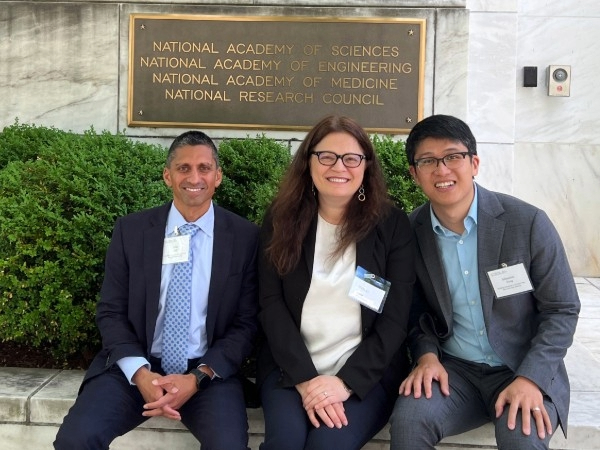
 Irfan Asif, M.D., Lusine Poghosyan, Ph.D., and Sebastian Tong, M.D., addressed the Standing Committee on Primary Care about the importance of primary care research.At the May public meeting of the National Academies of Sciences, Engineering, and Medicine (NASEM) Standing Committee on Primary Care, Irfan Asif, M.D., chair of the UAB Department of Family and Community Medicine and associate dean of Primary Care and Rural Health, joined national leaders to spotlight the value of primary care research.
“I was honored to participate in this discussion and help elevate the role of primary care research,” said Asif. “I hope the committee heard that primary care research is uniquely positioned to bridge discovery and implementation—not just determining what works, but how to make it work for everyone, everywhere. That is why primary care is indispensable to our national research agenda.”
Joining Asif on the panel were Lusine Poghosyan, Ph.D., MPH, RN, a professor of nursing and health policy and management at Columbia University, and Sebastian Tong, M.D., MPH, a family physician and associate director of the Washington, Wyoming, Alaska, Montana and Idaho (WWAMI) Practice and Research Network.
Throughout the panel, these leaders emphasized that primary care research sits at the intersection of care delivery, population health, and policy, and without stronger investment, the field risks falling behind at a moment of rapid transformation.
Primary care already serves as first contact for many patients but, as the panel underscored, the field continues to operate with significant gaps in evidence. Clinicians are increasingly asked to manage patients with complex, chronic conditions, often without the data needed to guide best practices or evaluate emerging models of care. However, primary care research is equipped to address these challenges, not only by identifying effective interventions but also ensuring those solutions can be implemented across real-world settings.
A key theme of the remarks was the risk of continued underinvestment. Without stronger research infrastructure, both clinicians and policymakers will be forced to make decisions without relevant evidence. This gap limits innovation, slows the adoption of effective care models, and ultimately puts patient outcomes at risk.
Unlike many other areas of medicine, primary care operates in community-based settings, where clinicians care for patients across the lifespan and address a wide spectrum of health and social needs. This positioning creates an unparalleled opportunity to study care in context if researchers are equipped with the right tools, funding, and partnerships.
According to the panel, those partnerships require meaningful collaboration from a variety of stakeholders. In addition to clinicians and investigators, impactful primary care research must also include patients, communities, health systems, payers, and employers. By bringing these voices into the research process, the field can ensure that studies address real-world challenges and produce findings that are both relevant and actionable.
As the U.S. health system grapples with workforce challenges, rising chronic disease burden, and widening health disparities, the insights generated through primary care research will be essential to shaping effective, equitable solutions.
By elevating these issues at the National Academies, Asif helped to ensure that primary care and its critical contributions to research remain at the center of conversations about the future of healthcare.