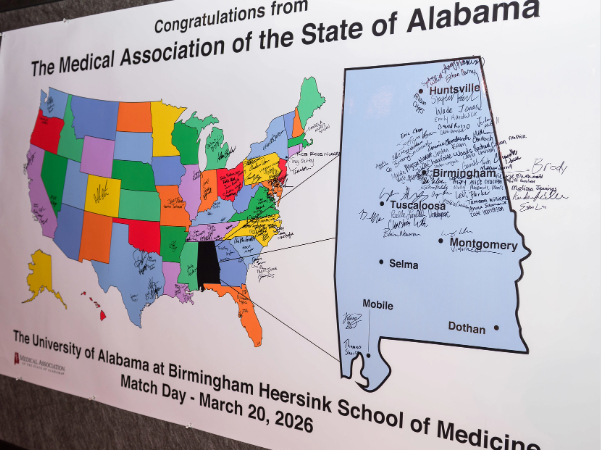
 Across the country, thousands of new family physicians took the next step in their medical journey when they began residency training in July. For graduates of the UAB Heersink School of Medicine who matched into primary care residency programs in Alabama, taking that monumental step came with less educational debt.
Fourteen members of UAB’s Class of 2026 who opted to stay in Alabama received the 2026 Primary Care/Family Medicine Match Scholarship award, sponsored by the Department of Family and Community Medicine's Comprehensive Urban Underserved and Rural Experience (CU2RE) Program.
"Our goal is to remove barriers that may prevent medical students from practicing as primary care physicians in Alabama’s high-need communities," said Irfan Asif, M.D., chair of the UAB Department of Family and Community Medicine and associate dean of Primary Care and Rural Health. "Alleviating some of the medical school debt burden is one strategy to open up the pathway for students who may be drawn to primary care but feel they need to pursue a more lucrative specialty."
According to the Alabama Office of Healthcare Workforce, to address the state’s primary care access shortage, in 2026 we need an additional 329 primary care physicians seeing an average of 20 patients per day, 5 days a week, 48 weeks per year, located in 62 specific communities. The residency match scholarships are part of the department's ongoing commitment to strengthening Alabama's physician workforce by supporting students who choose careers in primary care, particularly in rural and medically under-resourced communities.
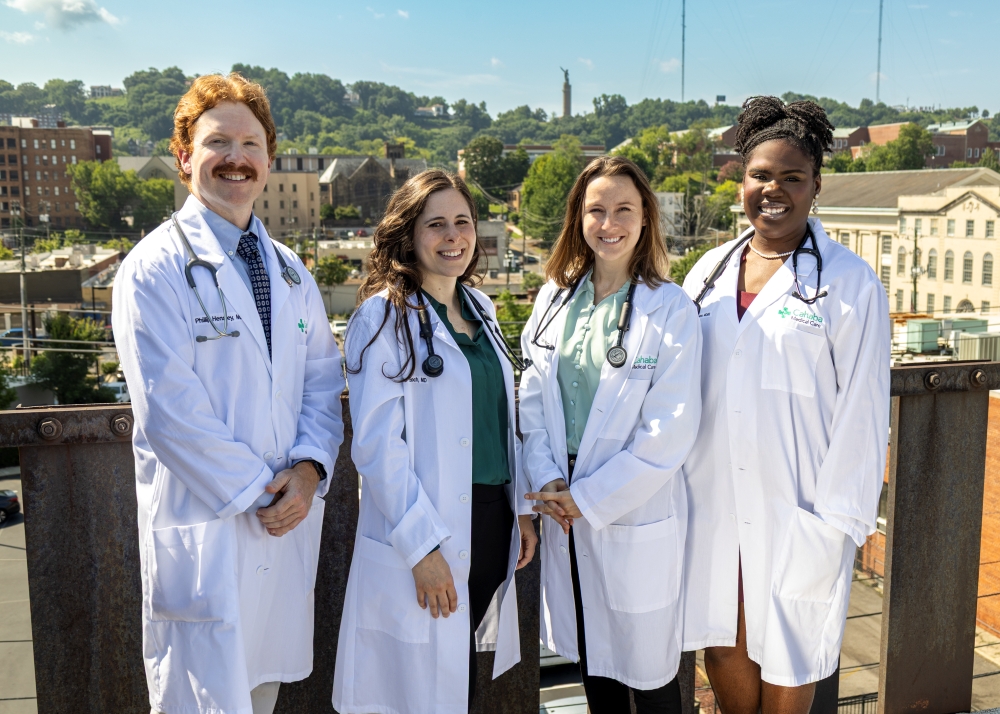 Phillip Hensley, M.D., (far left) matched into the Cahaba-UAB Family Medicine Residency. "These awards did not just reduce a financial metric, they provided the psychological peace of mind necessary to stay entirely true to my original dream of serving Alabama's most vulnerable communities without the overwhelming pressure of financial strain," said Phillip Hensley, M.D., who remained on campus to train with the Cahaba-UAB Highlands Family Medicine Residency program. "I am incredibly grateful to the Department of Family and Community Medicine for investing in my training, and I fully intend to pay this generosity forward through my future practice as a primary care physician in an underserved region of Alabama."
The investment comes as UAB continues to build a strong pathway for future primary care physicians. Family medicine was the second most popular specialty among Class of 2026 graduates, with 18 matching into the field. Overall, 62 Heersink students matched into primary care specialties, representing nearly 35% of the class.
For scholarship recipients, the support represents more than financial assistance. It reinforces their commitment to serving Alabama communities where access to care remains limited.
"I grew up in a small town where everyone looks out for each other, so I knew early on that I wanted to pay it forward as a primary care provider," said Amayrani Ramirez, M.D., who matched into family medicine at UAB Huntsville. "I am very grateful for this scholarship as it allows me to focus on my training while lessening my financial strain."
Hensley said the scholarship support helped him remain focused on his long-term goal of practicing in an underserved area of Alabama despite the financial pressures many medical graduates face.
"Addressing the severe primary care physician shortage in Alabama was my primary motivation for pursuing medicine in the first place," Hensley said. "From day one, my goal has been to practice primary care in a medically underserved region of our state."
For Blaine Newman, M.D., who is part of the Tuscaloosa Family Medicine Residency, the scholarship highlights a shared commitment to improving access to primary care across the state.
"After growing up and completing medical school in Alabama, it is easy to see the profound need for primary care in our state," Newman said. "This will help me focus on becoming a competent physician and less on financial strain as I begin my career."
By investing in future primary care physicians at a pivotal point in their training, the Department of Family and Community Medicine aims to ensure more Alabama communities benefit from a sustainable, well-trained workforce dedicated to meeting the state's health care needs.
Through initiatives like CU2RE, UAB continues to demonstrate its commitment to developing the next generation of physicians while creating pathways for graduates to serve the communities that need them most.
The CU2RE Program is supported by the Health Resources and Services Administration (HRSA) of the U.S. Department of Health and Human Services (HHS) as part of an award totaling $17.175 million, with 10% financed with nongovernmental sources. The contents are those of the author(s) and do not necessarily represent the official views of, nor an endorsement by, HRSA, HHS, or the U.S. Government.