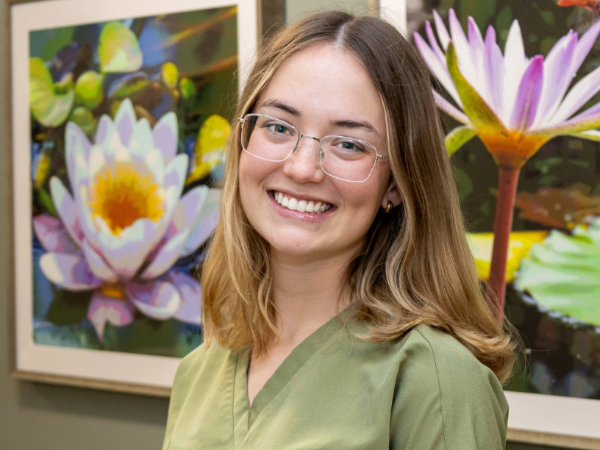
 UAB Family Medicine certified medical assistant Mabry Smyer will begin physician assistant training.For nearly two years, Mabry Smyer has been a friendly, trusted face in UAB’s Family Medicine Clinic at UAB Hospital-Highlands. First as a clinic technician and then advancing to a certified medical assistant, Smyer supported patients and providers across a wide range of needs. She has also drawn on experience in emergency medicine and research, building a strong foundation rooted in teamwork, adaptability, and compassion. This summer, Smyer takes her next step forward as she leaves Birmingham to begin physician assistant training at the University of South Alabama. According to Smyer, she’ll be carrying lessons learned from those who helped shape her path into medicine.
“If I could go back and see myself two years ago, it’d be hard to believe the level of confidence and competence I’ve developed. I owe so much to the mentors and colleagues I’ve worked with, who created an environment where I felt supported but also challenged. Ultimately, I’ve become more confident in my ability to contribute meaningfully to patient care, which has been incredibly rewarding and affirming as I prepare for PA school.”
You've worked in both the Emergency Department and Family Medicine. How did those environments shape your understanding of patient care?
Smyer: I worked at UAB’s Main Emergency Department as a Patient Care Technician during a summer break from college, and it was an incredible introduction to fast-paced, high-acuity care. I learned how to think quickly, stay calm under pressure, and support patients in vulnerable situations. Working in family medicine over the past couple of years has shown me a fairly different, but equally important, side of patient care.
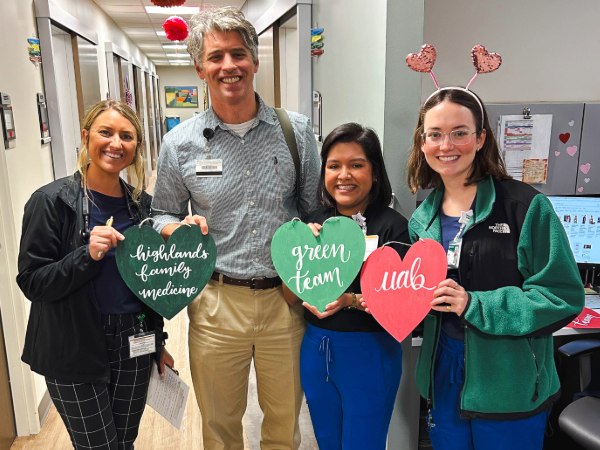 Smyer with colleagues at the Highlands Family Medicine ClinicAlthough family medicine is known for its emphasis on prevention and long-term management, I’ve learned that extreme variety exists in both primary care and emergency settings. Family medicine in particular requires constant adaptability and vigilance as providers manage both acute concerns and chronic conditions within the same visit. There is also a kind of heroism existing in both environments. In the ED, it’s often dramatic and immediate while, in family medicine, it’s quieter and sustained over time. I’ve come to really value that longitudinal care and the relationships it builds between provider and patient, and it has strongly influenced my desire to practice in a setting where I can follow patients over time and be part of their ongoing health journey.
How has your undergraduate work in neuroscience influenced your career path?
Smyer: Studying neuroscience was both inspiring and humbling; the more I learned, the more I realized how vast and complex the field really is. After three years in a lab studying systems neuroscience, it became clear that even deep focus on one area only scratches the surface. That experience helped me come to terms with an important mindset: that medicine isn’t about mastering everything, but about committing to lifelong learning. Letting go of the pressure to know it all and instead focusing on continuous self-improvement has already been very rewarding.
My research experience also emphasized the importance of collaboration. Whether we were developing a poster or troubleshooting experiments, progress depended on people sharing ideas and working across disciplines. I’ve seen that same dynamic in clinical medicine. Some of the best patient care decisions form through thoughtful teamwork and open communication. Ultimately, a combination of intellectual curiosity, humility, and collaboration has strongly shaped how I approach both learning and patient care.
What drew you to the physician assistant role?
 Smyer with other Halloween heroes in the Highlands Family Medicine Clinic.Smyer: One of the things I value most about the PA profession is that it exemplifies adaptability in healthcare, both in terms of specialties and in responding to the evolving needs of patients and communities. I feel an acute sense of urgency to become a provider when I reflect on the severe, growing shortage of healthcare providers in our country. I see the creation of the PA role as a very practical part of the remedy to that problem. By forging a path through which competent providers can be trained in a relatively short amount of time, gaps in healthcare access can steadily be filled across specialties. At the same time, I’m drawn to the collaborative nature of the role, and how the PA profession demonstrates the efficacy of physician-led, team-based medicine. I appreciate working in environments where input is shared and patient care is approached as a team effort to create a comprehensive treatment plan. Overall, becoming a PA feels like the best fit for both my personality and the kind of provider I hope to be.
What areas of medicine or patient populations are you most passionate about serving?
Smyer: Gearing up for school to begin, I’ve realized that my interest in bringing care to underserved populations melds perfectly with the vision adopted by the PA program at the University of South Alabama. Their focus on rural medicine reflects one of the most exciting qualities about the PA role: flexibility, which can be applied to help patch up the urgent need for healthcare providers across our country, especially in relatively remote or isolated places. It’s hard to believe that in only a couple of years, I will have the credentials and capabilities to provide care to others. I know that my journey will only be just starting when I graduate, that I will still have a lot to learn, but I can see now that my ability to heal is about to grow exponentially as my future unfolds. Ultimately, I’m drawn to various aspects of a wide array of specialties, and I am looking forward to exploring these specialties during my training. All the while, I will always want my work to be centered around making care more accessible and being a reliable presence for patients of all medical and socioeconomic backgrounds.
When you imagine yourself as a provider, what does that look like?
Smyer: When I imagine myself as a provider, I think of someone who approaches every patient encounter, no matter how challenging, with energy and compassion. I’ve been fortunate to work alongside providers at UAB Highlands Family Medicine who bring both expertise and warmth to every patient interaction, and that’s something I hope to emulate as a PA. With that, I hope patients will always feel respected, reassured, and understood while under my care. As I train to become a PA, I plan to take what I am learning and reflect on how I can effectively educate patients on the same topics. Making thoughtful, individualized efforts towards improving a patient’s health literacy is such an important part of producing the attitudes necessary for improving health as well as maintaining it. This is a belief that I will always keep in mind as a provider.