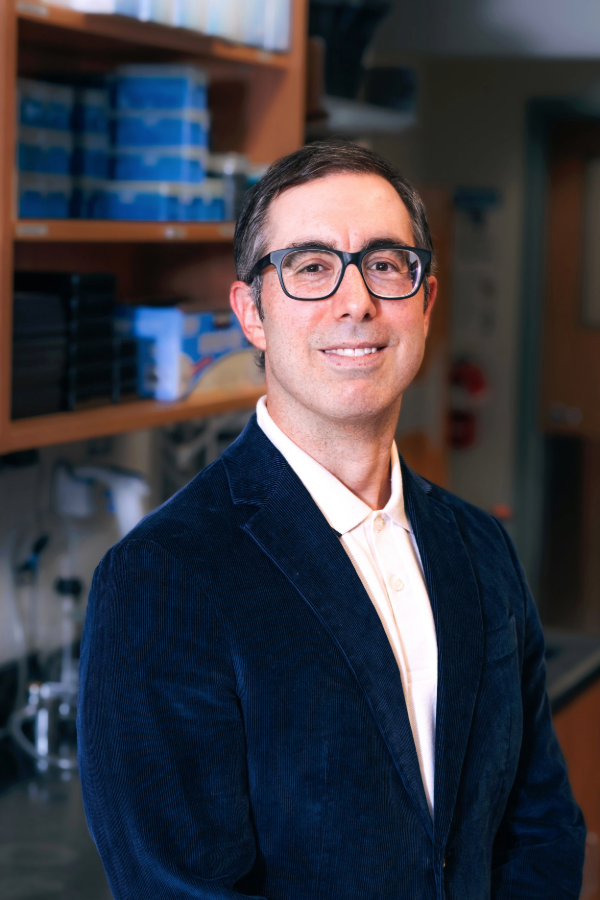
 Jeremy Herskowitz, Ph.D.Jeremy Herskowitz, Ph.D., professor in the Department of Neurology, has been named the latest recipient of the school's Featured Discovery award. This recognition celebrates notable faculty research contributions and highlights the impact of their scientific advancements.
His study, “Tau seeds induce neurofibrillary tangle formation across brain regions via individual-specific connectivity,” was published in Neuron.
Herskowitz’s research focuses on neurofibrillary tangles in the human brain. The amount and anatomical location of these tangles play a significant role in the development of Alzheimer’s disease.
“When tangles are confined to deeper brain regions, patients can experience memory problems,” Herskowitz said. “However, once tangles appear in the frontal regions, more advanced cognitive dysfunction emerges.”
Until recently, investigators have been unable to determine how the tangles are able to spread from the deeper regions to the rest of the brain. Thanks to their research, Herskowitz and his team discovered that tiny seed molecules from those deep tangles use neuron connections to spread and induce tangles in other areas.
The Heersink communications team met with Herskowitz to gain insights into the study and help raise awareness about both the research and the Heersink School of Medicine.
What compelled you to pursue this research?
When an older individual transitions from asymptomatic to symptomatic Alzheimer’s disease dementia, it is because tangles have reached vast areas of the human brain. Once this has happened, the current anti-amyloid-β therapies are less effective. Therefore, understanding how tangles spread through the aged human brain was a defining question at the core of Alzheimer's disease etiology and essential for identifying new, rational therapeutic targets.
What was your most unexpected finding?
The most unexpected finding was that the study actually worked. A coherent human-centric demonstration of how seed molecules from tangles spread in humans has not been available because it requires an impossible task of labeling the seed molecules in living humans. We circumvented this barrier by generating an unprecedented combination of data, including antemortem functional magnetic resonance imaging and postmortem human brains from the same individuals.
How do you feel your research will impact the science community?
By discovering evidence that tangles can spread through the human brain via connected neurons, it provides a mechanism by which therapeutics designed against tangles could be targeted. The seed molecules spreading around the brain and inducing new tangles will need to enter the extracellular space outside the neurons in order to hop from cell to cell. This would provide an opportunity for treatments, such as antibodies, to bind and eliminate the seed molecules while moving from cell to cell, potentially slowing the induction and spread of new tangles throughout the brain.
What made you come to UAB?
When I interviewed at UAB over 13 years ago for a faculty position in the Department of Neurology within the CNET (now Killion CNET), I was most impressed with how supportive David Standaert, M.D., Ph.D., former chair of the Department of Neurology, and Erik Roberson, M.D., Ph.D., interim chair of the Department of Neurology, were and are toward my research goals. They indicated that UAB would be an outstanding place to grow my program and reach my goals, and that convinced me to accept the position. They were right. My research team and I have made seminal discoveries on the neuroscience of Alzheimer’s disease, and that was possible only through the support and encouragement of the Department of Neurology, KCNET, and the UAB Alzheimer’s Disease Research Center.