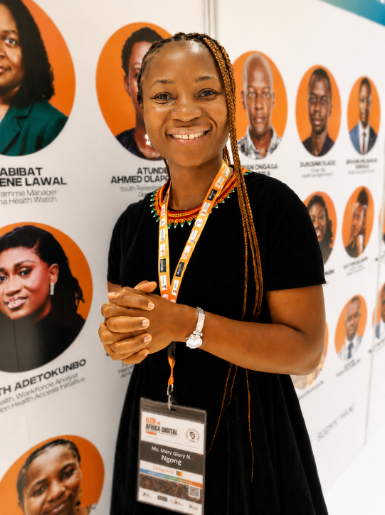
For the inaugural installment of “Postcards from the Field,” a new series highlighting the people and partnerships advancing global health, we spoke with Mary Glory N. Ngong, author, midwife, and lead research coordinator of the Cameroon Health Initiative at UAB (CHI UAB), whose work focuses on maternal and neonatal healthcare in Cameroon. She shared her experience attending the 6th Africa Digital Health Summit (ADHS) in Abuja, Nigeria.
"A senior colleague shared the call for abstracts for ADHS 2026 on LinkedIn. Inspired by the progress we have made with mMIST (adapted from UAB's MIST line), I approached our lead investigators about submitting an abstract," Ngong said. "With support from colleagues at UAB and in Cameroon, I prepared and submitted an abstract titled, ‘Bridging the Gap in Maternal Health Care in Remote and Crisis-Affected Communities Through mHealth,’ and I was delighted when the abstract was accepted for an oral presentation," Ngong said.
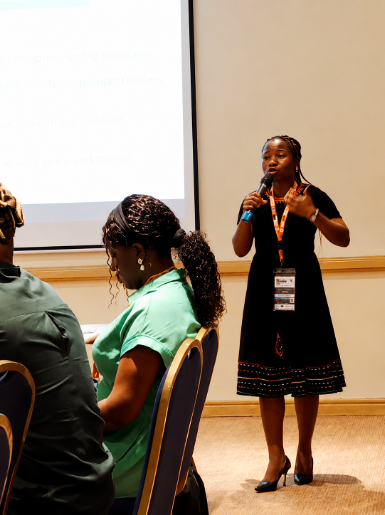
"My presentation highlighted how mMIST is being used to support maternal healthcare delivery in remote and underserved communities by connecting frontline healthcare workers with experienced clinicians through mobile technology," Ngong said. "I shared lessons learned from implementation, including how the platform facilitates timely clinical consultation, supports decision-making for complex maternal cases, and strengthens access to specialized expertise in settings where such resources are often unavailable."
"The presentation also generated valuable discussion on the role of simple, scalable digital health solutions in improving maternal health outcomes in low-resource and crisis-affected areas," Ngong said.
"The 6th ADHS was held under the theme ‘From Pilots to Scale: Growing Africa’s Digital Health Innovation Ecosystem,’” Ngong said. "The summit brought together researchers, innovators, policymakers, healthcare professionals, students, and government stakeholders from across Africa to share experiences in digital health implementation," Ngong said.
"Key challenges discussed included limited policy frameworks, inadequate funding, community resistance to change, and duplication of similar digital health tools," Ngong said.
 Recommended strategies for successful scale-up included:
- Strengthening collaboration among innovators to reduce duplication.
- Developing policies to support digital health ecosystems across Africa.
- Engaging communities, policymakers, and stakeholders from the start of pilot projects.
- Building sustainability plans early to reduce reliance on external funding
"Attending ADHS reinforced the importance of partnerships, local ownership, and sustainability in scaling digital health innovations across Africa. I am grateful for the opportunity to present mMIST, learn from colleagues across the continent, and build new professional connections," Ngong said. My sincere thanks to the entire mMIST team, including Drs. Tita, Tih, Budhwani, and Enah, for sponsoring my first international trip and making this memorable experience possible," Ngong said.
The mMIST project was funded by an NIH R21/33 (contact MPI Tita) and is now being considered for ongoing funding by the local regional health authority.
The Mary Heersink Institute for Global Health invites you to be featured in “Postcards from the Field." We welcome you to share your current global health projects, activities, and experiences here for the opportunity to be featured in an upcoming installment of the series.