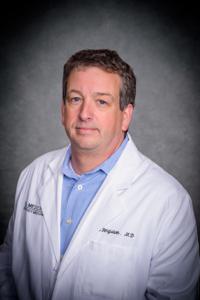
 When seconds count, seamless coordination between field providers and emergency rooms saves lives. Leading the effort to elevate out-of-hospital care across Alabama is William Ferguson, M.D., associate professor in the UAB Department of Emergency Medicine.
Ferguson brings a deep, firsthand background in pre-hospital and critical care to his work. He started his career as an Emergency Medical Technician (EMT) before working as an emergency room and flight nurse. He went on to attend medical school, completed an emergency medicine residency where he served as chief resident, and finished a specialized Emergency Medical Services (EMS) fellowship. Today, Ferguson serves as the inaugural chief of the new Section of Prehospital Medicine at UAB, overseeing the EMS training for the Department of Emergency Medicine. He also serves as the medical director for the Birmingham Regional EMS System, Alabama’s Life Saver bases, and speaks locally, regionally, and nationally on EMS topics.
Under his leadership, UAB EMS collaborates closely with local providers, private paramedic programs, and the Alabama Fire College. UAB also hosts the state's only accredited EMS Fellowship, which was established in 2020.
A pillar of prehospital provider education is the Alabama EMS Challenge, which Ferguson founded in 2014. Meeting on the second and fourth Wednesdays of every month, this free initiative offers bi-monthly physician-led training for paramedics and emergency personnel. This includes annual cadaver labs that give prehospital providers direct, practical experience with complex procedures.
Zoe Whorton, a firefighter and paramedic with the Sumiton Fire Department, highlighted the value of these sessions after attending a lab in April.
"Attending the cadaver lab with Dr. Ferguson was an incredible learning experience," Whorton said. "He is truly eager to help both new and seasoned EMS providers grow. After attending this lab led by Dr. Ferguson, I feel more confident performing the skills we practiced."
Ferguson is just as passionate about educating future doctors through early prehospital clinical experiences. First-year medical students participate in didactics geared for EMT-level care and spend 40 hours out in the field with EMS crews and 24 hours in the emergency department, while second-year medical students can build on this experience and get hands-on training tailored to advanced EMT and physician skills.
In addition, Ferguson serves as the medical director for the Birmingham Fire and Rescue Service. Working alongside Fire Chief Cory D. Moon, he helped launch a blood program and a strong continuous quality improvement plan to elevate patient care in the city. Beyond the training and innovative clinical operations, UAB EMS helps keep the community safe by running aid and cooling stations at major events like Protective Stadium, Talladega Superspeedway, Barber Motorsports Park, and the Coca-Cola Amphitheater, along with international events like the World Games.
Ferguson explained how the pre-hospital care given by first responders with the Birmingham Fire Department and medical personnel has made a substantial positive difference in people’s lives—from providing whole blood in the field for life-threatening blood loss, to responding to cardiac arrests, to delivering babies
“It is important to note that the work that our paramedics are providing in the field is physician-level care, just without the benefit of years of clinical training and feedback,” Ferguson said. “And we as physicians and the healthcare system must support them in their educational and clinical endeavors, or our patients will suffer.”
That is why Ferguson said these first responders, doctors, and nurses must have interdisciplinary training to work together to manage all aspects of emergency care.
At the heart of Ferguson's work is a simple goal: taking care of people.
“Patient care does not start at the doors of our emergency rooms,” Ferguson said. “It starts where and when our patients need help.”