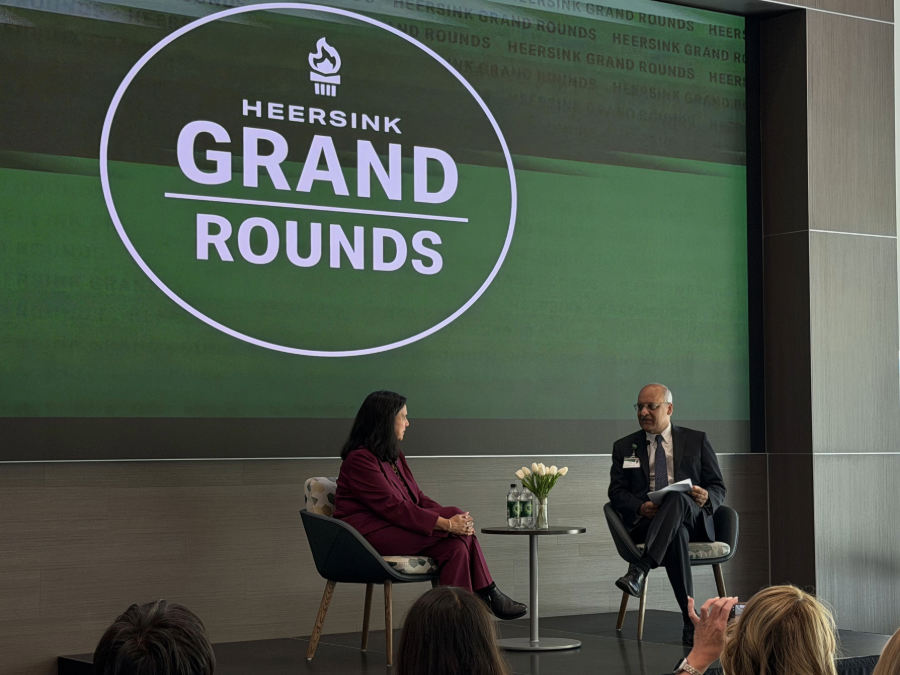
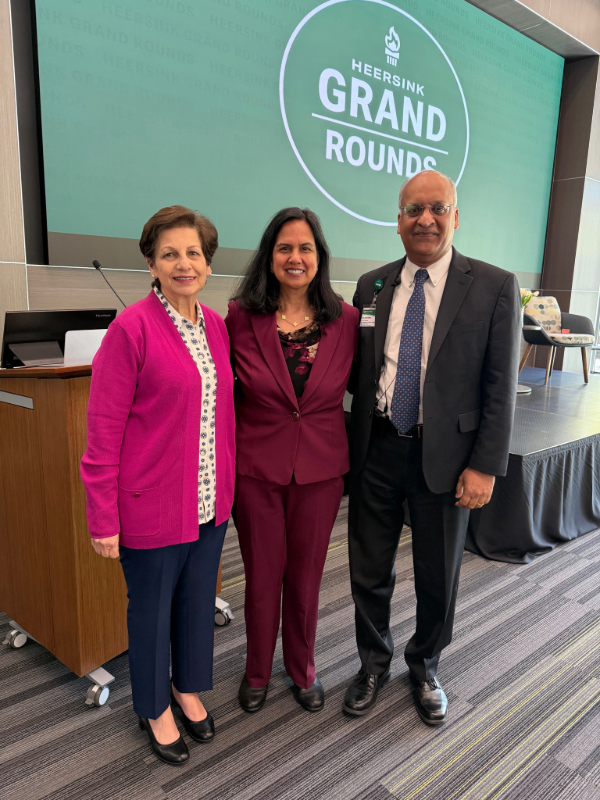
 On Tuesday, April 7, the Heersink School of Medicine welcomed Sharmila Makhija, M.D., MBA, founding dean and CEO of the newly established Alice L. Walton School of Medicine (AWSOM), as the speaker at the Heersink Grand Rounds. During her talk, she discussed the logistics and challenges of establishing a new medical school.
“Dr. Makhija has been deeply committed to strengthening medical education and preparing future physicians to serve communities with purpose and impact,” said Anupam Agarwal, M.D., senior vice president for medicine and dean of the Heersink School of Medicine. “She brings together clinical excellence, academic leadership, and a systems-level perspective, along with a strong commitment to mentorship and women's health.”
Makhija began her talk by sharing how the school came to be. An early vision for AWSOM was from Alice Walton herself, who wanted to make healthcare more widely accessible for the people of Arkansas and the surrounding region. There was also a major focus on strengthening healthcare in rural areas by training a new generation of doctors who will remain in the region and serve the community.
Early in her career, Makhija was a faculty member in the UAB Department of Obstetrics and Gynecology. She also served on the admissions committee, which taught her key attributes to look for when recruiting for medical school students, such as resiliency, adaptability, and flexibility.
 Makhija also spoke on the importance of AWSOM’s partnership with Mercy Health System, which is based in St. Louis and has several hospitals in Arkansas. “Because we are freestanding on the Crystal Bridges campus and do not have our own university or health system, we knew partnerships were essential,” she said. “Mercy is where our students will rotate for their clinical experience.” The school also partnered with the University of Arkansas, sharing faculty appointments and curriculum development.
The inaugural class of 48 was recruited in just three months. Of those 48, 15% are from rural areas, and 20% are first-generation medical students. The school takes advantage of its small size by fostering connections and building community. The curriculum is based on whole-person care, which looks at the whole individual rather than a single condition.
When asked what personal values guide her decision-making, Makhija said integrity was vital. “People can be intelligent and well‑meaning, but without honesty, you can’t build anything solid. I’d rather someone admit they don’t know or made a mistake. We openly talk about mistakes, and that openness is hard to build but essential.”
In five years, Makhija hopes to see AWSOM’s impact across the Heartland region, with a focus on building a healthcare campus with inpatient, outpatient, and virtual care, leveraging technology to support rural physicians. “Success is supporting communities in new ways,” she said.