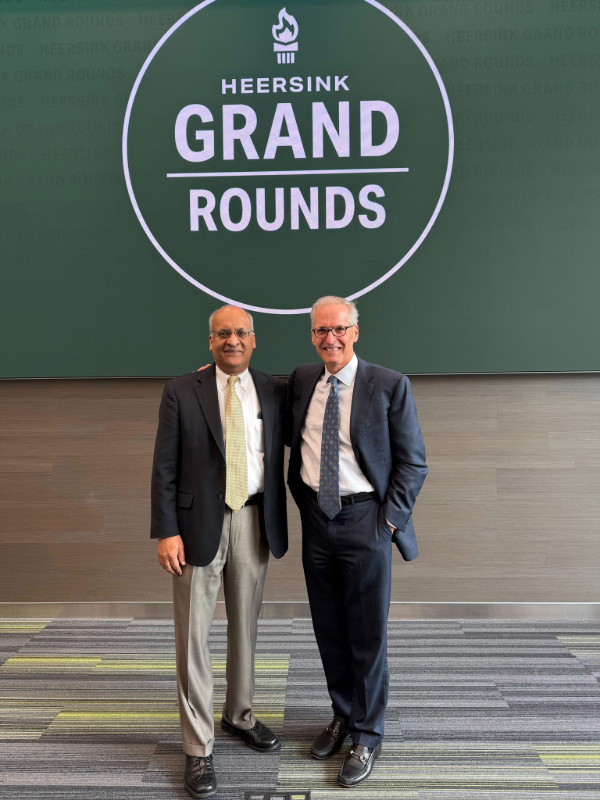
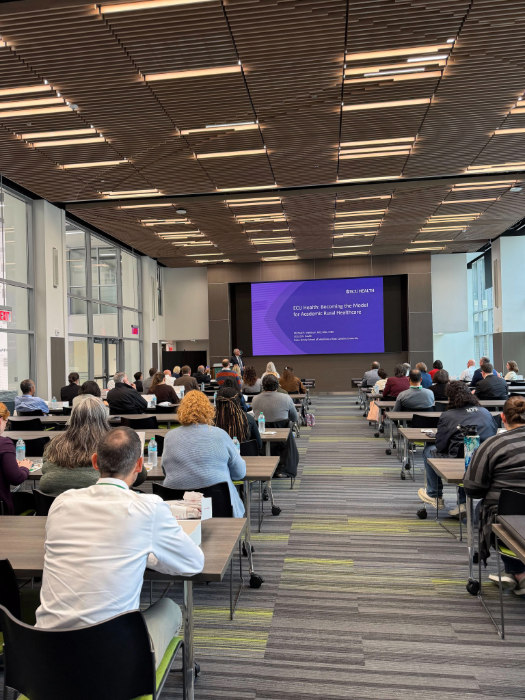
 On Wednesday, Nov. 4, the Heersink School of Medicine welcomed Michael Waldrum, M.D., MBA, CEO of ECU Health and dean of the Brody School of Medicine at East Carolina University, as the speaker at the Heersink Grand Rounds. His talk focused on academic health systems and their responsibility to develop sustainable, integrated models that improve access and outcomes for rural communities.
“Across Alabama, we continue to face many of the same challenges that rural communities nationwide face, including shortage of workforce, access to specialty care, hospital sustainability, and persistent health disparities,” said Anupam Agarwal, M.D., senior vice president for medicine and dean of the Heersink School of Medicine. “Under Dr. Waldrum's leadership, ECU Health has worked to address those challenges through a highly integrated approach that brings together healthcare delivery, medical education, workforce development, technology, and community partnerships.”
Waldrum began his talk by outlining the challenges rural healthcare faces, including chronic financial pressures, workforce shortages, limited access to specialty care, and worsening health disparities. Additionally, rural communities tend to see higher rates of chronic disease and delayed diagnoses.
According to Waldrum, there are six key factors that contribute to the healthcare environment of rural communities. These factors are density, distance, demographics, disease, determinants, and disparities. Waldrum said these factors create unique challenges for rural health systems and require solutions that extend beyond traditional models of care. He noted that rural hospitals often face persistent financial difficulties despite serving populations with greater health needs.
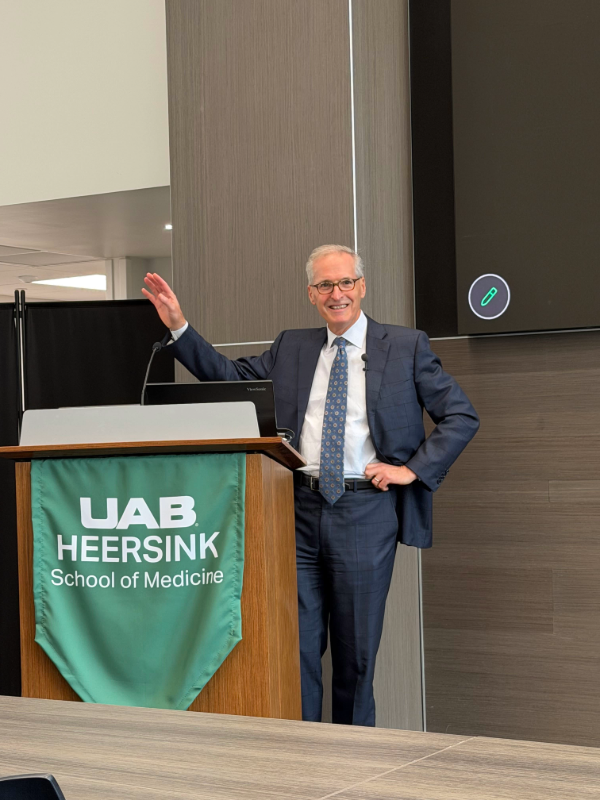 “To solve systemic problems, you have to take what I call the enterprise perspective and an integrated perspective,” Waldrum said. “How do you integrate interests and objectives, and then the systems and processes, to advance your mission and to advance the work?”
Drawing on his experience leading ECU Health, Waldrum described how the organization was created to combine the strengths of a health system, medical school, and university to improve health outcomes across eastern North Carolina, a largely rural region of 1.4 million residents.
“Our mission is to improve the health and well-being of eastern North Carolina,” Waldrum said.
Waldrum explained that ECU Health has responded by developing an integrated academic health system that includes nine hospitals, more than 250 clinics, a unified electronic health record system, community health partnerships, and the Brody School of Medicine. The model is designed to address healthcare delivery, workforce development, and population health simultaneously.
A major theme of the presentation was transforming care delivery to better serve patients in rural communities. Waldrum highlighted initiatives including telehealth access points in churches, libraries and community centers, mobile health units, virtual care platforms, and partnerships that connect patients with resources such as food, housing, and employment assistance.
 He also shared examples of how reimagining care delivery can improve access. In one rural community, ECU Health replaced an aging hospital with a modern outpatient and emergency care facility. Although the change faced initial resistance, the new model ultimately expanded access and lowered costs while allowing the health system to better meet community needs.
Workforce development was another key focus of Waldrum’s presentation. He described efforts to expand physician and nursing training programs, create rural residency opportunities, and strengthen educational pipelines that encourage students to practice in underserved communities. The Brody School of Medicine has built its mission around training physicians who will remain in North Carolina and serve rural populations.
“We needed the hospital system and the School of Medicine and university to combine their power and their assets to affect health outcomes for a highly underserved region,” Waldrum said.
Looking ahead, Waldrum discussed policy challenges that could significantly affect rural healthcare systems, including reimbursement pressures, workforce shortages, and threats to programs that support hospitals serving vulnerable populations. He emphasized that academic medical centers, policymakers, and community partners must work together to develop sustainable solutions that preserve access to care.
“The question is no longer whether transformation is needed,” Waldrum said. “It’s going to happen.”
Waldrum concluded by encouraging health systems to embrace innovation while remaining focused on their mission to serve patients, particularly those living in underserved and rural communities. He stressed that academic health centers are uniquely positioned to lead efforts that improve health outcomes through education, research, community partnerships, and integrated care delivery.