Equal Access Birmingham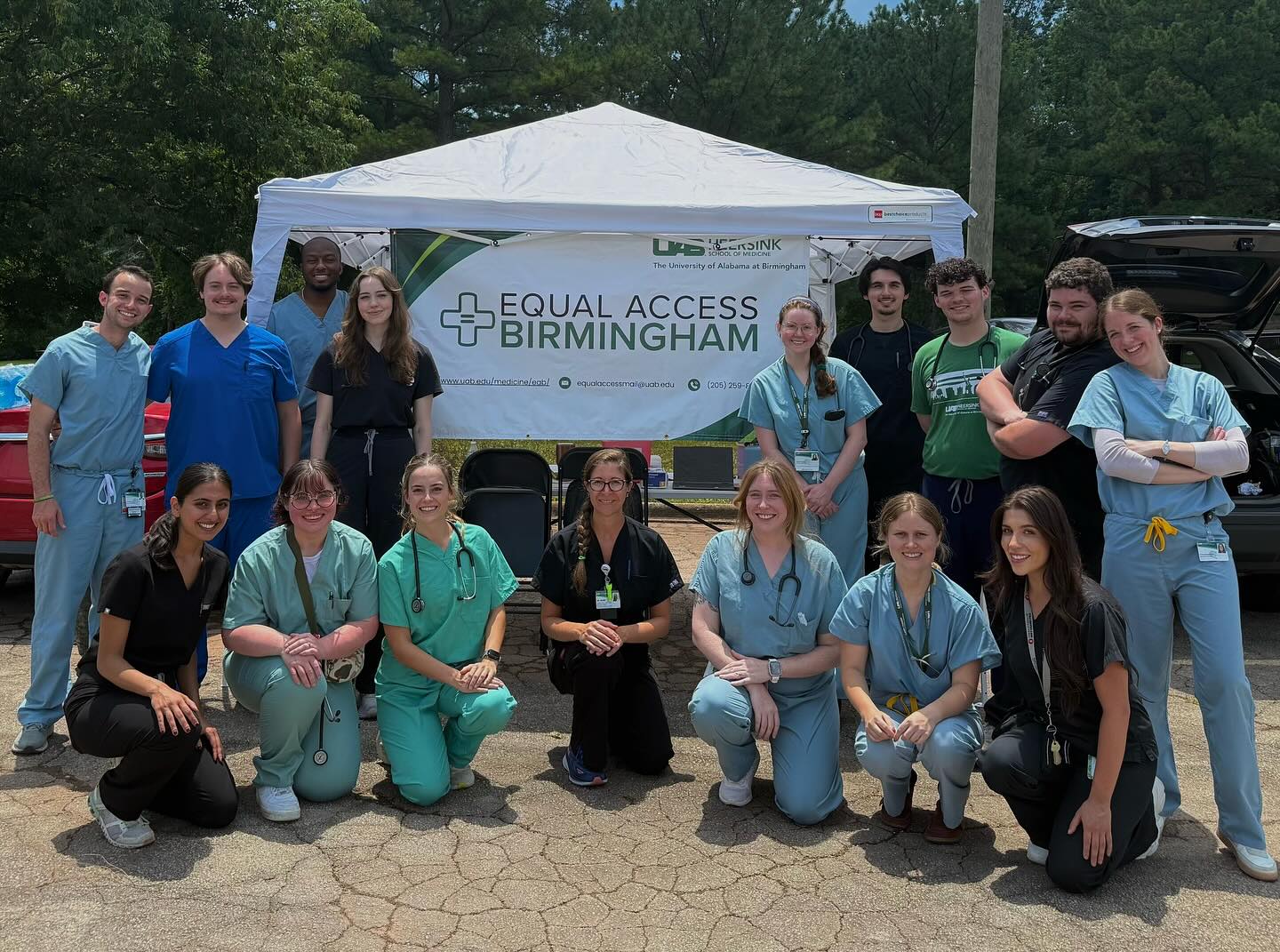 (EAB) operates with a rare combination of academic rigor and real-world responsibility: a clinic run entirely by students who treat every case as both a learning opportunity and a commitment to meaningful impact.
Housed in the UAB Heersink School of Medicine’s Department of Medical Education, this free clinic pairs compassionate care for uninsured and underserved Birmingham neighbors with hands-on training for tomorrow’s physicians.
“We have two missions,” said Jordan Pierce Robinson, who recently completed a year as EAB’s development director. “One is to serve the medically underserved patients of the greater Birmingham area, and our other big mission is medical student development.”
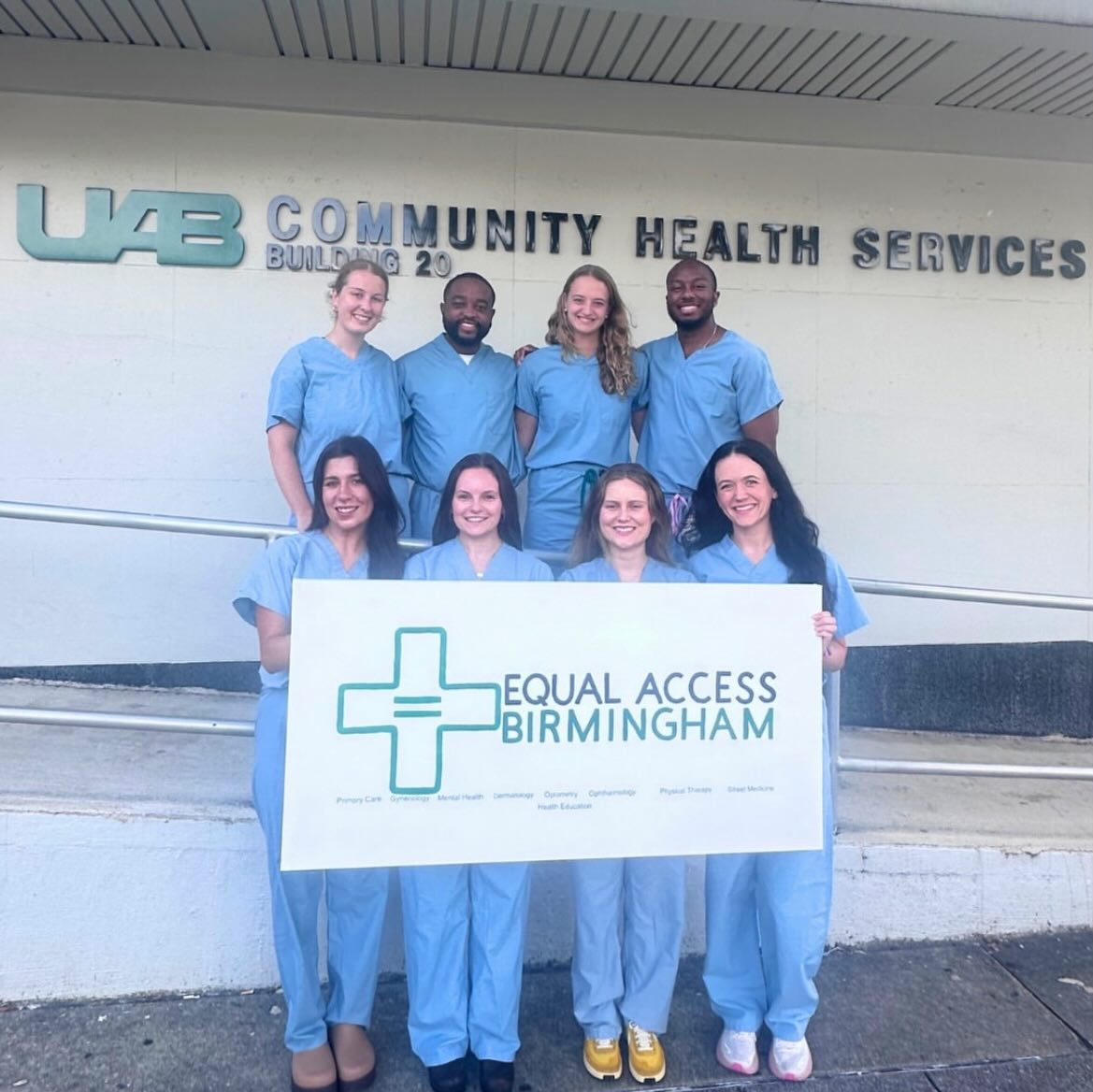
This dual purpose isn’t just theoretical; it’s lived every time the clinic is in session. EAB is comprised of an executive board of six medical students, more than 30 general officers, and a robust volunteer base that included (in 2025) 31 attending physicians, 33 resident physicians, and over 250 student volunteers—all of whom help shape the clinic’s culture of service and learning.
If these numbers sound like a feat of organization, it’s because running EAB truly is one. And the fact that the clinic is student led and run is a testament to just how much commitment it requires to operate.
“It’s been an incredible experience to make me feel like a more well-rounded individual,” Robinson said. “I’ve learned professional development skills, interpersonal skills, and how to talk with different people with various job roles and [within various] organizations.”
A clinic built for access and growth
EAB operates multiple clinics to meet a spectrum of needs—a general medical clinic, a mental health clinic, a reproductive health clinic, a dermatology clinic, and a street medicine clinic that brings direct care to unhoused neighbors across Birmingham. Last year alone, EAB held a total of 144 clinics with over 1,300 appointments.
All medical students are welcome to volunteer, and many sign up for history and physical (H&P) shifts, working patients up, performing physical exams, and presenting to attending physicians who supervise and guide their clinical reasoning. Most clinics have one attending and one resident, with street clinics varying in staff, Robinson notes.
Access to these clinics is deliberately broad. “We are here to help anyone. You can have Medicaid, insurance, or no insurance. We treat everyone the same,” Robinson said. Patients find EAB through referrals from UAB providers, online searches, and a steady cadence of community health screenings at churches, resource fairs, and even local markets.
Communication officers check and return voicemails daily to book appointments. And while EAB provides longitudinal primary care to many, it can also be a crucial bridge when life gets complicated. “If your insurance lapses for a few months, or if you just need a pap smear and haven’t gotten one in a few years,” Robinson said, “the clinic is here to help you.”
 Trust, restored
What does impact for EAB look like on the ground? For Robinson, it often begins with trust. “There’s nothing more satisfying than helping patients trust healthcare again,” she said. Many patients have gone years without seeing a physician. “We can make them feel instantly better just by prescribing a single medication, and we’re able to give out most medications for free.”
These wins ripple outward with better chronic disease control, potentially fewer emergency room visits, and renewed confidence that care is possible. This is especially clear at EAB’s street medicine clinic, which was launched in late spring 2024.
To conduct the street clinics, EAB takes tents, tables, and chairs to two Birmingham locations, George Ward Park and East Lake Market. By the end of 2025, 18 street clinics were completed.
Street medicine allows EAB to engage the social determinants of health in practical ways. “Because we’re working with a limited-resource population, we are able to go outside the scope of just healthcare and really address their social determinants of health. We work with social workers and many different members of the healthcare team,” Robinson said.
The result? Care that meets patients where they are—literally and figuratively.
The power of support
None of this happens without resources. Almost everyone at EAB is a volunteer—students, residents, and attendings alike. The role of director, which is held by Natasha Mehra, M.D., is the sole paid role.
“Dr. Mehra deserves about a million more dollars than she is paid,” Robinson said, laughing, but her point is serious. “Dr. Mehra not only teaches clinical medicine, she also teaches [us] a wide range of skills, including how to maintain a dispensary, how to calibrate the lab machines, and how to lead a team of peers.”
Mehra’s dedication to EAB doesn’t end with instruction, however. “She makes herself available seven days a week, so that students with urgent questions during a Sunday afternoon clinic always have someone to call,” Robinson said.
This year, a grant allowed EAB to run many routine labs in-clinic rather than referring to the Kirklin Clinic at UAB. This upgrade saves time, reduces barriers, and stretches clinic dollars. But grants end. Sustained donor support ensures these capabilities don’t disappear once a grant cycle closes.
“There are a lot of different ways that support translates into care,” Robinson said. With stable funding, EAB can expand preventative care—think colonoscopies and mammograms—so that patients don’t have to choose between screening and other essentials.
Giving to the clinic also supports the practical necessities that keep access open, such as medications, security for each clinic session, essential supplies, and diagnostic capacity.
Better funding can also mean higher-quality diagnostic equipment (like upgraded ultrasound and ECG units), external lab referrals when needed, more physical space for clinics, and potentially even a dedicated social worker to help patients navigate necessities like housing and recovery services.
 The EAB impact
As Robinson transitions off the board after a one-year term, her commitment to the mission is undiminished. “I want EAB to be super successful,” she said. “I’m excited to see it grow.”
The work of EAB is powered by a simple belief: everyone deserves compassionate, high-quality care, no matter their circumstances. Each day, the clinic expands access to essential medications, offers on-site lab services (funded through a grant that will expire), provides screenings, and meets patients where they are through its growing street medicine efforts.
Just as importantly, EAB serves as a living classroom that shapes future physicians who learn to practice with empathy, skill, and respect for every person they encounter. It’s medicine at its most human, carried out by teams of volunteers committed to restoring trust and improving health in the communities they serve.
As Robinson puts it, “[EAB has] definitely been by far the most influential experience I’ve had in medical school, and probably the most influential experience on my journey to become a physician.”
Robinson’s exuberance reflects what so many students discover at EAB—a warm, collaborative environment that supports their growth as clinicians while allowing them to provide meaningful support to patients.
Give now to the Equal Access Birmingham Giving Days project. Learn more about UAB Giving Days and all of the 2026 projects.