
A family’s journey with the Golden Week Program for extremely preterm infants
On December 1, 2025, my wife, Taylor, and I left our home in Oneonta, Alabama, for a routine appointment with Maternal Fetal Medicine at UAB St. Vincent’s. We were nervous, but excited. Taylor was six months pregnant with our twin boys, James and Tex, and this was our first anatomy scan. We picked up breakfast on the way out of town and headed for Birmingham. We didn’t know then that we would not return for four and a half months.
It had been a mostly unremarkable pregnancy up to that point. Every medical appointment went smoothly, James and Tex were healthy and growing, and we couldn’t wait to meet them. We were called back for our appointment, and the doctor started the examination. After a few minutes, the energy in the room changed. It became clear something wasn’t right. She then told us that Taylor was dilated two centimeters.
We were admitted to the hospital immediately, but after only a few hours we were transferred to UAB Women and Infants Center by ambulance. UAB’s Regional Newborn Intensive Care Unit (RNICU)—the only Level IV RNICU in Alabama—is better equipped to care for very premature babies. Once there, it was less than 24 hours before the boys would make their grand entrance via emergency C-section on the morning of December 2. James weighed 1 pound, 2 ounces, and Tex weighed 1 pound, 3 ounces.

A Fragile Beginning
“The most important thing is to help the babies breathe,” said Colm Travers, M.D., associate professor in the UAB Department of Pediatrics and director of the Golden Week Program. “Usually, when a baby is born early, they may not be breathing, or they may not be breathing well. Sometimes that means having to put a breathing tube in and giving them surfactant, which helps the lungs to relax.”
Travers started UAB’s Golden Week Program in 2015, alongside his mentor, C. Vivek Lal, M.D., professor in the Department of Pediatrics and co-director of the program. It was designed by the multidisciplinary team at UAB’s RNICU to offer special care for babies born at 27 weeks’ gestation or earlier during their first week. While these babies only account for 1% of births, they make up 30-50% of infant deaths. The goal was to develop a standardized system to eliminate unnecessary variability. Being born at 23 weeks, James and Tex were prime candidates for the program. As an attending physician in the RNICU, Travers would be the boys’ primary neonatologist for their first month.
Right after the twins were born, I was quickly ushered away from the delivery room as a group of doctors worked to establish airways. Once the boys were stabilized, they were placed in incubators and wheeled into the RNICU, where they would receive round-the-clock care from a specialized team of nurses.
Golden Week nurses are specially selected and trained to care for extremely premature infants during their first week of life. Not only do the nurses have a passion for caring for these extremely small babies, but they also carry the fundamental conviction that these babies can survive. “Golden Week nurses are not just caring for the baby,” said Lal. “They are protecting the baby’s brain, lungs, temperature, lines, skin, and hemodynamics minute by minute.”
Whereas most babies in the RNICU receive care every three hours, Golden Weekers are more delicate. To assist with development and minimize the risk of infection, the nurses perform their care at six-hour intervals. The reason for this, according to Lal, is stability and brain protection. “Extremely premature infants are very fragile,” he said. “Rapid changes in blood pressure, venous pressure, carbon dioxide, oxygenation, pain, stimulation, head position, or handling can contribute to swings in cerebral blood flow.” Spacing out necessary care helps to prevent such changes from happening.
“Golden Week nurses are not just caring for the baby, they are protecting the baby’s brain, lungs, temperature, lines, skin, and hemodynamics minute by minute.”
C. Vivek Lal, M.D.
The First Week
While Taylor was recovering from delivery, we regularly called down to the RNICU to check in, always timing it to coincide with their care times so we could get the most information. The nurses reassured us that no news was good news and that they would call if there was anything we needed to know. For the most part, that is a comforting thing to hear. The downside is, when they do call, your mind starts preparing for the worst.
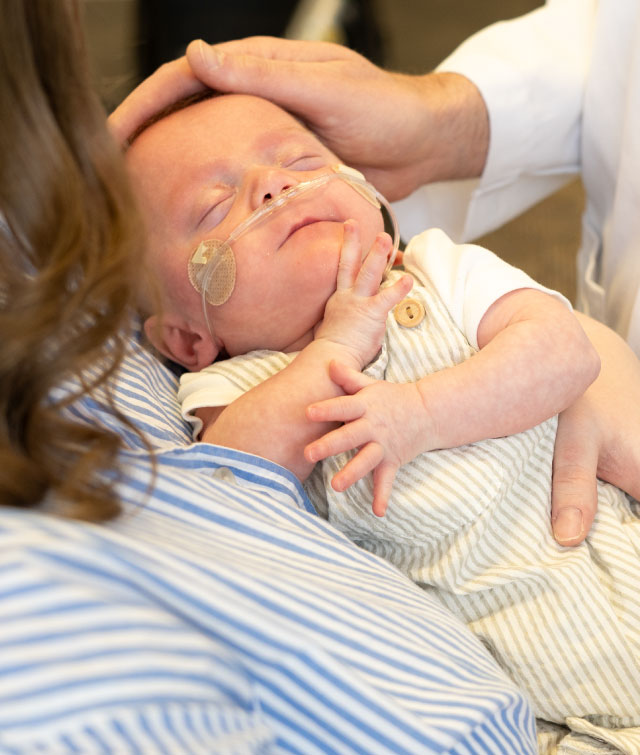
My phone rang in the early hours of December 4. A nurse gently told us that Tex was suddenly not doing well and we should come downstairs. When we arrived, the room was filled with doctors and nurses running back and forth, doing all that they could to help our son. They explained that Tex was no longer tolerating his ventilator but they were trying some potential solutions. We were taken to a family waiting room while they worked through the process. We sat there for what felt like ages, praying fervently for our son.
Eventually, a nurse came to bring us back to the boys’ room. When we entered, Travers told us that Tex had become very sick and nothing they tried was working. Any other methods they could try would not likely sustain him for long and would be too much for his tiny body. We made the decision to remove him from the ventilator, and the medical teams left the room so we could say goodbye. Tex passed away soon after, on his second day of life.
Unfortunately, our story is not unique. Twins are more likely to be born pre-term and tend to have more difficulties as preemies. According to Travers, a variety of factors are at play. “They tend to have worse lung disease. Sometimes they can share blood flow or fluid between them in the womb, and that can cause complications. But for whatever reason, preterm twins, and triplets, and quadruplets tend to have worse outcomes.” Additionally, male lungs develop more slowly in the womb than female lungs. All of these factors meant the cards were stacked against Tex and James from the start.
As a parent, losing a child is your worst nightmare. On top of our grief, we were met with even more fear and uncertainty, as James was still fighting for his life. The days started to feel endless as we sat next to his incubator, hoping and praying he wouldn’t get sick as his brother had. Due to their weakened immune system, pre-term babies typically have a 50% chance of getting an infection. Thankfully, the Golden Week team kept a close eye on him, as they do with every baby under their care. While James eventually developed an infection, he was well past his Golden Week and it was caught very early. With 10 days of antibiotics, he improved markedly.
The remainder of that first week was still scary, but fortunately less eventful. Eventually, James was moved to a private room and graduated from the Golden Week Program. He slowly began to hit encouraging milestones, such as gaining weight and coming off the ventilator.
However, James still had a long road ahead, with many hurdles to overcome. He spent the next few months getting regular visits from neurology, cardiology, ophthalmology, and other specialists, who will continue to follow up with him for at least the next few years to ensure he’s developing properly.
Homeward Bound
A little over two months after his birth, James was stable enough to leave the RNICU for the Continuing Care Nursery (CCN) to focus on feeding and growing. He was in CCN for another two months before finally coming home with us in April 2026.
Most parents of a 23-weeker can expect to be in the hospital at least until the baby’s due date, according to Travers. James was in the hospital for four and a half months, falling on the shorter end of the projected four to six months for a baby in his situation.
When asked what steps parents can take during their child’s stay in the RNICU, Travers emphasized the importance of being informed and present. “Don’t be afraid to ask questions. It's your baby, so you should know everything that we know.” He also stressed the value of breastfeeding. “Breast milk makes such a big difference to the long-term chance of survival and improves their chances of being healthy when they're older. It's such a hard thing to ask, and to imagine doing that when you're going through that as a parent. But that can be a life-saving decision that parents make.”
When the Golden Week Program started a decade ago, UAB saw a combined rate of death or severe intracranial hemorrhage in the first week for extremely premature infants of 27.4%. After implementation, that number fell to 15% and has continued to decline. While poor outcomes still occur, those losses are widely studied in hopes of preventing them in the future. While I’d do anything to have Tex back, it gives me comfort to know that his case might help the Golden Weekers that come after him. Even after just two days with us, his life will have an impact for years to come.
“These babies can survive and thrive,” said Travers. “The bigger risk would be assuming that they won't do well and not giving them every chance. It’s very important to provide them the best possible care, and high reliability and standardization can improve their outcomes. Thankfully, most of these babies will go on to live healthy lives in the future.”
After spending the majority of his early life in a hospital, James is learning what it’s like to live at home. Gone are the days of a full medical team—now he has his mom and dad tending to his every need. As of the time of writing, James weighs roughly 11 pounds, nearly 11 times his birthweight. He’s hitting all the major milestones for his corrected age, such as smiling socially, learning to roll, and engaging with toys.
While Taylor and I adjust to the life we spent months wishing for, we feel immense gratitude for Travers and Lal and the work of the Golden Week Program, as well as for the entire Golden Week team of doctors, nurses, respiratory therapists, and other care providers. Because of them, James is one of the many success stories to emerge from the RNICU. Now he can continue to grow from the comfort of our home, with his and his brother’s first ultrasound framed proudly in the living room.
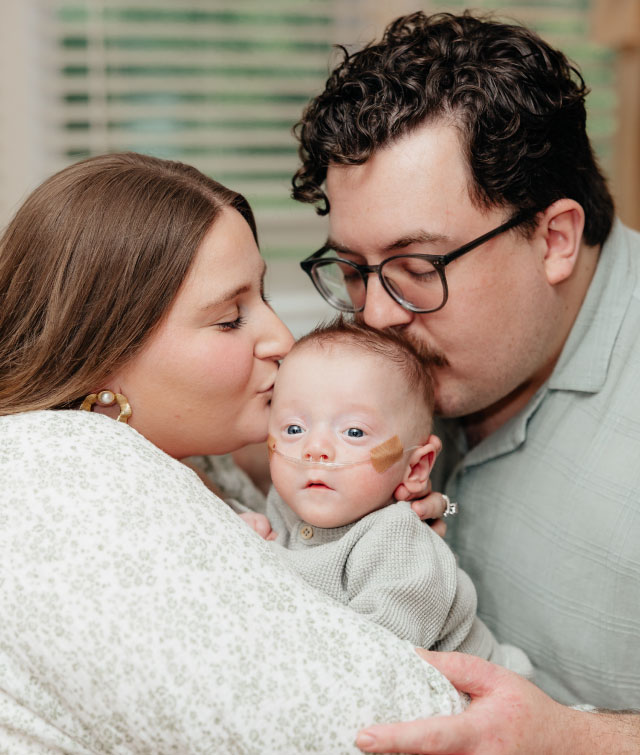
Family photo courtesy of Paden Allen.
Read more stories from UAB Medicine Magazine.