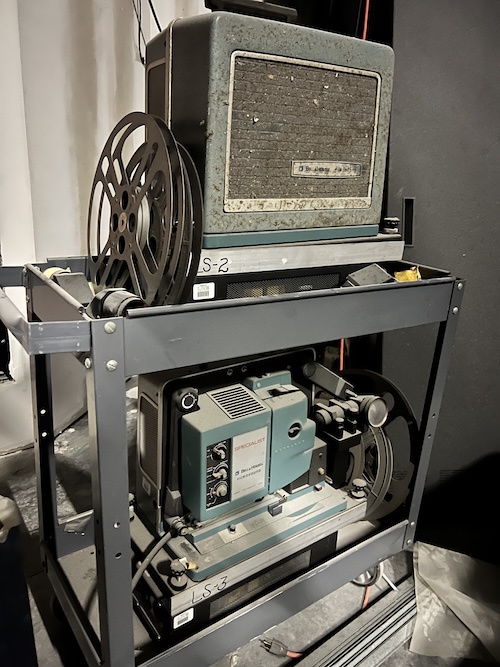
 A vintage reel projector used in Volker Hall in the 1970s.With the reopening of the Volker Hall Lecture Tower, academic activities have resumed in the space. Each of the lecture rooms has been updated with new projectors, computers, and WiFi technology. In appreciation of the many technological advances that have made our lives easier or better over the years, today we will take a look back at classroom innovations that paved the way to where we are now.
Presenting Lectures
In addition to our active learning methodologies, medical education still relies on a variety of activities that involve elements of a classic lecture: a speaker behind a lectern presenting projected material to an audience. Today’s speakers are able to present and control their slides as they walk around the room, and can even project their own notes onto a dedicated presenter’s monitor. As this has been common practice in recent years, it’s easy to forget how much of a leap this is for presentations.
Above each of the lecture rooms is a large control area that was once necessary for the act of giving a lecture. In the 1970s-80s, a school of medicine employee by the name of Bill Davis worked in this behind-the-scenes space to make sure lectures occurred. His “job description” is difficult to pinpoint, as he did a little of everything, including making and soldering audio cables from scratch. In the area above the lecture rooms, Davis controlled the reel-to-reel projectors for each of the lecture rooms. Where the white projector screens now hang at the front of the lecture rooms, glass screens were once the primary method of viewing projected lecture slides. A careful layout of projectors and mirrors allowed for the image to be cast onto the glass screens for student viewing during lectures.
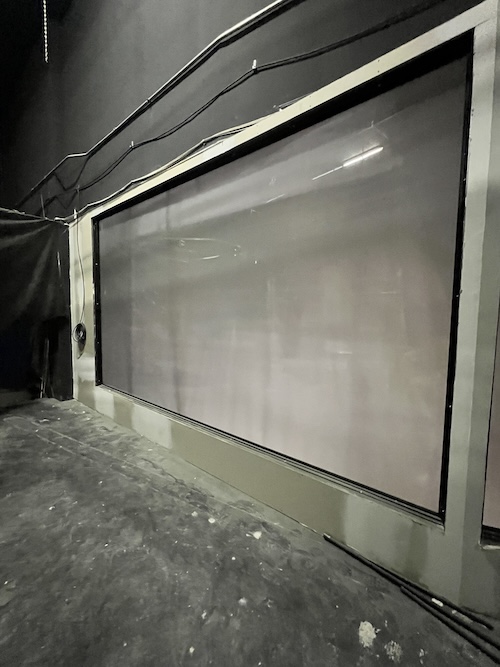 A vintage glass screen used to display projector slides.Years later, the school updated from reel-to-reel projectors to slide projectors. A person was still needed to run the projectors for every lecture. In this era, a wired phone ran from the area outside the lecture rooms to the space upstairs, allowing educators to communicate with the projector technician if there were changes to the slide presentation. What is now a few keystrokes required significant forethought and collaboration between multiple people in separate spaces.
Recording Lectures
The idea of recording a lecture or presentation feels trivial in 2026. The amount of video that is uploaded by educators and consumed by students each semester is staggering. Before a video recording option existed, recordings took place on cassette tapes. Instead of distributing cassettes widely to the student body, though, lectures were disseminated on paper. A UAB employee was tasked with transcribing entire lectures, after which they were printed in the Learning Resources Center. If you ever wondered what the now defunct mail slots on Volker Hall 4 and 5 were for, students could purchase a subscription to have the printed transcripts dropped there.
This process persisted until 2011 when the school began burning lectures onto CDs. The recording could be started automatically by the instructor beginning their presentation. Students could then stop by MEIS with flash drives to have the recorded lecture transferred to them, allowing them to listen back to lectures on their own devices, in their own time. Lecture transcriptions were still an option for students at this time, but these were created by a student on the Student Senate. Quite a complicated process compared to today’s recordings, that are automatically created and made available to students online, and today’s transcripts that are created in an instant by artificial intelligence.
From analog to digital
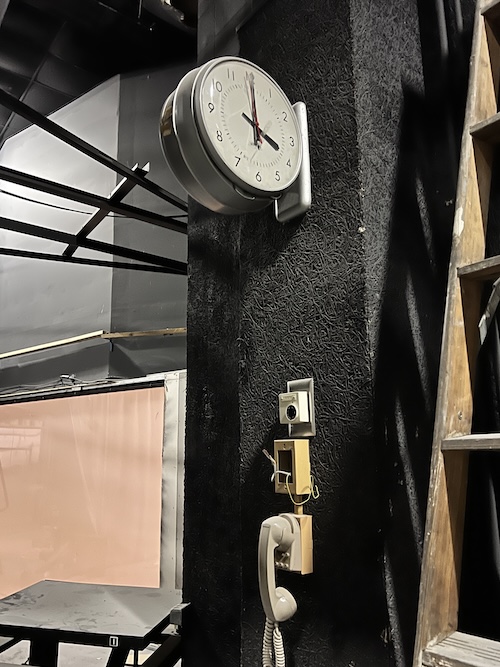 A clock fixed above a wired telephone used by projector technicians.One of the common threads in the advancement of technology in the Volker Hall Lecture Tower is a move from analog to digital. In addition to the evolution of PowerPoint slides and lecture recordings, general elements surrounding lectures also saw these advancements. If an instructor needs to show a supplemental video during a presentation today, they can either embed it directly into their slides or navigate to YouTube, almost without thinking twice about it. When Adam Agee, director of Information Technology for the Heersink School of Medicine, began working in the school, one of his tasks was to load a T.V. and VCR onto a cart to roll into a lecture room when an instructor wanted to show a surgery demonstration video.
Prior to displaying lecture room bookings on digital displays, these records had to be printed on paper and hung outside each room. In order to provide a preview of a week’s programming in the lecture rooms, a 50 page-document was printed each week. Agee recalls pinning all 50 pages on a bulletin board, and if there were cancellations or room changes, those specific pages had to be reprinted and replaced on the bulletin board by hand. The schedules are now managed on live webpages that allow changes to be entered and displayed within seconds.
Just as in biomedical science, there has been tremendous progress in the technology of medical education. Today’s medical educators and students may have forgotten the complex and time-consuming practices of yesterday, but the practices that seem simple and logical today will certainly be improved in the years to come. In twenty years, learners and teachers will no doubt laugh at the thought of today’s PowerPoint lectures and digital recordings.