A new study published in the Journal of Experimental Medicine proposes a new conceptual framework relating the magnitude of the CD4+ T cell response to the divergence of T follicular helper (Tfh) cells and non-Tfh cells and reveals that the transcription factor BACH2 has bidirectional effects on CD4+ T cell differentiation based on antigen dose, immunization method, and location of the immune response.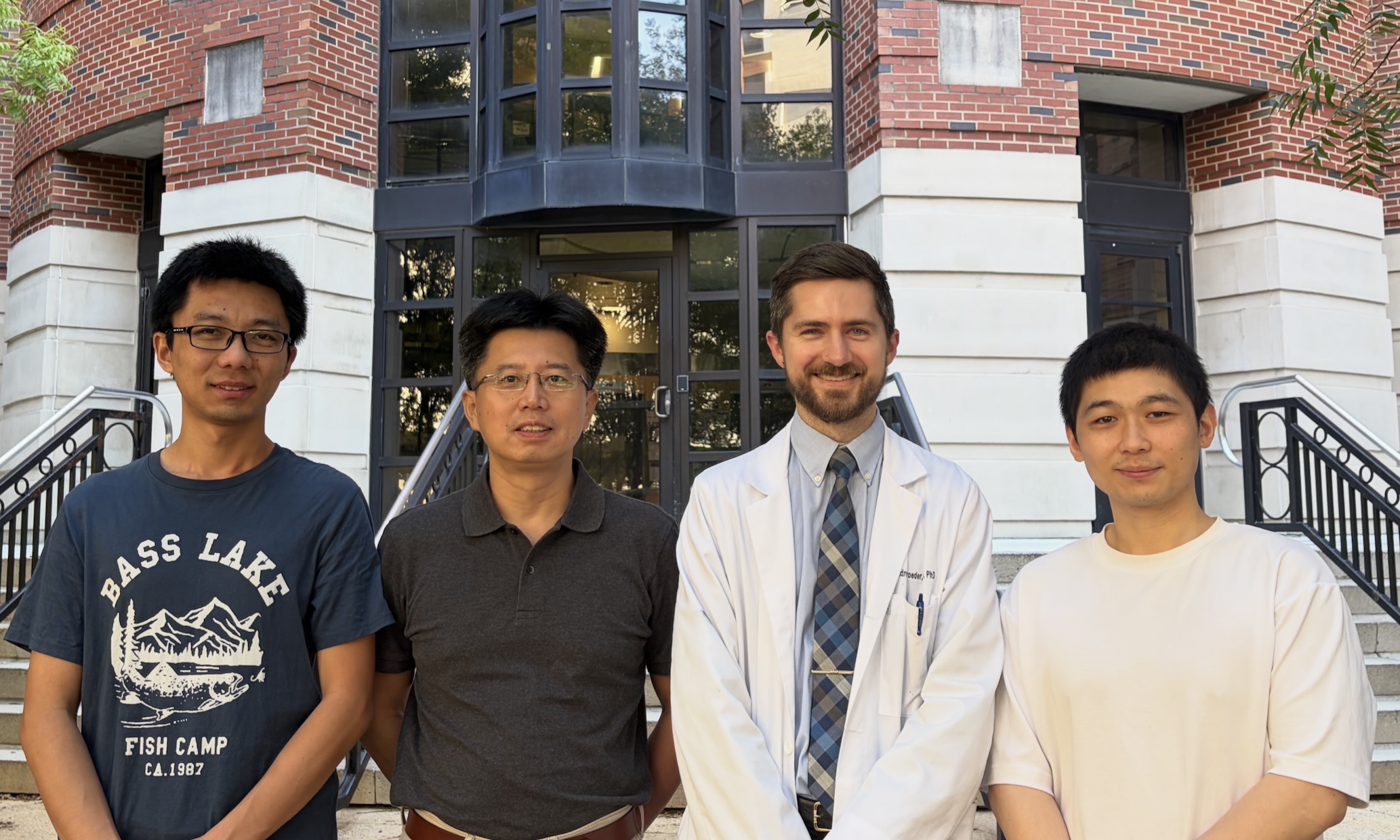 Fangming Zhu, M.S., Hui Hu, Ph.D., Andrew Schroeder, M.D., Ph.D., Xianyou Xia, M.S.
The immune system essentially has two ways to fight threats: making antibodies that circulate through the body and help neutralize infections (humoral response) or sending specialized immune cells to attack the infected or abnormal cells (cellular response), but how the immune system decides between these two strategies has not been elucidated. “The balance between humoral versus cellular response has always been one of the most fundamental questions in the immunology field,” said Hui Hu, Ph.D., professor in the Department of Microbiology, senior scientist in the UAB Immunology Institute and O'Neal Comprehensive Cancer Center, and corresponding author of the study.
In the study, titled “Bidirectional regulation by BACH2 coordinates systemic CXCR5– vs. CXCR5+ CD4+ T cell differentiation,” researchers, including Hu, Andrew Schroeder, M.D., Ph.D., Fangming Zhu, M.S., and Xianyou Xia, M.S., were studying a type of immune cell called CD4+ helper T cell. Hu explained that these cells start out undetermined but later become either Tfh cells, which express CXCR5 and help B cells produce antibodies for the humoral response, or non-Tfh cells, which do not express CXCR5 and facilitate cellular immune attacks.
Foundational research in CD4+ T cells detailed how the IL-2/CD25/STAT5 signaling pathway is critical for the survival and expansion of newly activated CD4+ T cells. However, several studies in the early 2010s argued that STAT5 inhibited the development of the Tfh subset of CD4+ T cells. The paradox of how IL-2/CD25/STAT5 signaling could be critical for the expansion of CD4+ T cells (including Tfh) yet also inhibit Tfh cell differentiation has puzzled immunologists for years, reports Hu. Another remaining question is how recently activated CD4+ T cells decide to express CXCR5 and become Tfh or choose not to express CXCR5 and become non-Tfh. Schroeder et al. sought to address these questions, but an unexpected discovery led them to uncover how the immune system balances its responses throughout the body.
Findings
Previous research from the lab showed that removing the BACH2 protein caused an increase in Tfh cells. Schroeder conducted a similar experiment, this time performing an immunization through the nose rather than the abdomen. Surprisingly, in this setting he found that removing the BACH2 protein led to a decrease in Tfh cells—a result that seemed to contradict to the earlier studies. Thinking this may have been a fluke, Schroeder quickly repeated the experiment, but the results were the same.
"Immediately we knew we found something important, because based on the existing knowledge, we had no idea how this could be happening," Schroeder said. In addition to solving this mystery, the researchers later gained insights which allowed them to address several central questions in the field.
Coordinated immune response
In addition to differences between immunization routes, the research team found that BACH2 coordinates immune responses across the body. Near an infection, in the draining lymph node, BACH2 encourages a strong Tfh response, while in non-draining lymph nodes in the rest of the body, BACH2 suppresses unnecessary Tfh responses. This increases the immune system’s effectiveness without wasting energy or causing damage elsewhere. These differences were also observed when using high versus low doses of antigen.
“These findings help us understand how the immune system will respond across the body and they show us that Bach2 integrates various signaling pathways of the response to balance the humoral and cellular arms” notes Fangming Zhu, a co-author on the study.
“We were surprised and amazed that millions of years of evolution has managed to pull off such an elegant mechanism to regulate and balance the humoral and cellular arms of the immune response at a systemic level,” Hu said.
Mechanistically, BACH2 suppressed CXCR5 directly in weak responses, thereby repressing Tfh. However, in strong immune responses, BACH2 helped Tfh cells develop by preventing another molecule called Blimp-1 from shutting them down. As Blimp-1 is activated by the IL-2/CD25/STAT5 signaling, these findings resolve the paradox of how recently activated CD4+ T cells can receive the benefits of IL-2/CD25/STAT5 signaling without being suppressed for subsequent Tfh differentiation.
To put it in a simple way, “the IL-2/CD25/STAT5 signaling is being ‘filtered’, transiently by Bach2,” Hu said.
Moreover, as BACH2 is directly inhibiting a target while simultaneously indirectly promoting that target (by inhibiting Blimp-1, another inhibitor of that same target), these findings also define a novel type 2 incoherent feed forward loop which fine-tunes CXCR5– versus CXCR5+ divergence in the early stage of the CD4+ T cell response.
Future implications
Beyond improving scientific understanding of the immune system, these findings could help inform the development of more effective vaccines.
"We want to understand the networks behind it so that later on, for any kind of new vaccine, we will be able to predict, or even better, we can design it in that way,” Hu said.
These new findings may also explain the medical puzzle of an autoimmune disease called BACH2-Related Autoimmunity and ImmunoDeficiency (BRIDA), in which patients have reduced levels of BACH2 protein. These patients often struggle to fight infections and respond poorly to vaccines, yet their immune system attacks healthy cells. At first glance, this seems contradictory because they appear to have both an underactive and overactive immune system. However, if BACH2 normally promotes helpful immune responses while simultaneously suppressing inappropriate ones, losing BACH2 could cause both problems at once.
In immune responses, the activation of naïve CD4+ T cells with T cell receptor signaling and co-stimulation represents step 1. The researchers detail that the bidirectional mechanism described in this study represents a critical step 2, guiding the activated CD4+ T cells to choose between CXCR5– and CXCR5+ fates as they expand, thus influencing the strategy the immune system will choose to fight the infection. As researchers continue investigating BACH2 and other factors that shape immune responses, they hope their findings will help inform the development of more effective vaccines and treatments for immune-related diseases. Hu believes the study offers insight into one of the immune system's most basic functions: deciding how and where to respond.
“We believe we’ve revealed a very fundamental principle,” Hu said.