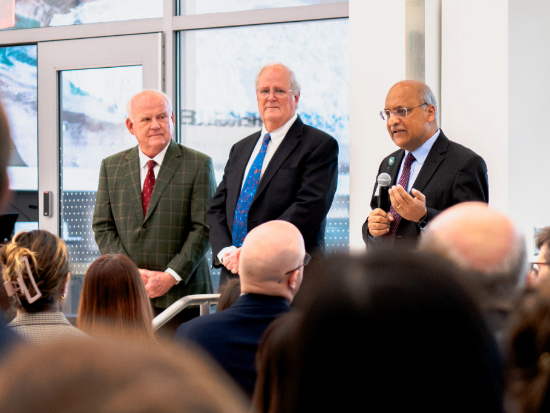
 David Standaert, M.D., Ph.D., professor and chair, John N. Whitaker Endowed Chair in the UAB Department of Neurology, delivered a special grand rounds and state of the department presentation titled “UAB Department of Neurology: Past, Present and Future” on Jan. 27, 2026. The grand rounds presentation was followed by a reception honoring the department’s 50th anniversary at UAB, with remarks delivered by UAB President Ray L. Watts and Anupam Agarwal, M.D., senior vice president and dean of the Heersink School of Medicine. See more photos from the grand rounds and reception.
At the reception, Watts, who was recruited to UAB in 2003 to serve as chair of the Department of Neurology, reflected on the department’s five decades of excellence to a crowd made up of department members past and present, Heersink School of Medicine and UAB Health System leaders, and beyond.
“It was a pleasure to serve as chair of this department and, now as UAB president, to see the continued exponential growth of the clinical, research, and educational programs,” Watts said. “With this talented faculty and the leadership of Dr. Standaert, we have one of the finest departments of neurology nationally and globally that continues impacting lives across our state, nation, and indeed the world.”
Agarwal commented on the leadership of the Department of Neurology, past and present.
“Thanks to leaders like Dr. Watts, Dr. Standaert, and those who came before them, including Dr. James Halsey and Dr. John Whitaker, the legacy we honor today is a rich and storied one,” Agarwal said.
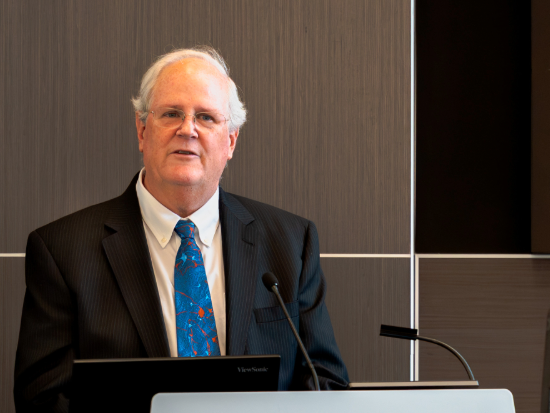 Recap: ‘UAB Department of Neurology: Past, Present and Future’
Standaert, who is the fourth chair of the department, having joined in 2010, covered several aspects of the department’s clinical, educational, and research-driven missions while highlighting the department’s recent growth and continued expansion.
“We’ve had four chairs in 50 years, and actually all of the living chairs of the UAB Department of Neurology are here with you in this room this morning, which is kind of an interesting moment,” Standaert said.
He touched on the history of the department, which was originally a division of the Department of Medicine, starting with four faculty members, while showing archival photos, including a faculty photo from 1997.
“Ten of the 32 people in the photo are still connected to the department 30 years later, which shows you the kind of department that we have,” Standaert said.
Standaert shared a slide of his first strategic plan as chair in 2011. At the time, the department had 190 full-time employees, 43 faculty members, 29 residents, 23,802 outpatient visits, and 2,000 inpatient discharges.
 Today, the Department of Neurology has 96 full-time faculty, 34 advanced practice providers, 39 residents, and 36 contract and tele-med providers, for a total of just over 200 providers. In addition, clinical highlights include the department’s high clinical volume and wide regional impact, with nearly 65,000 ambulatory visits per year, 2,700 inpatient admissions per year, more than 500 inpatient consults per month, and tele-neurology coverage across 35 hospitals statewide.
“Our mission is really to provide state-of-the-art care for neurologic disorders, train the next generation of neurologists and neuroscientists, and accelerate progress toward the therapies of the future,” Standaert said.
Standaert also described how the department supports multiple nationally recognized subspecialty programs, including stroke, epilepsy, movement disorders, neuro-oncology, neuroimmunology, neuromuscular disorders, cognitive neurology, and comprehensive neurology, with a number of specialty accreditations such as being an ALS Center of Excellence, HD Center of Excellence, Level 4 Epilepsy Center, Comprehensive Stroke Center, and more.
Clinics like the new UAB Brain Aging and Memory Hub are leading the way in the treatment of Alzheimer’s disease, as UAB is a top national site for anti-amyloid therapies delivering thousands of infusion treatments annually. In addition, telestroke and tele-neurology have recently surpassed 10,000 total consults in an effort to improve care across Alabama.
In research, the UAB Department of Neurology has experienced rapid growth in funding and research productivity in its 50 years as a department, with NIH funding now totaling nearly $20 million.
Standaert highlighted strong research programs like the Killion Center for Neurodegeneration and Experimental Therapeutics, which was established in 2007 to pursue translational research in neurodegenerative disease. Moreover, centers such as the Alzheimer’s Disease Research Center and Evelyn F. McKnight Brain Institute are conducting regional and population-focused research, leading studies on aging, cognition, and Deep South health disparities.
In the clinical trial space, the department’s active clinical trials currently exceed 100 and include major initiatives in Alzheimer’s disease, pharmacogenomics, gene therapy, neuroimmunology, and neuromuscular disease.
The UAB Department of Neurology also boasts a robust educational component, with a growing neurology residency program and multiple accredited fellowships across its subspecialties. The resident complement increased from 6 per year to 10 per year from 2011 to 2025, with a current 91.9 percent board pass rate and consistently above-average RITE scores among residents.
The department is also building a pipeline for future neurologists by strengthening exposure for medical students, now drawing 10 to 12 students per class into neurology, which is well above the national average of 2.6 percent.
Looking ahead, Standaert alluded to the rising burdens of neurological disease and how UAB Neurology will play a critical role in addressing them, with strategies like continuing to train neurologists, growing partnerships with APPs to increase capacity, the expansion of telemedicine, and more.
“In the end, it’s a new day in neurology,” Standaert said. “It’s a fantastic and exciting time for this field.”
View the full recording of “UAB Department of Neurology: Past, Present and Future.”