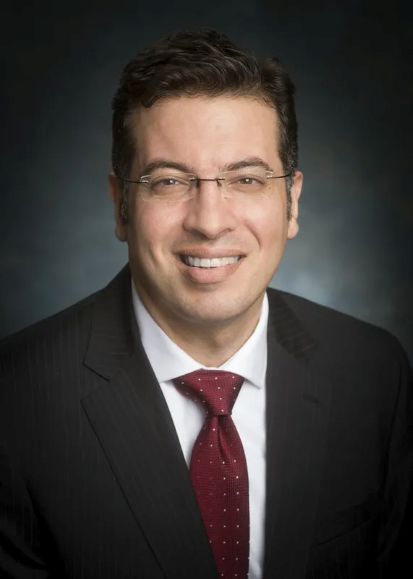
 Mohamed Kazamel. M.D.With a career distinguished by expertise in neuromuscular and autonomic disorders, the development of innovative clinical programs, and a commitment to advancing patient care and research, Mohamed Kazamel, M.D., credits UAB Neurology with providing the foundation for his professional growth. After matching into the residency program in 2008 and beginning his training in 2009, Kazamel found that UAB provided the combination of rigorous education, supportive mentorship, and collegial culture he was seeking. What began as residency training evolved into a long-term relationship with the institution, ultimately bringing him back to Birmingham as a faculty member in 2015.
“UAB Neurology was on top of my rank list,” Kazamel said of his time applying for residency. “I was impressed during the interview with how friendly the residents were and how thorough the program leadership was. It was the only program that interviewed applicants over two days, giving us all the opportunities to ask questions, tour everywhere in the hospital, and even take a tour of the city.”
Following residency, Kazamel completed a fellowship in Neuromuscular Medicine at Mayo Clinic in Rochester, Minnesota, before returning to UAB, where he spent a decade helping expand specialized neurological care. During his time on faculty, he founded and directed the UAB Comprehensive Autonomic Testing Laboratory and co-directed the multidisciplinary ALS Clinic, while further refining the electromyography and autonomic testing skills he first developed during training. Today, he serves as Senior Associate Consultant in Neurology at Mayo Clinic in Phoenix, Arizona, caring for patients with neuromuscular and autonomic disorders and contributing to research in those fields.
Learn more about the experiences, mentors, and opportunities that shaped Kazamel’s career, the lasting impact of his years at UAB, and the lessons he has carried with him throughout his journey.
What initially drew you to UAB for your training?
Kazamel: I think that I got exposed to quite a diverse experience during my training at UAB. This was the result of different factors including the large and growing number of attendings with different subspecialty areas, the large catchment area of the hospital with patients coming not only from Alabama, but also from neighboring states, and in addition to that, the huge hospital size with its state-of-the-art facilities. It was a testimony of my attachment to UAB and Birmingham when I decided to come back as an attending in 2015.
How would you describe the culture of the UAB Department of Neurology during your time there, and what made it unique compared to other institutions?
Kazamel: Inclusive— I always enjoyed the spirit of camaraderie within each and every team I was a part of, never felt excluded either from important decision-making or a fun event. The residents had each other's backs all the time. To keep this spirit alive despite a busy service and, more than that, to feel that you are actually having fun learning and training—these are things that you would not be able to find in many other institutions.
Can you share a favorite memory or defining moment from your time at UAB Neurology that still stands out to you today?
Kazamel: I was a PGY2 early during a night call, and we were during Ramadan. I was fasting all day and a Code Stroke got activated exactly at the time I was supposed to break my fast and eat. My upper-level, Dr. Ashley Thomas, realized that and, without me even asking, she told me to go find something to eat, and she came to handle the code. I do not think I will ever forget that.
What lessons or skills gained at UAB have proven most valuable in your career since leaving the department?
Kazamel: The UAB experience taught me that as an academic neurologist, I would have a bigger chance of growing with collaboration rather than competition. Almost every research project I worked on and every article I published involved collaborators from other departments and different levels of training and academic career. I could not develop the courage of initiative without working in an environment like UAB where everyone is approachable and willing to help, especially when it comes to mentorship during residency or early career. I was fortunate to have a mentor like Dr. Peter King, who I worked with since PGY2. This work has resulted in several published papers and continuing research collaboration until this moment.
Looking back, what do you think UAB Neurology did especially well in training neurologists and advancing the field?
Kazamel: I would think that the combination of stable program leadership over the years, updated facilities, availability of expertise in every neurology subspecialty, and the large patient population catchment area has all contributed to the secret recipe of success in training the best future neurologists that our aging population in the US currently needs.
Anything else you would like to add?
Kazamel: I am forever proud to have trained and worked at UAB. The institution gave me everything to grow up as an academic neurologist. Although I came to UAB after already training in neurology in my home country, Egypt, I do not think there was a day during my UAB training when I did not learn something new. The professional and clinical expertise I gained here, the friendships, and the memories I keep have always been invaluable to me and forever will be cherished.