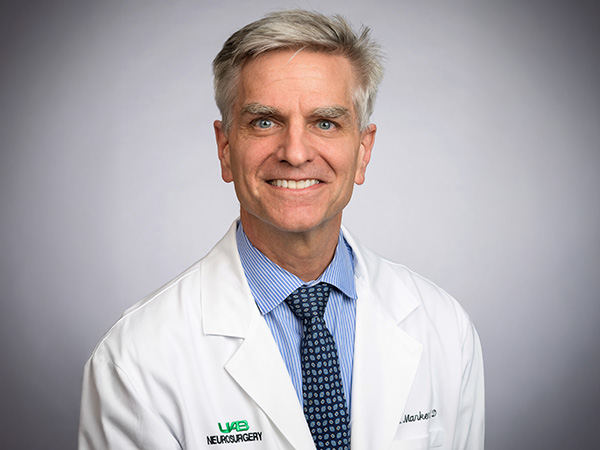
 James Markert, M.D., MPH, James Garber Galbraith Endowed Chair of Neurosurgery at the University of Alabama at Birmingham Department of Neurosurgery, highlighted the growth, innovation and impact of the department at the Society of Neurological Surgeons 2026 Annual Meeting.
During his presentation, Markert reflected on the Department of Neurosurgery’s evolution to one of the nation’s leading academic neurosurgery departments for clinical care, research and education.
Markert began by welcoming conference attendees to Birmingham, highlighting the city’s transformation from an industrial steel center once known as the “Pittsburgh of the South” into a thriving academic medical hub. He also noted Birmingham’s important role in the Civil Rights Movement and the economic impact of UAB, Alabama’s largest academic medical center.
Markert shared the history and rapid growth of the Department of Neurosurgery, founded by pioneering neurosurgeon James Garber Galbraith, M.D., in 1954 as a division within the UAB Department of Surgery. In 2013, the program officially became a department and now includes 39 faculty members and is projected to perform 7,000 surgical cases this year.
Markert noted that those case numbers include more than 1,000 pediatric procedures and more than 1,150 endovascular cases annually, with operations spanning seven clinical sites, including UAB Hospital, Children's of Alabama, UAB Medical West, UAB St. Vincent’s, UAB Callahan Eye, the UAB Neurosurgery Inverness Clinic and the Birmingham VA Medical Center.
Throughout the presentation, Markert emphasized the department’s longstanding national influence within organized neurosurgery, sharing that six Department of Neurosurgery faculty members have served as directors of the American Board of Neurological Surgery.
Markert also highlighted the department’s residency program, which he described as a major strength of UAB Neurosurgery. Built under the leadership of Mark Hadley, M.D., and now led by Curtis Rozzelle, M.D., the program attracts trainees from across the country and continues to produce neurosurgical leaders internationally.
Research innovation served as another major focus of the presentation. Markert highlighted UAB’s more than 40-year legacy in brain tumor research and treatment, including pioneering work in immunotherapy and oncolytic viral therapy. Markert also showcased the department’s broad research portfolio across spine surgery, epilepsy, neuroengineering, neurovascular surgery and global neurosurgery.
Markert concluded by reflecting on the future of the specialty and the transformative role emerging technologies are expected to play in neurosurgery.
“I think with all the new technology, there is just no way to tell exactly where we’re going, except to say there are going to be some very exciting and dramatic changes,” Markert said, quoting Galbraith to conclude the presentation.