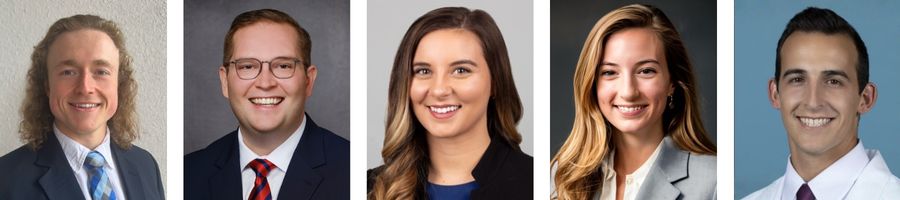
 from left
Cole Garrison, M.D. — University of Alabama at Birmingham
Tanner Nelson, M.D. — University of Utah
Emily Scircle, M.D. — Medical University of South Carolina, Charleston
Elizabeth Van Swol, M.D. — Medical University of South Carolina, Charleston
Tyler Whitaker, M.D. — University of Utah
Choosing UAB
What inspired you to choose UAB Callahan Eye for your residency, and what stood out to you about the program?
Garrison — I think the quality of training you receive at UAB Callahan Eye rivals any program in the country. When rotating here as a medical student, I saw residents who were confident in their abilities and clinical decision making. They routinely managed complex patients in the emergency department, Lion’s clinic, and operating room. Everyone appeared well prepared to become attendings.
Whitaker — It all came down to the quality of the training and the culture at UAB Callahan Eye. Coming from the West Coast, I had never even set foot in the South, so I was surprised to have gotten offered an interview at UAB. When I had the interview, I could immediately feel the genuine connection amongst the residents. I was also impressed with the volume and diversity of the clinical and surgical training here. I immediately realized that this was a special place and I feel so grateful to be here.
Intern Year Experience
How would you describe the structure and goals of the intern year curriculum? What has been most valuable about this foundation so far?
Nelson — The intern year curriculum is designed to give us the medical foundation that will be required to treat our patients as we consider their eye health in the greater context of their overall health. We do this through rotating in fields that have great overlap with ocular disease, including rheumatology, neurology, and more.
Van Swol — Our intern year is comprised of different rotations designed to develop well-rounded physicians. The primary goal is to equip us as ophthalmologists with a broad medical perspective, recognizing that the eye often serves as a critical window into overall health. What has been most valuable to me is the direct relevance of this training to ophthalmology. By learning and practicing general medicine, I have gained a deeper understanding of systemic conditions, like diabetes, HTN, and autoimmune disorders, that frequency manifest in the eye.
Rotations
Which rotations have you completed to date, and which ones stand out as particularly meaningful? Are there any upcoming rotations you’re especially excited about?
Scirce — I have completed neuroradiology, neurology, endocrine consults, and anesthesia. Each specialty has been beneficial to building the foundation to be a well-rounded ophthalmologist. My time on the inpatient stroke service has so far been the most beneficial with reading MRI’s and CT scans, having difficult life changing conversations with families and patients, and improving my ability to localize a stroke.
Nelson — So far, I have completed adult and pediatric emergency medicine as well as endocrinology. It has been meaningful to spend time with sick patients as their physician in the emergency department to listen to their concerns and guide them through the healthcare system. I am excited for my upcoming neuroradiology rotation to better learn how to interpret scans, which will be a crucial skill throughout the remainder of my training.
 Learning & Growth
What has surprised you the most about your training so far, and how has it shaped your perspective as a future ophthalmologist?
Van Swol — I knew I loved ophthalmology, but I didn’t expect residency itself to be this much fun. In medical school, you’re often guarded about what you don’t know to protect your grades. However, in residency, asking questions and admitting gaps is the whole point; it’s how you learn. Every day in residency is honestly just so much fun.
Scirce — I think the vast differences in the rotations that we experience during intern year is what makes residency at UAB special. Since our program is integrated, we have more ophthalmic specific rotations rather than having a typical internal medicine or general surgery intern year. I am actually excited to learn and show up to rotations since the medicine is applicable.
Looking Ahead
As you continue through your integrated year, what are you most looking forward to experiencing or learning? What excites you most about the years ahead in the ophthalmology residency program?
Whitaker — I’m excited for the Emergency Medicine rotations. I enjoy the fast pace and the interesting cases that show up in the emergency departent. I’m also excited to be in the stage of learning things that are directly applicable to what I will be doing in my day-to-day of my future career like surgical training.
Garrison — I’m excited to continue forming relationships with people throughout the hospital. I think it’ll be fun to get consulted later on and see that it’s coming from a resident I worked with during intern year. I’m looking forward to feeling myself becoming more knowledgeable and independent as a clinician. There is a great deal of growth that occurs during the PGY-2 year, and while you have to earn it, I think it will be a rewarding process.