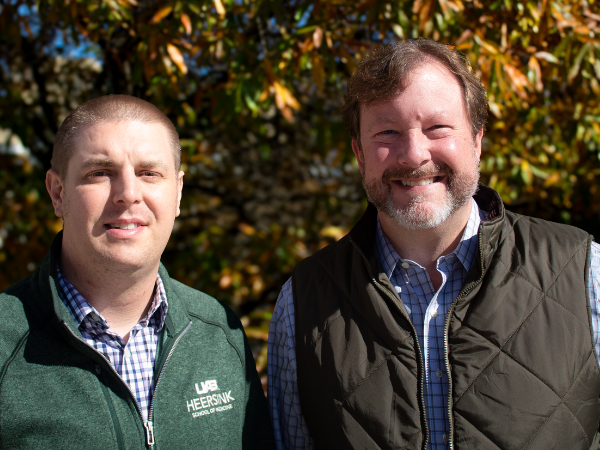
 Marshall Holland, M.D., M.S. and J. Crawford Downs, Ph.D.
At a Starbucks inside UAB Hospital, J. Crawford Downs, Ph.D., Professor of Ophthalmology, Biomedical Engineering and Computer Science at UAB, met with Marshall Holland, M.D., M.S., Assistant Professor of Neurosurgery. Holland led with a vexing question: “Is it possible to wirelessly monitor pressure within the brain in patients before they get to the hospital?” Within two hours, they had devised a new system that combined Downs’s foundational glaucoma research and biomedical engineering expertise with Holland’s neurosurgical knowledge. Weeks later, they filed for a provisional patent and established the new UAB startup company: IntracraniaLink, LLC.
A pioneer in ophthalmic research and innovation, Downs, his collaborators, and the researchers in his laboratory have dedicated more than two decades to exploring the relationship between glaucoma and its principal risk factor, intraocular pressure (IOP). By combining computer simulations with engineering-based experiments, the Downs Lab approaches the eye as a mechanical pressure vessel — work that redefines how researchers understand IOP’s role in glaucoma development and underlies the technology behind IntracraniaLink.
In May 2025, Downs and his team published research examining the role of IOP and cerebrospinal fluid pressure (CSFP) on the optic nerve head (ONH). Using a new viscoelastic model of the ONH microstructure created by the Downs Lab, this study provides deeper insight into what drives glaucoma development and progression.
“With research, it is very difficult to move the needle and make an impact,” Downs said. “My team is changing how clinicians view and think about IOP, glaucoma’s largest risk factor, in managing their patients. It’s a big deal.”
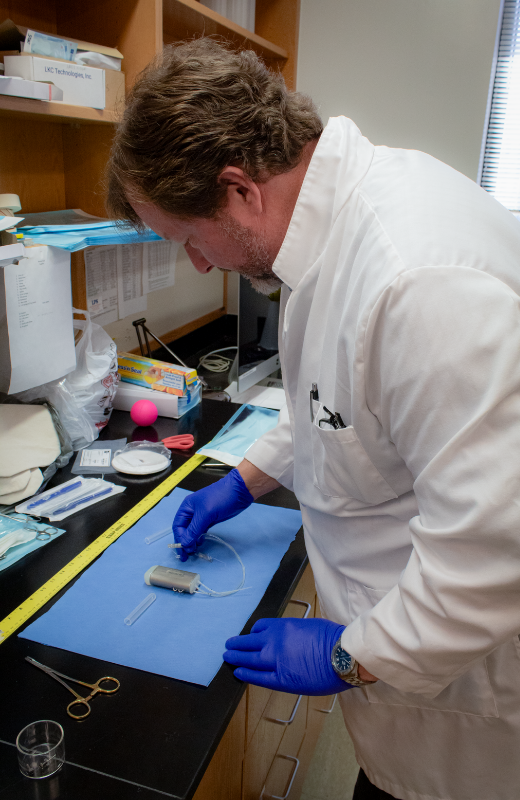 Among his many contributions to glaucoma research include his radiotelemetry system that can wirelessly monitor and record real-time eye and brain pressures. Made possible through an NIH-funded study, the Downs Lab remains the only group in the world with this capability.
Downs’ wireless IOP and CSFP monitoring system forms the foundation for IntracraniaLink’s flagship prototype — a patent-pending system designed to wirelessly provide early, accurate, and actionable intracranial pressure readings for up to a week when neurosurgical care isn’t available, such as in traumatic brain injuries that occur in remote locations. IntracraniaLink’s innovation could allow for brain injury patients to be treated in the field before reaching the hospital. It has the potential to revolutionize neurotrauma care through faster triage, improved survival, and reduced long-term brain injury outcomes.
The sensor, measuring 0.7 millimeters in diameter, is inserted into the brain via an adjustable-depth drill with fail-safe penetration indicators to ensure accurate placement. The sensor and drill are packaged in a sterile, field-ready kit along with infection prevention materials and can be administered by an emergency medical technician or field medic.
Downs’s academic journey reflects the unique interdisciplinary perspective he brings to vision science. After earning a master’s degree in economics, his interest in creative problem solving led him to pursue both a master’s and Ph.D. in biomedical engineering from Tulane University. At Louisiana State University Eye Center, he completed his postdoctoral fellowship and later served as Assistant Research Professor. He went on to direct the Ocular Biomechanics Laboratory at the Devers Eye Institute in Portland, Oregon, where he mentored Rafael Grytz, Ph.D., and Massimo Fazio, Ph.D.
Downs, Grytz, and Fazio joined the UAB Department of Ophthalmology and Visual Sciences in 2012, bringing their shared expertise and commitment to advancing the field.
Downs’s pursuit of these “unsolvable” problems continues to drive innovation — not only advancing glaucoma research but also expanding its impact to new frontiers in neuroscience and patient care.