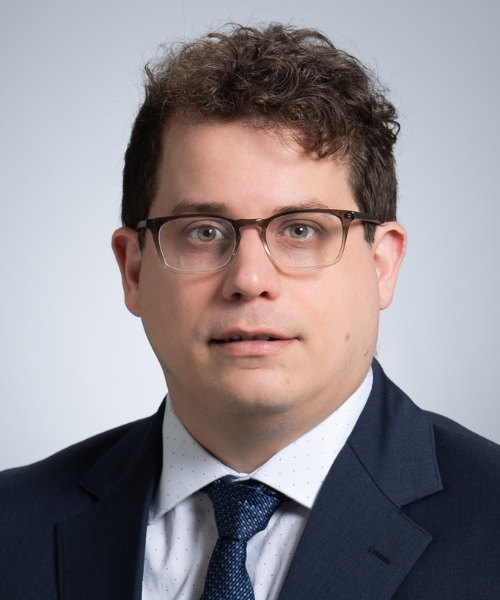
Tylor Lewis, Ph.D., assistant professor in the UAB Department of Ophthalmology and Visual Sciences, is a cell and developmental biologist whose research centers on the mechanisms that drive inherited retinal diseases (IRDs). His work combines cellular, genetic, biochemical, and proteomic approaches to better understand how retinal cells function, why photoreceptors degenerate, and how those pathways might be targeted to slow or prevent vision loss.
Lewis’s research focuses particularly on the development and maintenance of rod and cone photoreceptors, the neurons in the retina that convert light into electrical signals processed by the brain as vision. The light-sensing outer segments of these cells undergo continual renewal, operating on a roughly ten-day cycle of generating new membrane components while shedding older material. That process depends on the retinal pigment epithelium (RPE), a supportive layer of cells that recycles photoreceptor outer segments, regulates nutrient exchange, and maintains the environment necessary for photoreceptor survival. Although the photoreceptor-RPE partnership is essential for vision, many of the molecular signals that coordinate it remain unknown, a challenge Lewis’s laboratory is working to unravel.
In parallel, the Lewis Lab studies genetic mutations that contribute to IRDs, a group of rare conditions affecting roughly one in 4,000 people. With more than 300 implicated genes, each capable of causing degeneration through distinct pathways, gene-specific treatments remain limited. Lewis’s team is therefore investigating gene-agnostic strategies that may slow cellular death across multiple forms of IRDs, broadening the potential impact for patients regardless of their underlying mutation.
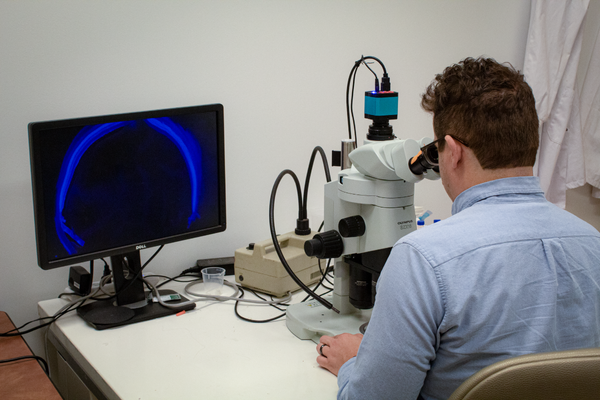 One promising direction involves ADAM9, a gene whose loss can lead to IRD. The laboratory has found that ADAM9 deficiency results in abnormal extracellular material accumulating at the interface between the RPE and photoreceptors. This buildup disrupts normal communication and support between the two cell types. By clarifying how ADAM9 loss drives disease progression, Lewis’s team aims to identify new targets for slowing vision loss in affected patients.
Lewis’s path to vision science began during his doctoral training at the Medical College of Wisconsin, when a lecture on imaging techniques first introduced him to the structural beauty and biological complexity of photoreceptors.
“I fell in love with the beauty of those cells,” Lewis recalled. “The technical aspect drew me in as well. There are so many ways to visualize these neurons to better understand their biology and, in disease conditions, their pathophysiology.”
His contributions to the field have already earned national recognition. He has received major research support, including the prestigious K99/R00 Pathway to Independence Award and the F32 Ruth L. Kirschstein National Research Service Award, and has published in leading journals such as PNAS, eLife, and the Journal of Neuroscience. These achievements underscore the momentum of his work and its growing influence within the vision science community.
Lewis graduated summa cum laude from Carthage College with a bachelor’s degree in biology and chemistry, earned his Ph.D. in cell and developmental biology from the Medical College of Wisconsin, and completed postdoctoral training at Duke University under the mentorship of Vadim Arshavsky, Ph.D. He joined the UAB Department of Ophthalmology and Visual Sciences in 2024.
By dissecting the pathways that govern photoreceptor survival and advancing gene-agnostic approaches to IRDs, the Lewis Lab is helping to shift how researchers understand and address retinal degeneration. His work continues to open new avenues for therapies that may one day preserve vision for patients facing these challenging diseases.