The UAB Department of Orthopaedic Surgery, in collaboration with the departments of Neurosurgery, Neurology, and Surgery, has launched a new Peripheral Nerve Clinic to address the complex needs of patients with serious nerve injuries.
Because timely evaluation and intervention can be critical to preserving function, the clinic brings together specialists in orthopaedic surgery, neurosurgery, neurology, and vascular surgery to evaluate each patient, discuss treatment options, and develop an individualized plan of care.
Addressing a complex need
Serious nerve injuries can have a profound impact on a person’s movement and sensation. The Peripheral Nerve Clinic was created to care for patients with injuries or other conditions involving the brachial plexus, as well as those with major peripheral nerve injuries.
The brachial plexus is a network of nerves that extends from the spinal cord into the arm, providing both sensation and motor function. Injuries to these nerves can occur following high-energy trauma, most commonly motor vehicle accidents. Other causes may include gunshot wounds or tumors and masses affecting the brachial plexus.
“There’s a population of patients that needs help,” said Mohamed Morsy, M.D., assistant professor in the Department of Orthopaedic Surgery and an orthopeadic provider within the Peripheral Nerve Clinic. “This clinic was designed for that specific population of complex patients.”
Before the clinic was established, caring for these injuries could require patients to see several specialists through separate appointments. The new clinic brings those visits together, allowing multiple physicians to evaluate a patient during the same appointment.
“This makes it more convenient for them to come for one visit, see everyone at the same time,” Morsy explained. “It also speeds up the process, which is very important for treating nerve injuries. Otherwise, the loss of function can be permanent.”
A multidisciplinary approach
The Peripheral Nerve Clinic brings together physicians from four specialties, each contributing expertise to the evaluation and treatment of these injuries:
- Mohamed Morsy, M.D., assistant professor in the Department of Orthopaedic Surgery
- Jasmine Thum, M.D., assistant professor in the Department of Neurosurgery
- Rocio Vazquez Do Campo, M.D., associate professor in the Department of Neurology
- Jarrad Rowse, M.D., assistant professor in the Department of Surgery, Division of Vascular Surgery and Endovascular Therapy
The collaboration grew from the team’s experience caring for this specialized patient population. Morsy initially treated these patients independently before partnering with Thum, who has peripheral nerve fellowship training. The two had been operating together for about a year and a half before the clinic began. Vascular Surgery became involved because these injuries can also have a vascular component, while Neurology provides expertise in evaluating nerve function and performing nerve testing.
Before each clinic, the team reviews each patient’s case together, bringing different perspectives to the discussion before meeting with the patient.
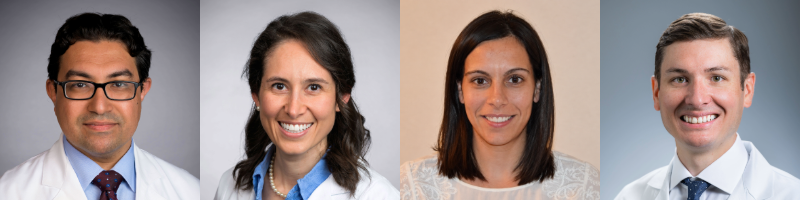 Mohamed Morsy, M.D.; Jasmine Thum, M.D.; Rocio Vazquez Do Campo, M.D.; Jarrad Rowse, M.D.“These injuries are complex and rarely belong to just one specialty. In neurosurgery, we think about the nerve across its entire course—from its relationship with the brain and spinal cord and nerve roots to the peripheral targets we ultimately hope to reinnervate. By combining our complementary expertise, we can evaluate the entire injury, determine what recovery may occur naturally, and identify when surgical reconstruction may offer the best opportunity to restore function. In peripheral nerve surgery, timing matters, so having everyone thinking about the patient from the beginning can make a meaningful difference for patients,” Thum said.
“Brachial plexus injuries often involve the subclavian or axillary vessels, given their close proximity, so treating one without the other can leave patients with an incomplete recovery. By starting a peripheral nerve center, we can bring vascular and nerve expertise together in one place, giving these patients a coordinated path to reclaiming their lives,” said Rowse.
“My role is to use electrophysiology studies to establish the exact location and severity of nerve injury and to help identify donor nerves, healthy nerves that can be redirected, and recipient muscles, paralyzed muscles waiting for reinnervation. This information will, in turn, assist with surgical decision-making,” said Vazquez Do Campo.
This collaborative approach allows the physicians to communicate directly about each case and consider the patient’s needs from multiple perspectives.
Putting patients at the center of care
Recovery from a major nerve injury can be a prolonged and complex process, particularly in severe cases. Treatment may involve multiple stages of care over several years, depending on the nature of the injury and how the patient responds to treatment.
“We want to know what their goals are, what is important for them, and then we also talk about what is realistic,” Morsy noted. “We tell them the options, we talk to them about everything, from the very complex options to the very simple options, and what each one will look like for them.”
Patients are encouraged to play an active role in determining the direction of their care.
“We always want them to be driving their own care,” Morsy emphasized.
Because early evaluation can be important in the treatment of nerve injuries, Morsy encourages providers across Alabama to refer patients with brachial plexus or major peripheral nerve injuries as early as possible. The team hopes to evaluate patients within the first two to three months so they can assess the injury and begin planning care appropriately.
By combining specialized expertise with a coordinated approach to care, the Peripheral Nerve Clinic gives patients with complex nerve injuries access to a team working toward the same goal: helping them achieve as much function as possible.