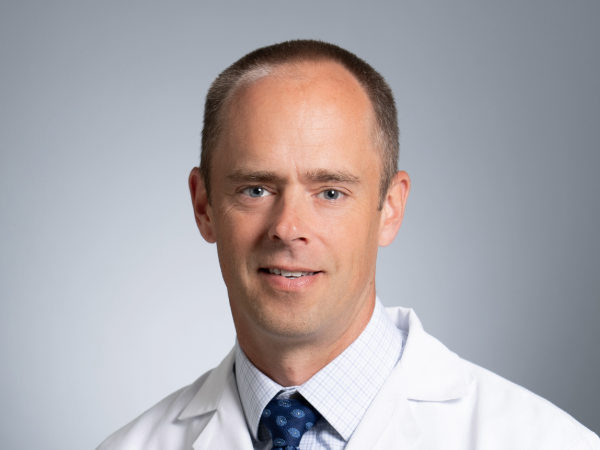
 Daniel Rocke, M.D.The UAB Department of Otolaryngology-Head and Neck Surgery has expanded its thyroid care offerings with the launch of a radiofrequency ablation (RFA) program, providing a minimally invasive, non-surgical treatment option for patients with benign thyroid nodules. Performed in an outpatient setting using local anesthesia, RFA can significantly reduce nodule size while preserving healthy thyroid tissue, offering an alternative to traditional surgery for appropriately selected patients.
Thyroid nodules are extremely common, and most are benign. While many never require treatment, some continue to grow over time, causing symptoms such as difficulty swallowing, difficulty breathing, or a sensation of pressure in the neck. For other patients these nodules can create cosmetic concerns, as enlarging nodules can become visible on the front of the neck. Certain patients with hyperthyroidism, those with hyperfunctioning or “hot nodules,” are also candidates for the procedure. In select cases, small thyroid cancers may be able to be treated as well.
Now, under the leadership of Daniel Rocke, M.D., associate professor in the Department of Otolaryngology-Head and Neck Surgery and director of the Division of Head and Neck Oncology/Endocrine, the department is offering RFA as an in-clinic procedure performed under local anesthesia. The technique uses a specialized probe to deliver radiofrequency energy under ultrasound guidance directly into a thyroid nodule. According to Rocke, treated nodules can shrink by 70 to 80 percent over the months following the procedure.
“Historically, the only treatment for these benign nodules was either to do nothing or to do an operation to remove it,” Rocke said. “Radiofrequency ablation is a great treatment as it allows us to avoid creating a surgical scar, and we can preserve more normal thyroid tissue.”
Because more of the thyroid gland is preserved, patients undergoing RFA are less likely to require lifelong thyroid hormone supplementation compared with surgical approaches. The procedure also eliminates the need for general anesthesia and operating room time, allowing treatment to be completed in a clinic setting with a relatively quick recovery.
The addition of RFA reflects a broader evolution in thyroid care. As insurance coverage expands and clinical experience grows nationwide, the procedure is becoming increasingly accessible to patients seeking non-surgical treatment options.
For Rocke, incorporating RFA into his practice was a natural extension of his expertise. He has extensive experience performing ultrasound-guided procedures, including thyroid biopsies and other targeted thyroid interventions. Those skills translated readily to radiofrequency ablation and positioned the department to bring the technology to patients in a convenient outpatient setting.
Although the program is still in its early stages, Rocke has already treated four patients and believes the therapy's role will continue to expand. Beyond benign nodules, clinicians are exploring its use for additional thyroid conditions in carefully selected patients.
“I think there's a growing demand for it,” Rocke said. “It's a technology that I think will, over time, be used for more and more people, and so I think it's important for us to offer it more broadly.”