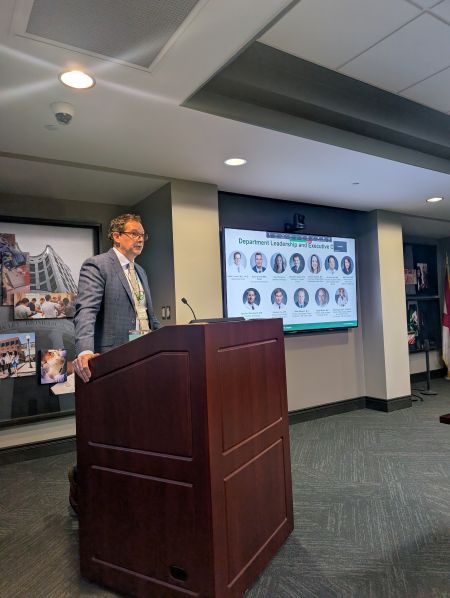
 Justin H. Turner, M.D., Ph.D., professor and chair, John S. Odess Endowed Chair in the UAB Department of Otolaryngology—Head and Neck Surgery, presented the 2026 State of the Department on Tuesday, March 10.
A key highlight in recapping the department’s 2025 year included the celebration of the 10th anniversary of Otolaryngology—Head and Neck Surgery as a department in the Heersink School of Medicine.
“Reaching our 10-year anniversary as a department is an important milestone and a testament to the vision, collaboration, and sustained commitment of our faculty, staff, trainees, and institutional partners,” Turner said.
Leaning into the department’s tripartite mission of clinical care, research, and education, Turner highlighted the growth of the faculty that contribute to each of these missions – with otolaryngology at UAB originating with two faculty, to now a department boasting not only 23 faculty but 15 advanced practice providers (APPs), seven speech-language pathologists, and nine audiologists. Three of those faculty members – Anne Kane, M.D., FACS, Mollie Perryman, M.D., and Michael Sillers, M.D., FACS – joined the department in 2025, and two more are expected to join in 2026-2027.
The Department of Otolaryngology—Head and Neck Surgery also experienced expansion in 2025 in terms of physical space, as its seven service sites grew to eight with the addition of UAB Otolaryngology at St. Vincent’s One Nineteen. To date, the clinic has brought 2,000 new patients to UAB Medicine, with a 34 percent increase in patient volume expected over the next year.
“The addition of new clinical sites reflects both growing demand for our services and our commitment to increasing access to high-quality otolaryngologic care,” Turner said.
In research, Turner shared that in 2025, the department collectively published 84 publications/book chapters, received five NIH grants, conducted 15 clinical trials, and delivered 75 national and international presentations. He highlighted several high-impact faculty papers published in 2025 in journals such as The Laryngoscope, Theranostics, the International Forum of Allergy & Rhinology, and Head & Neck.
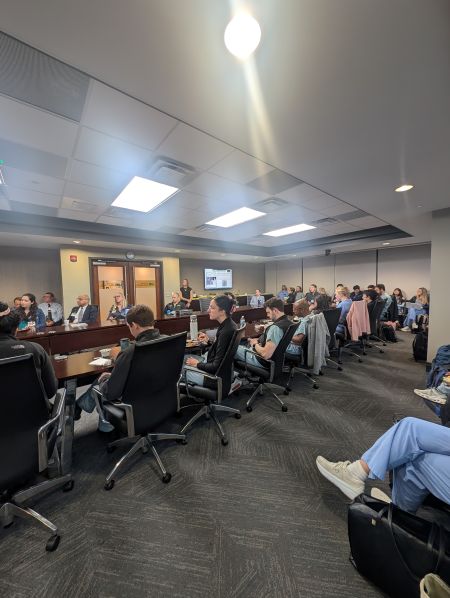 “Our faculty are advancing the field through impactful research, from NIH-funded investigations to clinical trials and high-level publications,” Turner said.
Moving on to education, Turner shared highlights from the UAB Otolaryngology residency program, which currently features 20 residents. Over the last 10 years, the program has boasted a 100 percent board pass rate. In addition, Turner shared that 68 percent of residency graduates go on to pursue clinical fellowships, while 46 percent land in academic practices.
Fellowships in the department offer several specialty training options, including laryngology, clinical speech-language pathology, and head and neck oncologic and reconstructive surgery.
Retention is another theme that has been successful in the education space within the Department of Otolaryngology—Head and Neck Surgery, as 50 percent of the department’s clinical faculty also trained at UAB for medical school, residency, fellowship, or a combination.
Education beyond residency and fellowships in the department includes CME event offerings. In 2025, the Department of Otolaryngology – Head and Neck Surgery hosted its Clinical Practice Update and Gary T. Turner Lectureship in October, followed by its Thyroid and Parathyroid Surgery Update in November, with a Facial Plastic and Reconstructive Surgery Course scheduled for April 2026.
Turner also acknowledged the strength of philanthropy in the department, driving efforts such as the Gary T. Turner Lectureship, the George W. Barber Jr. Foundation Lectureship, and the Ann B. and Julius N. Hicks Lectureship, as well as three endowed chairs and three endowed professorships. Soon, that number will grow to four endowed professorships with the addition of the Glenn and Allison Peters Endowed Professorship, which has just been fully funded.
“The continued growth of endowed support reflects confidence in our department’s vision and its long-term impact,” Turner said.
Looking ahead, Turner said it is a departmental priority to continue expanding access for patients through recruitment, leveraging APPs, and embracing AI technology, as the possibilities for improving efficiencies in both the clinical and research spaces continue to unfold.
“As we reflect on the progress of the past year and decade, it is clear that our momentum is driven by a shared commitment to excellence across all aspects of our mission,” Turner said. “Looking ahead, we are focused on building thoughtfully, innovating responsibly, and ensuring that our work continues to make a meaningful difference for our patients, trainees, and the field as a whole.”