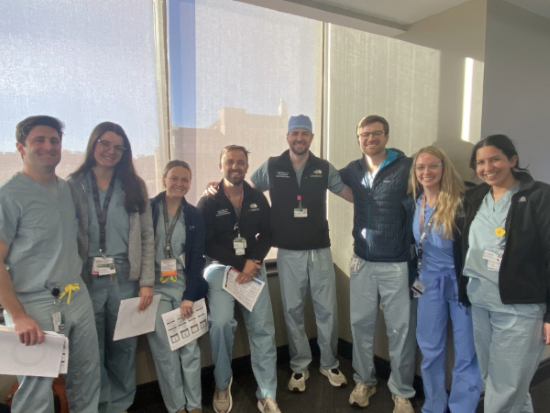
 The UAB Department of Otolaryngology – Head and Neck Surgery is leading the way with a new non-clinical curriculum for its residency program that features practical courses for trainees as they prepare to take on leadership positions, start and run a practice, and more.
Launched last spring and implemented by Michelle Thrasher, Supervisor of Administrative Projects, and Taylor Richardson, Education Coordinator, the new curriculum was developed based on an idea from Justin Turner, M.D., Ph.D., professor and chair in the Department of Otolaryngology – Head and Neck Surgery. According to Benjamin Greene, M.D., professor and program director for the department’s residency program, Turner’s idea first focused on giving trainees more opportunities to sharpen their leadership skills.
“But we kind of left it open for whatever we wanted to do,” Greene said. “So, I polled many of our recent graduates and said, ‘What do you wish that you would have known going into this, or what do you wish you knew finishing residency that you didn't know?”
Billing and coding, how to start a practice, the ins and outs of running a business, wellness tips, and leadership skills were among the topics residents suggested for the non-clinical curriculum.
“It's pretty rare within the world of otolaryngology to have something like this,” Greene said. “So, I basically looked at the general overarching picture of what our recent graduates wanted and then said, ‘OK, how can we implement this?’”
The curriculum is structured as one-to-two-hour sessions happening in the spring, strategically timed after residents take the annual ABOHNS Otolaryngology Training Examination in March. From March to June, residents spanning all residency classes meet on Tuesday mornings to learn from a mix of internal and external speakers on various helpful topics.
“For example, we had a national speaker, Dr. Wayne Sotile, come to speak about physician resiliency and how to build a career,” Greene said. Dr. Sotile is the founder of The Sotile Center for Resilience and the Center for Physician Resilience in Davidson, North Carolina. “We had UAB facilitate DISC assessments and interpretations for the residents to talk about their personality profiles. We've had other folks come in and talk about how to bill, how to code. Dr. Danielle Sutzko presented “Financial Literacy for the Surgeon”, that included wealth management, investing, and financial literacy.” The Office of Risk Management Director, Caroline Hammonds discussed the services available, including education, help with clinical risk management, insurance and finance, managing claims and litigation, and proactive risks.
Though the non-clinical curriculum is geared toward residents primarily, the sessions are open to faculty and APPs as well as part of the department’s grand rounds lecture series.
“I think there's always something to be learned for everybody in these aspects of it, and it's something that really is applicable across multiple areas within the world of medicine,” Greene said. “All of these things like leadership, resiliency, financial management, billing and coding, are very applicable to everybody involved.”
Greene emphasized that implementing the new curriculum was truly a team approach, crediting Thrasher and Richardson with launching the concept and organizing the curriculum.
“This new curriculum would not have been possible without Michelle and Taylor’s hard work and dedication,” Greene said. “Their guidance and expertise are wholeheartedly what have made this effort a success thus far.”
As the new non-clinical curriculum continues, Greene said the team will continue to get feedback from residents and faculty as to the topics they would find most helpful.
“Now that we know that it works, and now that we know we can get buy-in from the residents and the faculty members, I'd really like to have it slowly grow, bring in more national speakers, bring in more topic experts, and just make sure that we keep this fresh and fun for everyone.”