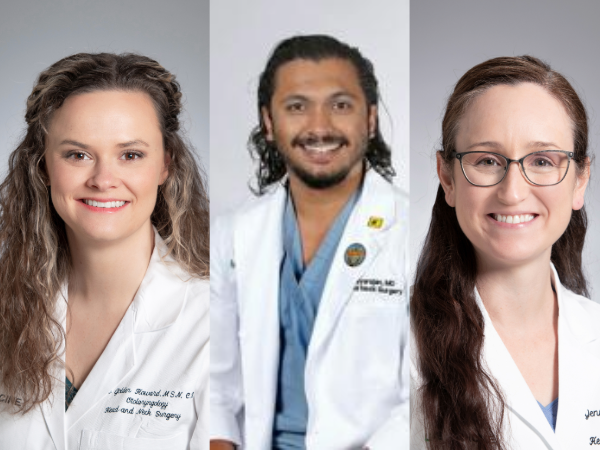
 Maddie Golden Howard, CRNP, Harishanker Jeyarajan, M.D., and Jennifer Faulkner, PA-CNote: This article was adapted from the UAB MedCast, “Navigating Tracheostomy Care”
A pioneering initiative at UAB is transforming care for patients with tracheostomies. Spearheaded by Harishanker Jeyarajan, M.D., associate professor in the Department of Otolaryngology-Head and Neck Surgery, UAB’s first dedicated Tracheostomy Management Clinic was born out of a growing need for consistent, specialized care for patients with complex airway conditions.
Tracheostomy—a surgical procedure that creates an opening in the neck to bypass the upper airway—is commonly performed at UAB, with more than 600 procedures annually. Many patients require long-term ventilatory support or suffer from airway obstructions due to trauma, tumors, or infections. During the COVID-19 pandemic, the number of tracheostomy cases surged, revealing gaps in care and a high rate of preventable complications.
“During COVID, we were seeing a lot of airway complications and a lot of people requiring tracheostomy tube insertion,” Jeyarajan said. “I realized that there was a significant number of complications I thought were avoidable, and a significant variation in care provided for different tracheostomy patients. I just thought that this is something we could do a better job of.”
Recognizing this, Jeyarajan formed a multidisciplinary team including physician assistant Jennifer Faulkner, PA-C, and Maddie Golden Howard, CRNP. Together, they launched a clinic focused on both inpatient and outpatient trach care. The clinic now operates twice a week, offering follow-up care for recently discharged patients, chronic tracheostomy management, and support for those experiencing complications after decannulation, a surgical procedure that involves removing a tracheostomy tube from the neck.
The clinic’s impact has been profound. In just one year, patient visits more than doubled—from 179 to more than 350. Education is a cornerstone of their approach, with a structured three-day program and a checklist to guide patients through home care. This initiative has led to a 43 percent reduction in emergency room visits related to tracheostomy complications.
“This is a highly skilled team, whose only job is to help improve outcomes for these patients,” Jeyarajan emphasized. “We want all services in the hospital—and beyond—to know they can reach out at any point.”
As the only tracheostomy management clinic in the state, UAB’s program stands out as a model of innovation and compassion—ensuring that no patient faces the challenges of trach care alone.
“I feel like this is an excellent service to our community that we did not previously have,” Faulkner said. “So many people are discharged with very little education, or they don’t have the supplies. They just don’t have anybody or another doctor or provider who is familiar with tracheostomies and tracheostomy care. Many people have told us that this has just been a godsend for them.”