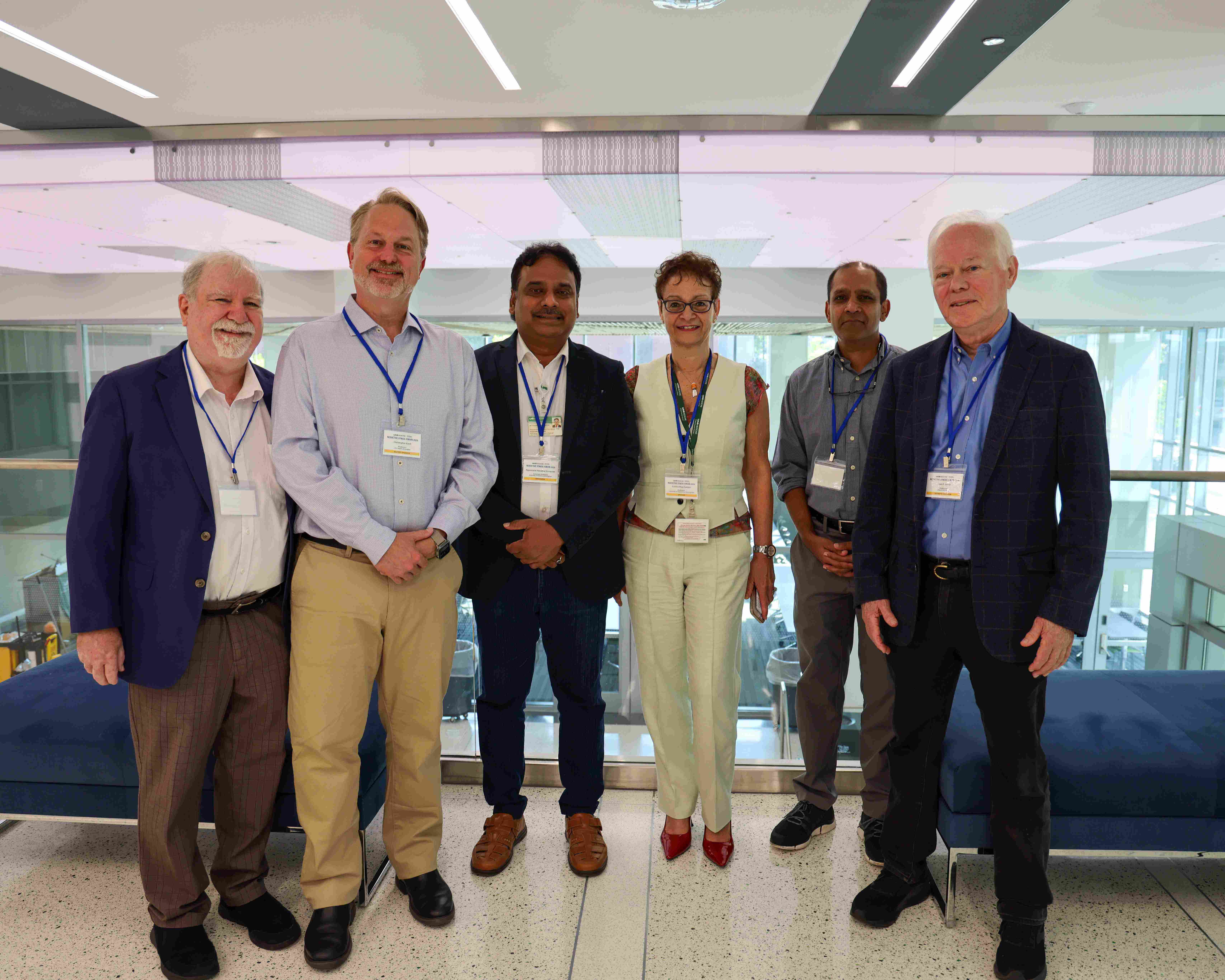
 What if too many antioxidants could be just as harmful as too many oxidants? This question brought together more than 70 scientists, clinicians, faculty, trainees, and students from around the world for the inaugural Reductive Stress Mechanisms in Chronic Diseases Symposium, hosted by Rajasekaran Namakkal-Soorappan, Ph.D., at the Marnix E. Heersink Conference Center on July 9.
For decades, biomedical research has focused on oxidative stress, the damaging effects of excessive reactive oxygen species. However, growing evidence suggests that reductive stress, an imbalance caused by excessive reducing equivalents and antioxidant signaling, represents a distinct biological state with unique mechanisms that contribute to heart failure, cancer, aging, metabolic disorders, mitochondrial dysfunction, and other chronic diseases. Rather than simply being the opposite of oxidative stress, reductive stress is emerging as a new paradigm in understanding human disease.
The event opened with remarks from Dr. Namakkal-Soorappan, followed by a welcome from Cristina Magi-Galluzzi, M.D., Ph.D., Robert and Ruth Anderson Endowed Chair in Pathology. The inaugural address was delivered by Rakesh Patel, Ph.D., Victor Darley-Usmar, Ph.D., Endowed Professor and Division Director of Molecular and Cellular Pathology, and included a special note titled “Discovery of Reductive Stress” presented by Ivor J. Benjamin, M.D., Professor of Medicine at the Medical College of Wisconsin.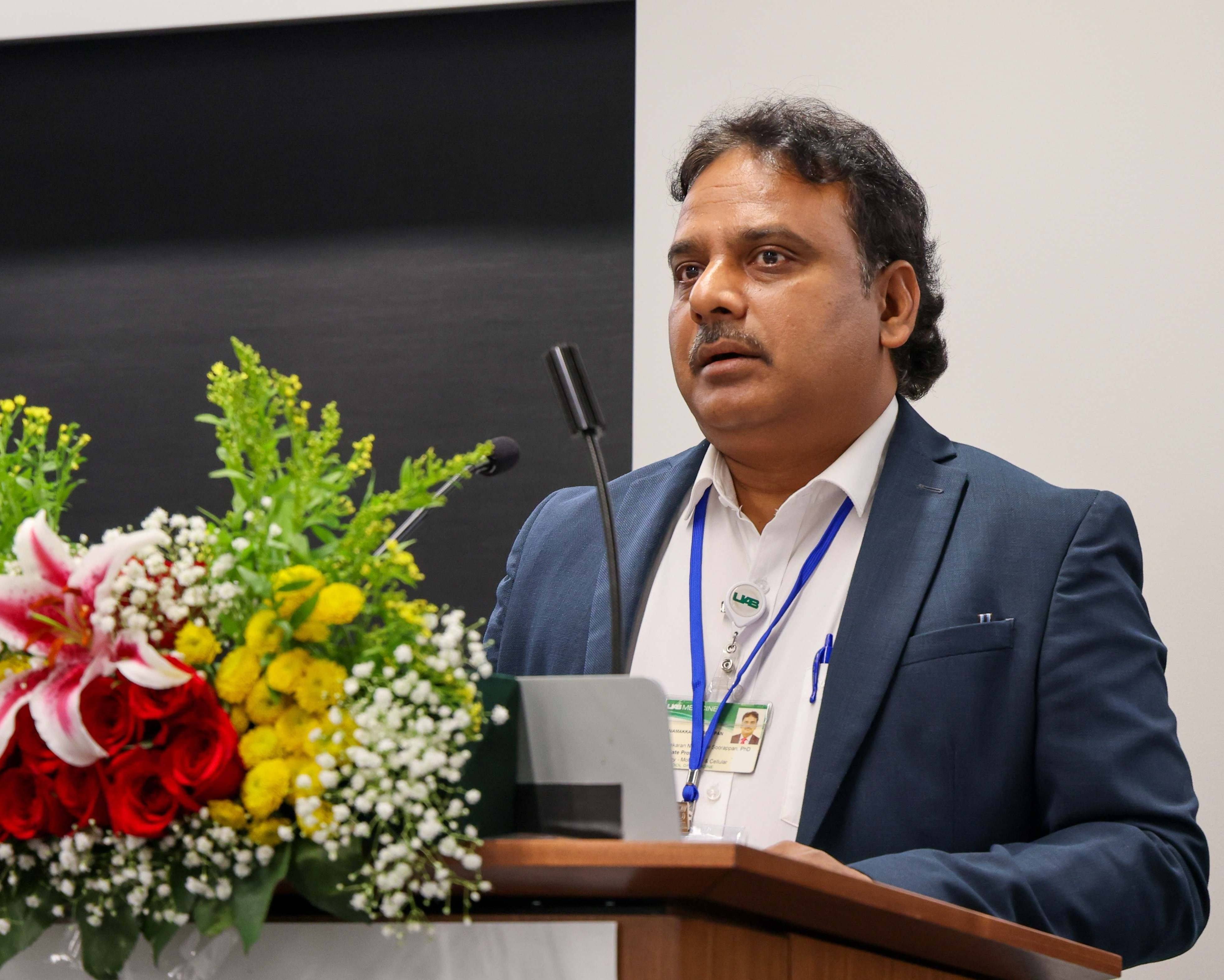 Rajasekaran Namakkal-Soorappan, Ph.D.
The morning featured presentations by Victor Darley-Usmar, Ph.D., Endowed Professor of Mitochondrial Medicine and Pathology, titled “Can Reductive Stress Induce ROS?” and Chris Kevil, Ph.D., Malcolm Feist Endowed Chair in Cardiovascular Disease at LSU Health Shreveport, who presented “Reductive Stress and Sulfhydryl Biology in Health and Disease.” The keynote address was given by Dean P. Jones, Ph.D., Professor of Medicine at Emory University School of Medicine, titled “The Other Side of the Redox Coin — Heart and Lung Axis.” The session was moderated by Gregory Payne, Associate Professor in Medicine, Director, Comprehensive Cardiovascular Center.
The program continued with a series of six TED-style talks delivered by postdoctoral and predoctoral trainees and early career faculty. Abstracts focused on reductive stress mechanism in various diseases. The session was moderated by Camilla Maragoli Bell, M.Sc., Ph.D., assistant professor in the Division of Molecular and Cellular Pathology, and Sini Sunny, Ph.D., a researcher in the laboratory of Dr. Namakkal-Soorappan
A networking lunch followed, along with 12 data blitz presentations by trainees, showcasing research across multiple institutions, moderated by Dr. Praveen Kumar Dueby.
The afternoon featured invited faculty presentations, including:
- Vinodkumar Bala, M.D., Ph.D., Professor in the Department of Cardiology at Sri Ramachandra University Medical Center, presenting “Redox Stratification of Heart Failure Patients and Personalized Antioxidant Treatment” sponsored by AHA International Visiting Professor Award.
- Joel D. Trinity, Ph.D., Associate Professor of Internal Medicine at the University of Utah, presenting “Redox Stratification of Aging Veterans with Muscular and Vascular Dysfunction.”
- Sushma Reddy, M.D., Associate Professor of Pediatrics (Cardiology) at Stanford Medicine, presenting “Redox Stratification of Pediatric Heart Failure Patients.”
- Daniel A. Bachovchin, Ph.D., Chemical Biology Program, Memorial Sloan Kettering Cancer Center, presenting “Reductive Stress in Cancer: NLRP1 and CARD8 Inflammasome Activation.”
- Thomas Vondriska, Ph.D., Professor of Anesthesiology, Medicine and Physiology at the David Geffen School of Medicine at UCLA, presenting “Redox Regulation of Epigenetics.”
- Liang-Jun Yan, Ph.D., Professor of Pharmaceutical Sciences at the UNT System College of Pharmacy, University of North Texas Health Science Center, presenting “Mitochondrial Oxidative Stress, Redox Dysregulation, and Aging-Related Metabolic Disorders.”
- Maolin Ge, Ph.D., Instructor in Medicine at the Krantz Family Center for Cancer Research, Massachusetts General Hospital and Harvard Medical School, presenting “Reductive Stress in Mitochondrial Function.”
The symposium concluded with a panel discussion featuring all speakers and faculty, focusing on the future of reductive stress research and opportunities for collaboration. The symposium closed with the valedictory address and award presentation by Selvarangan Ponnazhagan, Ph.D., Jay M. McDonald, M.D., Endowed Chair in Laboratory Medicine, and Vice Chair for Research, followed by closing remarks from Dr. Namakkal-Soorappan.
Dr. Gregory A. Payne moderated the keynote and morning scientific sessions. Additional sessions were moderated by Drs. Louis Dell'Italia, Jianhua Zhang, Camille Margaroli Bell, Praveen Dubey, Sini Sunny, and Anil Kumar Challa.
The symposium was organized by Rajasekaran Namakkal-Soorappan, Ph.D., Anil Kumar Challa, Ph.D., Sini Sunny, Ph.D., and Praveen Dubey, Ph.D.