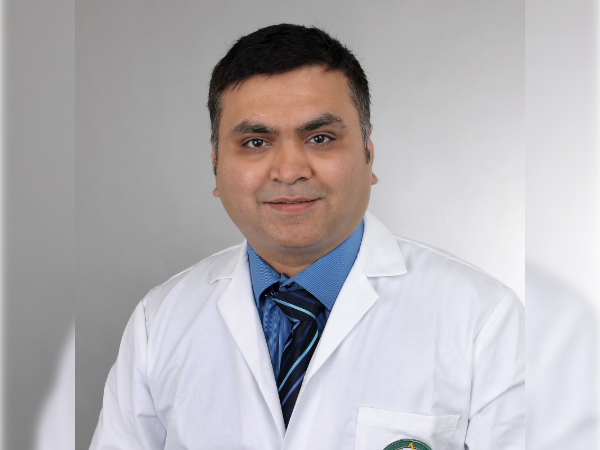
 For critically ill newborns, seizures can be difficult to recognize and because effective treatments can reduce brain injury and long-term neurodevelopmental outcomes, it is important to identify them early. Vivek V. Shukla, M.D., assistant professor in the University of Alabama at Birmingham (UAB) Department of Pediatrics Division of Neonatology, has received national recognition with an R21 award from the National Institute of Neurological Disorders and Stroke, part of the National Institutes of Health (NIH). The award funds the study "Prediction of Risk of Infant Seizures using Machine Learning (PRISM)", which will examine whether artificial intelligence can help identify newborns at risk for seizures before they occur.
Many neonatal seizures have no obvious clinical signs and can only be recognized with electroencephalogram (EEG) monitoring. A higher seizure burden is associated with worse neurologic outcomes and may contribute to additional brain injury, making timely recognition important. Continuous EEG requires specialized equipment, trained technologists, and clinicians with expertise in neonatal EEG. Clinicians therefore have to decide which infants need prolonged monitoring. Clinical risk factors help guide those decisions, but considerable uncertainty remains for an individual infant.
“We do not want to miss seizure episodes in a baby, but we also cannot monitor every infant indefinitely,” Shukla said. “The question is whether we can identify the infants who need that monitoring the most before the seizure occurs.” This award supports the uniquely strong research, collaboration and clinical care environment the team of neonatologists, neonatal neurologists, and biomedical engineers have established.
Predicting what comes next
EEG can tell clinicians whether an infant is having a seizure. PRISM asks a different question: Can information available before a seizure identify which infant is likely to have seizures later?
The investigators will first test whether an initial 60-minute EEG segment contains patterns that predict subsequent seizures, while also examining whether shorter EEG recordings retain useful predictive information. They will then determine whether adding routinely available clinical and video information improves prediction beyond EEG alone. The goal is to develop a model that estimates an infant’s future seizure risk while also allowing investigators to understand which features contribute to that estimate. The aim is not to replace clinical judgment or EEG interpretation, but to give clinicians additional information about an infant’s risk. The current R21 is focused on developing and evaluating these prediction models. It will not test changes in EEG monitoring or treatment. Subsequent prospective studies will determine whether providing seizure-risk estimates to clinicians changes decisions or improves outcomes.
Bringing clinicians and engineers together
PRISM brings together expertise in neonatology, pediatric neurology, EEG, biomedical engineering and machine learning across UAB and Children’s of Alabama, drawing on the institutions’ clinical, EEG and engineering capabilities.
Shukla’s research program sits at the intersection of neonatology, physiologic signal analysis and machine learning. In addition to his clinical work in neonatology, he serves as director of Clinical AI at the Marnix E. Heersink Institute for Biomedical Innovation and is pursuing doctoral training in electrical and computer engineering at UAB. His American Heart Association-supported research uses machine learning to improve the interpretation of fetal heart-rate monitoring data. Across these projects, the central question is similar: Can analysis of physiologic and clinical information already collected during care assisted with machine learning and artificial intelligence, identify risk early enough to ultimately help clinicians make better decisions?
Shukla credits UAB neonatologists Waldemar A. Carlo, M.D., and Namasivayam Ambalavanan, M.D., professors in the Division of Neonatology, as key mentors in shaping the project. “The opportunity is to identify infants at greatest risk before seizures occur, when that information could help guide monitoring,” Carlo said. “This study explores a possibly transformational shift from detection to prediction leveraging machine learning to empower physicians to use a more individualized approach to neonatal neurologic care that ultimately improves long term outcomes.”
“Prediction is only the first step,” Ambalavanan said. “A model has to be reproducible and validated in different patient populations before we consider using it clinically.”
Arie Nakhmani, Ph.D., and Rachel June Smith, Ph.D., in the UAB Department of Electrical and Computer Engineering bring complementary expertise in biomedical signal analysis, machine learning and neuroengineering. “EEG is a complex signal, and potentially useful information may be distributed across time, frequency, and multiple channels,” explained Nakhmani. “Machine learning allows us to ask whether patterns already present in EEG can predict a seizure before it occurs.”
Smith focuses on understanding what information the model is using to make that prediction. “It is not enough for a model to produce a risk score,” she said. “We also need to understand which EEG features are driving that prediction and whether they make sense based on what we know about brain activity and seizures.”
Salman Rashid, M.D., MSHQS, MBA, associate professor, and Stephen Walker, M.D., assistant professor in the Division of Pediatric Neurology, bring expertise in neonatal neurology, critical care neurology and neurophysiology. “Clear seizure definitions and careful EEG review are fundamental because the model is only as reliable as the outcomes used to develop and test it,” Rashid said.
Walker focuses on how prediction might eventually inform monitoring. “The clinically useful question is not only whether an infant is having a seizure now, but how likely that infant is to have one over the next several hours,” he said. “That information could eventually help us make more individualized decisions about continued EEG monitoring.”
Trei King, BS, R.EEG.T, CNIM, director of Neurophysiology at Children’s of Alabama, brings the operational perspective of continuous EEG monitoring. “The quality of the model begins with the quality of the data,” King said. “Reliable EEG recordings, synchronized video and consistent monitoring are essential for this type of analysis.”
“You cannot solve a problem like this with an algorithm alone,” explains Shukla. “Clinicians have to define the question that matters, neurologists have to establish reliable seizure outcomes, and engineers have to identify meaningful information within complex signals. Ultimately, whatever we build has to work in the real environment of a NICU.”
From prediction to clinical use
If the models perform well, the team plans to pursue prospective and multicenter validation. Testing the approach in new infants and at hospitals with different patient populations and clinical practices will be necessary to determine whether the findings generalize beyond the original study setting. A later step would be to test whether providing clinicians with a reliable estimate of future seizure risk improves monitoring decisions.
“Building a model is not the endpoint,” Shukla noted. “We need to know whether it works in different hospitals, whether clinicians can use the information, and ultimately whether using it changes decisions and improves outcomes for infants.” If validated, the approach could eventually help clinicians identify infants who need the closest EEG monitoring and tailor monitoring to an infant’s estimated risk.
For Shukla and the PRISM team, the longer-term goal is to leverage a precision neonatal neurology approach with personalized neurologic monitoring to enable individualized neonatal neurologic care using an infant’s own physiologic and clinical information to guide monitoring while there is still time to act. The R21 will test the first step: whether information available early in an infant’s course can reliably predict what happens next. Ultimately, the goal is to recognize risk early enough to give every infant the best possible chance to reach their full developmental potential.