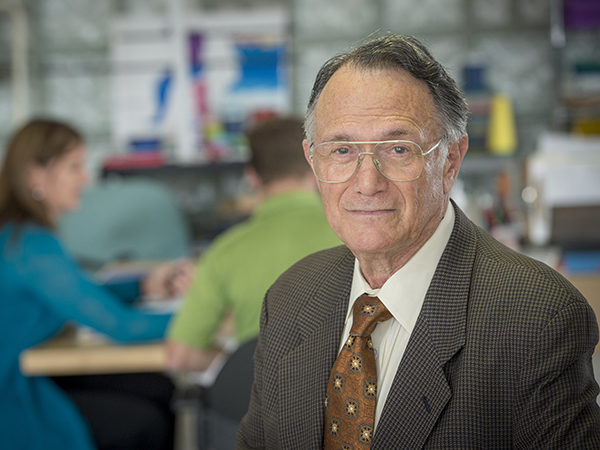
 Behavioral neuroscientist Edward Taub, Ph.D. challenged conventional thinking and transformed the lives of countless individuals living with the effects of stroke, brain injury, and neurological impairment.
Dr. Edward Taub leaves behind far more than a body of scientific work. He leaves a lasting legacy of innovation and hope. His pioneering contributions to Constraint-Induced (CI) Movement therapy at the University of Alabama at Birmingham (UAB) forever changed the field of rehabilitation medicine and expanded what clinicians, researchers, and patients believe is possible.
It is with great sadness that the UAB Department of Physical Medicine and Rehabilitation (PM&R) conveys the passing of fellow colleague retired UAB Department of Psychology University Professor Edward Taub, Ph.D. (1931-2026) from heart failure on November 11. His work influenced and will positively impact basic neuroscience, psychology, and neurological rehabilitation for years to come.
Dr. Taub was born in New York City, awarded his BA degree from Brooklyn College, MA from Columbia University, and his Ph.D. in psychology from New York University. His basic behavioral neuroscience research was in New York City and Maryland from the 1950s to the 1980s. In his pathbreaking work, he tackled the problem to overcome the chronic loss of limb use after focal central nervous system (CNS) injury by using behavioral training. Prior behavioral neuroscience training in laboratory animals had not succeeded to improve the limb nonuse that had followed experimentally reduced limb sensation. Dr Taub operated on the spinal sensory nerves to one arm in experimental monkeys, which rendered the arm anesthetic and was followed by limb nonuse. Dr. Taub’s novel approach was to apply operant conditioning, by using food rewards to prompt re-using the desensitized forelimb for self-care, progressively shaping the spatial precision of the forelimb for reaching for food, and concurrently physically restraining the unaffected forelimb. The monkeys consequently fully and permanently regained use of the affected forelimb after as little as three days of training. The initial nonuse was hypothesized to have been learned following the unsuccessful initial attempts for self-care and the concurrent compensation with the unaffected forelimb. This phenomenon became termed “learned nonuse.” The successful treatment, a re-learning process, was the basis for “Constraint-Induced Movement therapy” or CI Therapy.
Dr. Taub hypothesized that learned nonuse could also occur in humans after nervous system injury, and similar behavioral retraining could overcome learned nonuse in humans. To bring his theories and model of treatment to neurological patients, he relocated to UAB in 1986. The first patients were adults with stroke who had paresis on one side of the body. Dr. Samuel Stover (PM&R chairman from 1976-1994, and pioneer in spinal cord injury care) facilitated Dr. Taub to run pilot CI Therapy trials at UAB Spain Rehabilitation Center, with patient referrals from the PM&R Department. PM&R doctors Cecil Nepomuceno, M.D. (physiatrist), and Thomas Novack, Ph.D. (neuropsychologist) contributed, along with physical therapist Jean Crago, PT, and psychologist Edwin Cook III, Ph.D. The initial success for CI Therapy for stroke patients launched funding for multiple clinical trials from the NIH, the Department of Veterans Affairs, the National Multiple Sclerosis Society, and the National Institute of Disability, Independent Living, and Rehabilitation Research.
What is CI Therapy and why it is important?
CI Therapy refers to a family of rehabilitation techniques. They involve (1) intensive training on the part of the body that is most disabled, (2) shaping of activities (gradually improving trained activities under the therapist’s supervision, to accomplish personal best, and with praise at every attempt), and (3) a set of behavior change techniques that is called the Transfer Package. The Package aims to transfer the gains from the treatment setting to real-world activities. The Package includes completing a behavioral contract between the patient and the therapist that outlines the extent and content of treatment, practicing prescribed activities after-hours, daily half-hour problem-solving discussions with the therapist, and completing a self-report, validated assessment of the quality of body use on common daily activities, adapted to the part of the body that is trained. CI Therapy is usually given over a few consecutive weeks.
CI Therapy is important because it transfers gains from the supervised training environment to the unsupervised setting of everyday self-care activities. Numerous studies have shown that the CI therapy gains are retained for months, even years, on self-care with little decline.
Taub’s influence on rehabilitation medicine
The core techniques of CI Therapy and outcomes have been demonstrated that they can be given or measured in rehabilitation clinics. CI Therapy was successfully extended to impaired walking, children with cerebral palsy, traumatic brain injury, spinal cord injury, multiple sclerosis, limited hand use in expert musicians, post-amputation phantom pain, stroke-induced aphasia (impaired language), and brain fog in persons with Long COVID. Learned nonuse is extensively recognized in various forms of disabling neurological disease. CI Therapy is now endorsed by regulatory bodies across the globe and practiced worldwide.
Dr. Taub trained numerous graduate and undergraduate students in psychology, neuroscience, physical therapy, and engineering, many of whom have continued their work in post-graduate careers. The research lab continues to this day. The CI lab has supported PM&R Department faculty, including Victor Mark, M.D., and Fedora Biney, Ph.D. The lab collaborations extend to UAB Departments of Neurology, Physical Therapy, and Engineering. Dr Taub’s research led to the first multi-site national randomized controlled trial of neurological rehabilitation anywhere; several validated self-report measures of spontaneous self-care in the community; human MRI results from CI therapy that demonstrated significant neuroplastic reorganization in the brain; and inspiration of numerous basic neuroscience research studies in laboratory animals following experimental neurological lesion.
Dr Taub’s impact on rehabilitation and neuroscience is inestimable.
In remembrance of Dr. Taub
Dr. Taub’s wife, Mildred Allen, a former opera singer and music professor at Birmingham-Southern College, passed away in 2021. Dr Taub is survived by his sister, Phyllis Greer, her husband, Greg Greer, and their daughter, Amelia Greer, and her daughters Imogen Sophia and Josephine Mia. A memorial service will be held at a to-be-announced date in 2027. Friends and colleagues who wish to commemorate Dr. Taub’s life are invited to make a donation to the Foundation of Rehabilitation Psychology in his memory.