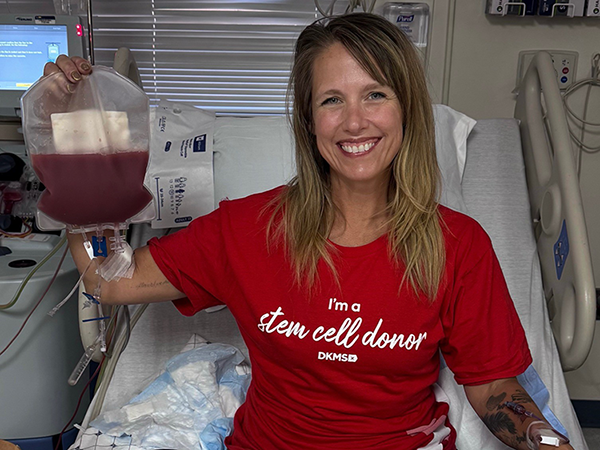
 For Jenn Coker, Ph.D., MPH, research has never been just a profession. It has been a lifelong commitment to improving the lives of others. In many ways, research is in her blood, literally.
Over the course of her distinguished career, Coker has dedicated herself to advancing outcomes research in spinal cord injury, working at some of the nation’s leading rehabilitation and academic institutions and securing more than $18 million in federal and foundation funding. She is currently an associate professor at the University of Alabama at Birmingham Department of Physical Medicine and Rehabilitation (PM&R) and serves as co-director for the National Spinal Cord Injury Statistical Center.
As a scientist, mentor, and national leader in her field, Coker has spent decades designing studies and translating research into meaningful change for patients. But in a powerful reversal of roles, Coker recently found herself on the other side of the consent form.
More than a decade after casually registering as a bone marrow donor and swabbing her cheek at a concert in Colorado, Coker received an unexpected call from DKMS, an international donor registry. She was the sole match for an adult patient with an aggressive form of blood cancer. The odds were slim, less than 1 percent, and the implications were enormous. Her decision could mean the difference between life and death for someone she never met.
For Coker, the choice was immediate.
“When I got the call, I did not hesitate. I have spent my research career asking others to place their trust in science. Becoming a donor brought that full circle for me. Saying yes felt like the most meaningful way I could honor both the science I believe in and the lives it can save,” Coker said.
As a researcher, she understood the weight carried by informed consent, particularly for procedures that are complex and time sensitive. Once she agreed to donate, the anonymous recipient would undergo chemotherapy to destroy their existing blood-forming cells, leaving them entirely dependent on her stem cells for survival. That reality was clearly outlined in the consent documents. It did not deter her.
The donation process required both physical endurance and trust in the process. For a week prior to the donation, Coker administered medication to stimulate stem cell production, experiencing intense bone pain she later described as contraction-like. She then completed an eight-hour outpatient procedure in which blood was drawn from one arm, processed to extract stem cells, and returned through the other. Movement was limited, fatigue followed, and full recovery took time. Throughout it all, she remained not just a donor, but also a participant in additional research studies, consenting to extra blood draws and genetic testing to help advance future scientific understanding.
The experience carried personal meaning. A close friend had died from a similar type of blood cancer several years earlier. When Coker learned she was a match, her thoughts immediately turned to him. In donating, she felt she was offering another person the chance her friend never had. While the outcome of the transplant remains unknown, Coker waits. If the transplant is successful, anonymous contact with the recipient may be allowed months down the road. There is also the possibility she could be called upon again if additional stem cells are needed. Whatever the outcome, the experience has reshaped her relationship with research.
After a career devoted to advancing science for others, Coker became the research subject herself. This time, the potential result was not a publication or a grant, but the chance to help save a life.
Register to become a donor
It is easy to join this lifesaving mission. Visit the DKMS website to order a swab kit.