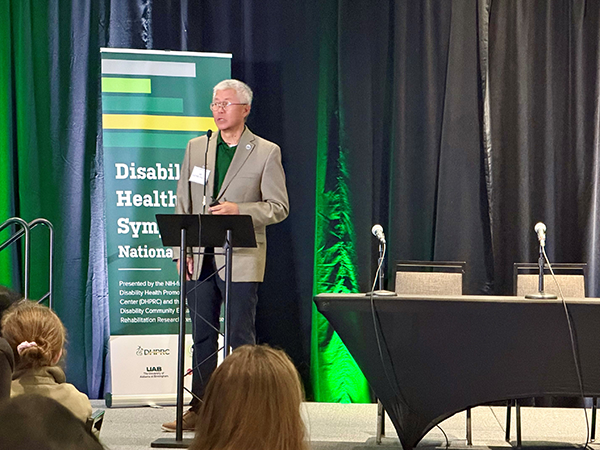
 Dept. of PM&R Chair Vu Nguyen, M.D., MBA, provided opening remarks for the symposium.September highlighted the strong, collaborative relationship between UAB’s Department of Physical Medicine and Rehabilitation (PM&R) and School of Health Professions (SHP) Center for Engagement in Disability Health and Rehabilitation Sciences (CEDHARS) through the annual Disability Health Symposium.
The event brought together researchers, practitioners, community members, and organizations to share knowledge and explore the latest in disability health research. CEDHARS began in 2019 as a research collaboration between UAB PM&R and SHP. Yuying Chen, M.D., Ph.D., vice chair of PM&R research and director of the National SCI Statistical Center (NSCISC), also serves as the co-director of CEDHARS.
Robert B. Kyle Endowed Professor and Chair Vu Nguyen, M.D., MBA, provided opening remarks for the symposium, and faculty Stephanie Agtarap, Ph.D., Fedora Biney, Ph.D., and Jenn Coker Ph.D., MPH, presented their recent research. Read more about the studies.
Examining Posttraumatic Growth After TBI
Oftentimes, we focus on challenges and limitations associated with TBI. Associate Professor Stephanie Agtarap, Ph.D., took a different approach by examining the construct validity of posttraumatic growth (PTG), or positive psychological changes that can emerge after a traumatic event, for individuals with moderate to severe TBI.
“Posttraumatic growth is not just looking at the bright side of things,” says Agtarap. “It is a direct result of reconstructing one’s worldview after a crisis, which usually means sitting with some discomfort and reconciling values, identity, and goals with what’s possible. It’s a concept from psychology literature that is especially important for life after inpatient rehabilitation.”
The study included 40 adults who were more than one-year postinjury and had received rehabilitation services following a TBI. Participants completed assessments of posttraumatic growth, mental health, quality of life, and social support. They also described significant life changes they had experienced since their injuries. Using a mixed-methods approach, Agtarap and her research team compared scores on the Posttraumatic Growth Inventory with themes identified through qualitative analysis. 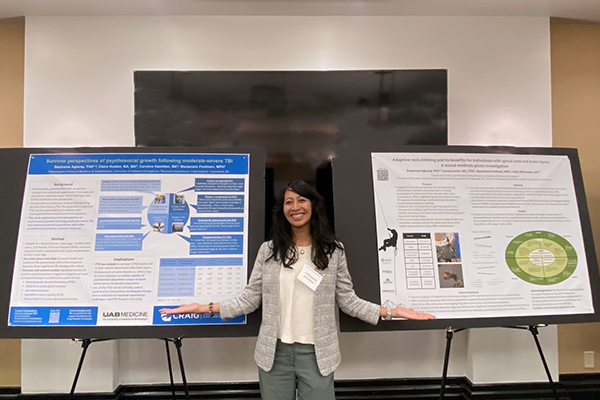 Associate Professor Stephanie Agtarap shares two research poster presentations at the Disability Health Symposium.The findings showed that participants' experiences aligned closely with established domains of posttraumatic growth, including stronger relationships, greater personal strength, increased appreciation for life, and new perspectives on the future. Participants who reported greater posttraumatic growth also reported better mental health and stronger social support. At the same time, many described posttraumatic depreciation (PTD), or negative changes that occurred after injury, demonstrating that growth and distress can coexist.
Overall, the findings support posttraumatic growth as a valid construct after TBI and highlight its potential role in psychosocial adjustment, recovery, and long-term adaptation following brain injury. Agtarap believes it’s important to study more than just deficits and impairment after brain injury but knowing how to scientifically study positive adjustment has been a challenge for psychologists.
Agtarap says, “These findings have shaped a conceptual framework through which we can track the process of PTG and hopefully encourage its development toward lifelong thriving.”
Oral Health After Spinal Cord Injury
Two U.S. Surgeon General reports highlighting persistent oral health disparities among people with disabilities prompted Associate Professor and Co-director of the National SCI Statistical Center Jennifer Coker, Ph.D., MPH, to examine oral health after SCI.
For the study, 529 individuals with SCI completed a self-reported questionnaire using established oral health measures. Results showed that 69% of respondents reported seeing a dentist regularly for cleanings, with 63% receiving at least one cleaning per year. In addition, 64% of people were satisfied with their oral health and almost 80% reported being able to receive dental care since acquiring a SCI. Still, barriers remain. Over 50% of respondents reported lack of dental insurance coverage and almost 25% said their dentist office was not accessible. Participants also reported several oral health concerns including jaw clenching or grinding (54%), dry mouth (50%), and headaches (25%).
The findings highlight the need for additional research on the relationship between oral health and psychosocial outcomes to inform interventions and improve access. Coker is continuing the research with a recently awarded Craig H. Neilson Foundation grant that will look at the relationship between oral health, quality of life and social participation in people with SCI.
How Mental Health Impacts Care Partners of Individuals with TBI 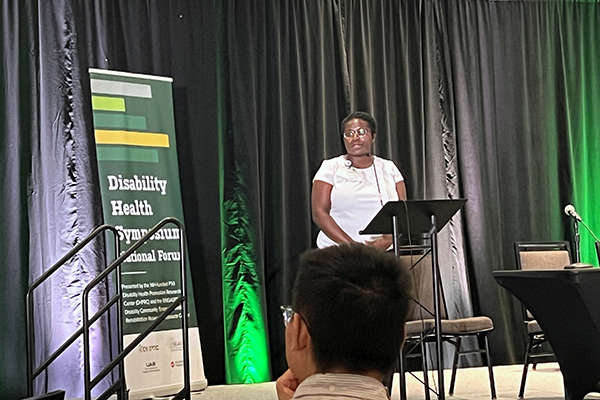 Assistant Professor and CEDHARS Awardee Fedora Biney presents her research at the Disability Health Symposium.While much research has examined how TBI affects an individual with TBI, Assistant Professor Fedora Biney, Ph.D., and the UAB TBI Model System (TBIMS) research team, shifted focus to care partners. The team explored whether care partners with a preinjury psychiatric history (PH+) experience different caregiving needs and emotional outcomes than those without a psychiatric history (PH-).
The study included 258 care partners of TBIMS participants. Researchers used questionnaires to assess the percentage of emotional, instrumental, professional, and community support needs met six months after injury. They also measured symptoms of depression and anxiety at six, 12, and 24 months postinjury. Results showed that PH+ care partners did not report significantly more unmet caregiving needs than PH- care partners. For both groups, community support represented the area of greatest met need. However, PH+ care partners consistently reported higher levels of depression and anxiety throughout the two-year follow-up period.
These findings suggest that preinjury psychiatric difficulties may not influence the amount or type of support care partners need or receive, but they may increase vulnerability to ongoing emotional distress. Biney suggests that assessing care partners' support needs and mental health history could help clinicians identify those at greater risk for long-term psychological stress and connect them with targeted support earlier in the rehabilitation process.
“I think these findings highlight that the consequences of TBI interact with the life histories of care partners,” says Biney. “Evaluating the mental health history of care partners during rehabilitation may go a long way in supporting them so that they can provide better care for their loved ones while meeting their own needs.”
Adaptive Rock Climbing Benefits for People with SCI and/or ABI
The benefits of adaptive sports and recreation therapy in rehabilitation are well documented, but Associate Professor Stephanie Agtarap, Ph.D., wanted to specifically explore whether adaptive rock climbing could improve biopsychosocial outcomes and promote community and social participation among people with spinal cord injury (SCI) or acquired brain injury (ABI). Agtarap chose to study adaptive rock climbing because it forces presence, focus, and mindfulness, while also engaging the body and emotions in a relatively safe environment.
“There is no wrong or right way to climb,” says Agtarap. “The work and subsequent success is personal, and the social culture of the sport helps encourage individuals to overcome initial fears or reservations and feel a sense of achievement, no matter if it’s the first or tenth time climbing.”
The exploratory mixed-methods pilot study included individuals who received rehabilitation services for SCI or ABI. Agtarap partnered with an adaptive sports organization and indoor climbing gym to host free monthly adaptive climbing sessions for current and former rehabilitation patients. Before and after each session, participants completed self-reported questionnaires that measured perceived fitness, mood, and self-esteem, and they answered open-ended questions about perceived benefits.
Qualitative analysis identified four categories of benefits: physical, mental, emotional, and social. Quantitative findings supported these results, showing medium to large effects across measures. Participants reported the greatest improvements in emotional, social, and mental well-being, with these areas demonstrating the largest mean changes and effect sizes.
Future research can be done to examine subgroup differences, implement standardized controlled interventions with larger samples, incorporate objective outcome measures, and assess long-term outcome effects.
“With the wealth of adaptive resources right here in Birmingham, my hope is to keep demonstrating the utility of adaptive sports and recreation to keep psychosocial recovery going long after someone leaves the hospital,” says Agtarap.