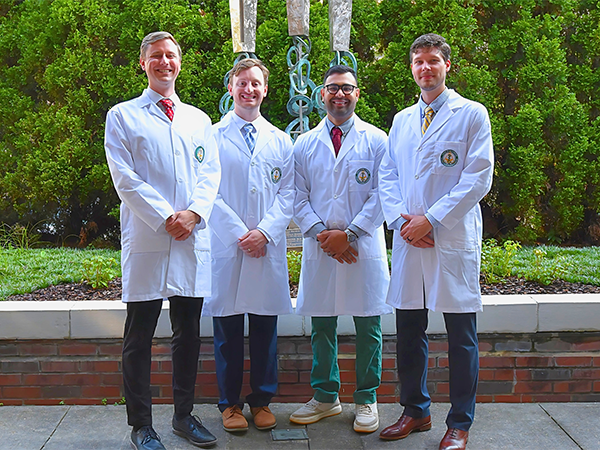
 The UAB Department of Physical Medicine and Rehabilitation is proud of its four graduating residents, David Berry, D.O., Ian Cummins, M.D., Nandan Patel, M.D., and Casey Roark, M.D. As part of their training, each doctor conducted a research study during their second to fourth years of residency. Their projects culminated with poster presentations at PM&R Grand Rounds, showcasing their research.
Berry, who was mentored by Elizabeth Twist, M.D. and Rachel Cowan, Ph.D., explored how dry needling can be used for pain control in patients with SCI. Roark, who was also mentored by Twist, studied the role of cryotherapy in neurorehabilitation. Cummins and Patel focused on brain injury topics. Mentored by Dale Colorado, D.O., Cummins examined recovery outcomes in pediatric patients with concussion compared to concomitant skull fracture. Patel, mentored by Jenny Marwitz, M.A., investigated BMI trends following traumatic brain injury.
The award for best research poster, voted on by PM&R Grand Rounds attendees, was awarded to Nandan Patel, M.D. at graduation on June 24.
In the following Q&A, the residents share insights from their research, key findings, and how their work can inform and enhance clinical practice.

David Berry, D.O.
Dry Needling in Inpatient SCI for Pain Control: A Retrospective Chart Review
Q: What was your study about?
A: I wanted to investigate whether dry needling could help reduce pain and decrease the use of opioid medications in patients with cervical spinal cord injuries. I also wanted to evaluate how dry needling is currently being utilized and documented in the inpatient rehab setting.
Q: Who participated in your study?
A: Our study included 12 adult patients with cervical spinal cord injuries who were admitted to inpatient rehabilitation and receiving opioids “as needed” for pain. The average age was about 49 years, and most participants (83%) were male. The group was racially diverse, with 58% identifying as white and 33% as African American.
Q: How did you conduct the study?
A: This was a retrospective chart review conducted between September 2023 and June 2025. We used our clinical database to identify eligible patients, then reviewed their medical records. We looked at the patients’ opioid use the day before, the day of, and up to three days after dry needling treatment. We also reviewed therapy documentation to capture details about how dry needling was performed and tolerated.
Q: What did you find?
A: We found that pain levels decreased significantly, but only in a small subset of patients with complete pre-and-post-treatment data. Within this group of 5 patients, average pain scores dropped from 6.3 to 0.6, which was statistically significant. However, this result is limited because pain scores were not consistently documented across all participants. There was a trend toward reduced opioid use following dry needling, although this change was not statistically significant. The treatment only had minimal side effects such as minor bleeding.
Q: How can these results be used in practice?
A: These findings suggest that dry needling may be a low-risk, non-drug option to help manage pain in patients with spinal cord injuries and reduce reliance on opioids. Additionally, the results highlight the need for more standardized documentation practices and future studies with larger sample sizes and broader outcome measures.

Ian Cummins, M.D.
The Association of Concomitant Skull Fracture on Recovery After Pediatric Concussion
Q: What was your study about?
A: Our study explored whether having a skull fracture alongside a concussion affects recovery time in pediatric patients. There has been very little research on how this combination influences recovery, so we aimed to determine if children with both conditions recover differently compared to those with an isolated concussion.
Q: Who participated in your study?
A: The study included 587 pediatric patients seen at a large academic emergency department or concussion clinic over a two-year period. Among them, a small subset (4%) had both a concussion and a skull fracture, while others had either an isolated concussion or an isolated skull fracture.
Q: How did you conduct the study?
A: We designed this as a single-center retrospective study comparing recovery times between patients with isolated concussion and those with both concussion and skull fracture. We then used statistical analyses to evaluate differences in recovery while accounting for factors such as age, gender, and insurance status.
Q: What did you find?
A: This study found that having both a concussion and a skull fracture was relatively uncommon. Interestingly, patients with isolated concussions had significantly longer recovery times compared to those with both conditions – about 87 days versus 42 days. Statistical modeling showed that patients with a skull fracture were likely to recover two times faster than patients with only a concussion, even after adjusting for other factors.
Q: How can these results be used in practice?
A: These findings suggest that the presence of a skull fracture may actually be associated with faster recovery after pediatric concussion, which is somewhat unexpected. In clinical practice, this could help inform prognosis and guide conversations with families about expected recovery timelines. It also highlights the need for further research to better understand the mechanisms behind this relationship and refine treatment approaches.

Nandan Patel, M.D.
Examining BMI Trends After TBI From Admission to Five Years Post-Injury
Q: What was your study about?
A: My study examined how body mass index (BMI) changes over time in individuals with traumatic brain injury (TBI). Because TBI can disrupt metabolism and increase the risk of obesity, I wanted to better understand BMI trends from the time of hospital admission through one year and five years after injury. I also explored what patterns and demographic characteristics might predict outcomes.
Q: Who participated in your study?
A: The study included 363 individuals with TBI who were enrolled in the UAB Traumatic Brain Injury Model System (UAB-TBIMS) Database between 2012 and 2018. BMI data was recorded for participants at admission and at follow-up time points, allowing us to track changes over time.
Q: How did you conduct the study?
A: I conducted a retrospective cohort study using data from the UAB-TBIMS Database and inpatient rehabilitation records. I analyzed BMI as both a continuous and categorical variable at admission, one year, and five years post-injury. To understand patterns and predictors of BMI change, I used descriptive statistics and mixed-effects regression models, examining factors like age, sex, race, insurance type, and length of care.
Q: What did you find?
A: There was a significant decrease in BMI during the first year after injury, but BMI generally stabilized by five years. On average, participants in the study were in the overweight BMI category at all time points. About half maintained the same BMI category, while the other half shifted up or down. Key predictors of increases in BMI were older age and longer acute care stays. A decrease in BMI was associated with longer post-traumatic amnesia.
Q: How can these results be used in practice?
A: These findings suggest that the first year after TBI is a critical period for weight changes, making it an important window for intervention. We should prioritize early weight management strategies and tailor care plans based on individual risk factors. By addressing weight and metabolic health early, we may be able to improve long-term outcomes and reduce the risk of obesity-related complications.

Casey Roark, M.D.
Cryotherapy in Neurorehabilitation: A Scoping Review
Q: What was your study about?
A: My study was a scoping review examining how cryotherapy is used in neurorehabilitation. I wanted to better understand the different cryotherapy methods being used in the neurorehabilitation setting and how these interventions have been studied in clinical research. The goal was to map out the current evidence and identify gaps in the literature.
Q: Who participated in your study?
A: Rather than focusing on a single patient group, my study reviewed a wide range of published research involving patients undergoing rehab with various neurologic conditions. Across these studies, sample sizes varied but were generally small, with an average of 50 participants per study.
Q: How did you conduct the study?
A: I conducted a systematic search of databases including Embase, MEDLINE, and Scopus, using a screening process to identify relevant studies. I collected information on study populations, design, cryotherapy type and protocols, and outcomes. The review included both local cryotherapy that targets spasticity and movement and whole-body cryotherapy focused on symptoms like pain, fatigue, and sleep.
Q: What did you find?
A: I found that cryotherapy is most often studied as a short-term adjunct to rehab programs. Most research focused on spasticity and showed generally positive effects, although improvements in functional outcomes were less consistent. The literature was highly variable in terms of patient populations, protocols, and study quality, with many studies being lower quality overall.
Q: How can these results be used in practice?
A: These findings suggest that while cryotherapy may be useful, especially for managing spasticity, there is still a need for more standardized protocols and higher-quality research. In practice, clinicians should be cautious and consider safety, especially in patients who may have impaired sensation, cognition, or communication. The results also highlight opportunities to expand cryotherapy use in areas like neuropathic pain and to pair it with immediate task-specific training to maximize benefits.