 Department of Physical Medicine & Rehabilitation Psychology Postdoctoral Fellow Heather Clark, Ph.D.As the demands of daily life intensify, many find themselves trapped in an endless loop of worry. Whether it’s anticipating tomorrow’s challenges or replaying “what if” scenarios at 3 a.m., this universal human experience can quickly spiral from helpful concern to overwhelming anxiety. Heather Clark, Ph.D., a postdoctoral fellow in UAB's Department of Physical Medicine and Rehabilitation says worry is a natural response—but one that can take over if left unmanaged.
“Research suggests around 1 in 5 Americans experience chronic stress, which can result in worry,” Clark explains. “Some individuals even find that they are worried about how much they worry or how much worrying negatively impacts their day-to-day.”
Understanding the worry response
Clark emphasizes that worry itself isn’t inherently problematic. Our brains are designed to anticipate threats and keep us safe, making some level of future-focused thinking completely normal. “Worry is a form of repetitive self-talk about uncertain future events and the consequences that might occur from these events,” she notes. “Brief worry can be a positive process when it results in action-oriented problem-solving.”
The trouble begins when worry spirals out of control. Clark provides an example: Instead of thinking, “What if I perform poorly on this project? I should ask my manager for clarification,” the thought pattern becomes, “What if I perform poorly? I might lose my job. How will I pay for health insurance? What if the kids get sick?” Clark goes on to say, "Worrying becomes problematic when it is consuming, difficult to control or impairs functioning.”
Many people mistake worry for productive thinking because it creates an illusion of control. Clark explains the crucial difference between worry and genuine problem-solving. “Worrying is often confused for problem-solving because it is a way to spend a lot of time and energy on a problem, and it allows us to feel like we are in control and taking action,” she says. “However, if it results only in continued feelings of anxiety without any tangible steps toward resolution, no actual problem-solving has occurred.”
She recommends a structured approach for shifting from worry to action, with steps that include defining the problem, listing possible outcomes and making an action plan.
She suggests a structured approach to shift gears from worry to action:
- Define the problem. Separate your feelings from the facts.
- List possible solutions. Brainstorm options, big and small.
- Make an action plan. Choose one strategy and outline specific steps.
Practical strategies for breaking the worry cycle
When worry interferes with daily life, Clark recommends these evidence-based techniques: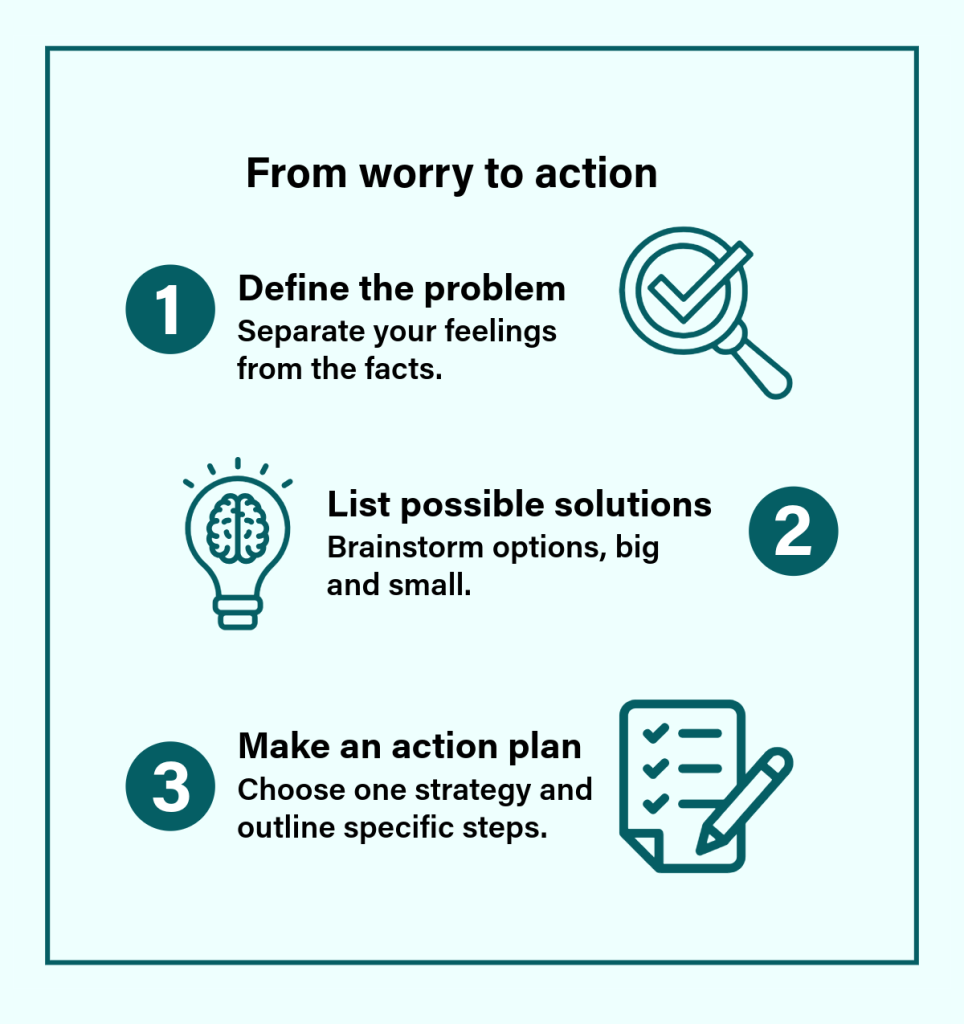
Present-moment grounding becomes essential when worry disrupts focus. "This can be done by focusing on your senses, practicing diaphragmatic breathing or using guided imagery,” Clark suggests. The 5-4-3-2-1 exercise (where you identify five things you can see, four you can touch, three you can hear, two you can smell and one you can taste) helps anchor you in the present.
Journaling serves as a powerful tool for identifying worry patterns. “Keeping a journal is a powerful way to identify worry themes and shift the focus to active problem-solving,” Clark notes. She suggests UAB’s Journaling Club focused on anxiety management.
Physical movement offers another escape route from anxious thoughts. “Another highly effective method for getting out of your head is to get into your body,” Clark emphasizes. “Taking even just a short walk can be a powerful tool for changing both our environment and our mindset.”
Strategic social support can help, but with an important caveat. While research shows that simply venting doesn’t alleviate long-term stress, “talking with someone you trust about alternative solutions and developing your action plan can be grounding,” Clark explains.
Moving forward with confidence
Clark’s approach emphasizes that managing worry isn’t about eliminating it entirely but rather channeling it productively. By recognizing when worry crosses from helpful to harmful and applying targeted strategies, individuals can regain control over their thoughts and improve their daily functioning.
Worry is a normal human response, but it doesn’t have to control your life. With the right tools and understanding, you can transform anxious thoughts into productive action.
For those struggling with persistent worry, Clark reminds UAB employees about the Employee Assistance & Counseling Center (EACC), though anyone experiencing chronic anxiety should consider reaching out to mental health professionals for additional support.
Suggested Resources:
Click here to subscribe to Take 5 Tuesday.