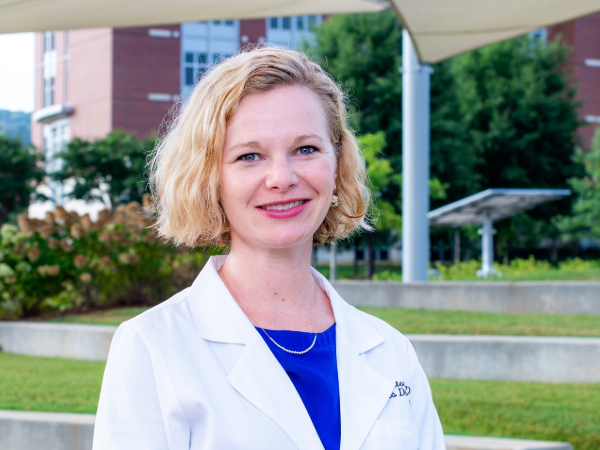
 The UAB Department of Psychiatry and Behavioral Neurobiology welcomed Ellen Eaton, M.D., MSHP, as a professor in January 2026.
Eaton completed her undergraduate studies at Vanderbilt University. She earned her medical degree from UAB, followed by an Internal Medicine residency and a Chief Residency at Stanford University. She then returned to UAB for her Infectious Diseases fellowship and completed a Master of Science in Public Health at UAB.
Eaton shares insights into her path from infectious diseases to addiction medicine and the impactful goals she’s eager to advance in her new role.
Can you share your professional background and experiences prior to joining our institution?
Eaton: In 2017, I was an early-career faculty in Infectious Diseases (ID) at UAB and received a fellowship at the National Academy of Medicine in Public Health and Policy. I was a new ID faculty member and was able to go to the National Academy in D.C. every quarter to participate in a working group on opioids and ID. I got to write a white paper on the topic and received mentorship from leaders in the field of Addiction Medicine and ID. That inspired me to get training in medications for opioid use disorder, and I eventually started an opioid treatment clinic at the 1917 HIV clinic in 2019. Around that time, I started writing grants to build clinical research infrastructure and test interventions at the nexus of HIV and addiction. I have been very busy; my success in this space has validated the great need for more clinical care and interventions for HIV prevention and treatment, Hepatitis C, and other ID care in persons who use substances.
What inspired you to pursue a career in this field?
Eaton: Seeing the substance use stigma and lack of addiction medicine training among healthcare providers has inspired me to keep chipping away at provider education, healthcare access, and disparities for people who use drugs.
What aspects of your new role are you most excited about?
Eaton: I have been collaborating with, mentoring, and working alongside many colleagues in this department for years. So, this transition feels like a natural extension of my leadership in addiction medicine and infectious diseases. I will say that my experience with the department's support staff has been incredible. I am writing several grants, moving my staff over to the department, and leading a large team. The grants management, finance, HR, and other support staff have been exceptional in helping me move my team and science along.
What are your goals for making an impact through both your teaching and patient care in this role?
Eaton: I am the PI of a NIDA-funded mid-career mentoring award (K24) titled HIV Education and Addiction Training Program, or HEAT, which allows me to mentor students, residents, fellows, and faculty. Over the years, I have mentored a psychiatry resident, addiction medicine fellows, and early-career faculty. I am looking forward to working with more trainees in the department and bringing them into our existing training offerings, such as our monthly substance use office hours. In addition, I am a member of the Center for Addiction and Pain Prevention and Intervention leadership and look forward to bringing more faculty into this space of addiction, pain, and infectious diseases.