The UAB Department of Radiation Oncology is introducing a new piece of technology that will treat hundreds of cancer patients each year. The new Halcyon radiation therapy system will simplify the treatment process and reduce time on the treatment table, improving the overall patient experience for radiation oncology patients. For patients receiving treatment multiple times a week, even a small reduction in treatment time can significantly improve their quality of life.
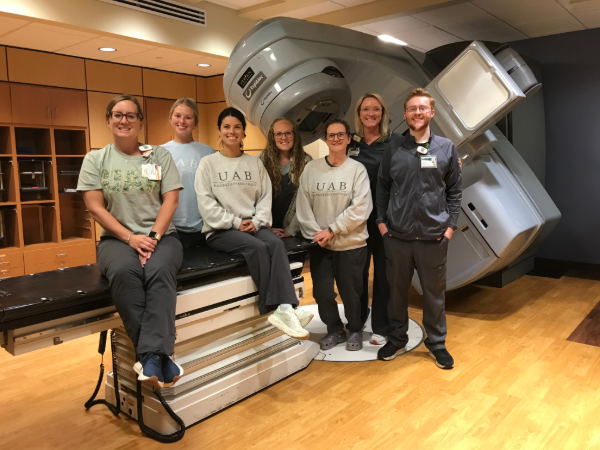 Varian IX linear accelerator
“By adding Halcyon to our treatment fleet, we can provide patients with faster treatments, advanced imaging, highly conformal radiation delivery, and increased access to care,” said Courtney Stanley, D.M.P., DABR, assistant professor in the UAB Department of Radiation Oncology. “It also allows our physicians, therapists, dosimetrists, and physicists to continue pushing the standard of excellence that patients expect from UAB.”
Halcyon comes at a critical time when the department’s existing machinery, a Varian IX linear accelerator at the Acton Road facility, is nearing the end of its lifespan.
“Replacing the equipment with such a significant upgrade allows us to maintain reliable access to care while introducing a platform designed to deliver treatments more efficiently and with an enhanced patient experience,” Stanley said. “Upgrading our equipment ensures we can continue delivering the highest quality treatments with the latest innovations in imaging, treatment, accuracy, and patient comfort.”
The department expects Halcyon to become one of its primary treatment machines and anticipates treating several hundred patients each year.
The new machine is designed to provide exceptional care for a wide range of cancers, but it is particularly well-suited for treating breast, prostate, head and neck, gynecologic, and gastrointestinal cancers. The largest advancement is the machine’s ability to effectively treat more complex areas while minimizing exposure to nearby tissues, thanks to its precise radiation shaping around the tumor.
Unlike many traditional accelerators, Halcyon was designed with the patient experience in mind, streamlining the process from start to finish—working faster while still maintaining exceptional accuracy. It combines advanced imaging, fast treatment delivery, and highly precise radiation shaping into a single, integrated system. Before every treatment, advanced imaging is used to verify the patient's position, so radiation is delivered exactly where it is intended. The machine is designed to operate efficiently and quietly, and many treatments can be completed in just a few minutes once the patient is positioned.
“While patients may notice that the machine looks different, the biggest difference is behind the scenes; its technology helps the treatment team deliver high-quality radiation therapy more efficiently while maintaining exceptional precision and safety,” Stanley said
UAB is recognized as a leader in radiation oncology by investing in innovative technologies and bringing new treatment options to improve patients’ quality of life. The addition of Halcyon further strengthens the department’s commitment to exceptional patient care and technological advancement.
“Very few centers have the breadth of technology available at UAB, including Ethos adaptive radiotherapy, TrueBeam, and now Halcyon,” said Dennis Stanley, Ph.D., associate professor and chief of Adaptive Therapy in the Department of Radiation Oncology. “Having multiple advanced treatment platforms allows our physicians to choose the technology that is best suited for each individual patient's cancer, rather than trying to fit every patient to a single machine.”
Installation of Halcyon requires construction, extensive testing, and rigorous quality assurance before the first patient receives treatment. The department aims to have the new machine installed and ready to treat patients before the end of 2026, assuming no unexpected delays. Patient safety is the highest priority, so the machine will only begin treating patients after it has completed comprehensive testing by the medical physics team and meets all clinical and regulatory requirements.