This is the second in a series of articles highlighting various radiation modalities, how they work, and what patients can expect from each one.
For many patients, the idea of brain-focused treatment can sound intimidating, but advances in technology have made Central Nervous System (CNS) stereotactic radiosurgery (SRS) a safe, efficient, and minimally invasive option.
What is CNS SRS, and how is it different?
CNS SRS is designed to treat one or more precise targets within the brain, such as tumors or vascular abnormalities. Unlike traditional radiation therapy, which may involve broader treatment fields, SRS focuses tightly on the abnormality itself.
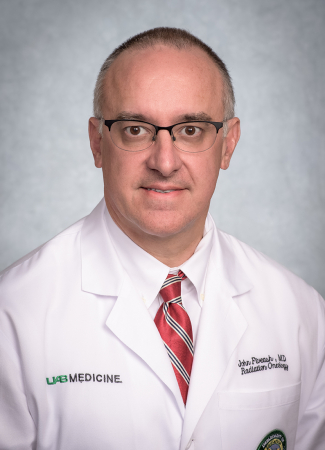
“This treatment is in contrast to broader forms of radiation therapy, most applicable to patients with benign tumors, functional conditions, and vascular abnormalities,” said John Fiveash, M.D., professor, section chief of CNS Malignancies, and Robert Y. Kim Outstanding Educator Endowed Chair in the UAB Department of Radiation Oncology. “Historically, this was a single-day treatment, but now we can use imaging and special surface cameras to replace a more invasive procedure. It only takes one to five days of treatment.”
It begins with a detailed evaluation, often involving both a radiation oncologist and a neurosurgeon. Patients usually already have a diagnostic MRI, which is used alongside additional imaging to guide planning. A custom-fitted plastic mask is then created to help keep the patient’s head still during treatment. This mask is lightweight and designed for comfort. Afterward, a team of specialists develops a personalized treatment plan using advanced computer software.
Once planning is complete, patients return for treatment. Depending on the condition being treated, this may occur in a single session or over several days.
Today, advancements in imaging and positioning technologies enable non-invasive treatment delivery, improving comfort and flexibility.
What else do patients experience during treatment?
For most patients, CNS SRS is a straightforward and comfortable experience. The procedure does not require anesthesia or hospitalization, and patients remain awake throughout.
During treatment, patients lie on a treatment table while wearing their custom mask. The treatment machine is open, and nothing covers the face or eyes, which helps reduce feelings of claustrophobia. The team remains in constant communication, and treatment can be paused at any time if needed.
“The entire time in the room is about 15 minutes,” Fiveash said. “Patients are not being poked or touched; they simply rest quietly with their eyes closed.”
This simplicity and efficiency make CNS SRS much easier for many patients than they might expect from a procedure involving the brain.
When is CNS SRS recommended?
CNS SRS is used to treat a wide range of conditions affecting the brain. It is most recommended for patients with brain metastases, including those with multiple lesions, as well as individuals with benign brain tumors. It is also used for vascular abnormalities, such as arteriovenous malformations, and for certain functional conditions, such as tremors.
Because of its precision, CNS SRS is often an alternative to open surgery, particularly when tumors are in difficult-to-reach areas or when patients are not ideal surgical candidates.
What are the benefits of CNS SRS?
“One of the most important advantages of SRS is its accuracy,” Fiveash said. “Treatment relies on detailed imaging, typically CT and MRI scans, to map the exact location of the target.”
During treatment, advanced surface-guided cameras monitor the patient’s position in real time to ensure they remain still. The treatment itself is also remarkably fast, reducing the risk of movement and improving precision. This combination of imaging and monitoring allows clinicians to deliver radiation with a very small margin of error.
What can patients expect in terms of side effects and recovery?
CNS SRS is generally very well tolerated. Some patients experience mild side effects shortly after treatment, such as headache, fatigue, or slight nausea. These symptoms are usually temporary and can often be managed with medications like steroids.
In the longer term, some treated tumors may temporarily swell before shrinking, a normal response that physicians monitor closely through follow-up imaging.
“Most patients are able to return to normal activities within a day, making SRS a convenient option with minimal disruption to daily life,” Fiveash said.
After treatment, patients return for imaging, usually an MRI within one to three months, to assess how well the treatment is working. Ongoing monitoring ensures that any changes are identified early and managed appropriately.
Who makes up UAB’s care team for CNS SRS treatment?
Delivering CNS SRS requires a coordinated, multidisciplinary team. This typically includes radiation oncologists, neurosurgeons, medical physicists, and radiation therapists, all working together to ensure precision and safety.
At UAB, this expertise is supported by decades of experience and a strong focus on education and innovation. The program also plays a leading role in training clinicians from around the world in radiosurgery techniques.
Clinicians in the Department of Radiation Oncology are leaders in both the delivery and advancement of CNS SRS, with a program that includes two physicians who specialize exclusively in CNS treatments, supported by several additional physicians experienced in performing these highly specialized procedures.
UAB is also home to one of the largest training programs in the world for this technology, particularly in the use of advanced radiosurgery equipment. For nearly 15 years, physicians from across the globe have come to UAB to gain hands-on experience and training. Today, the techniques pioneered and taught here are used in approximately 200 hospitals worldwide. There are also many clinical trials in progress, reflecting UAB’s longstanding commitment to education, innovation, and excellence in patient care.