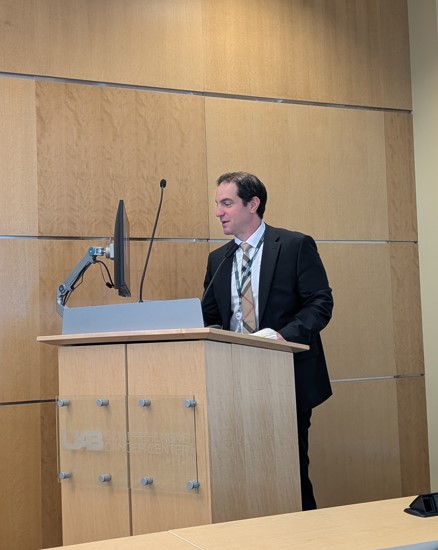
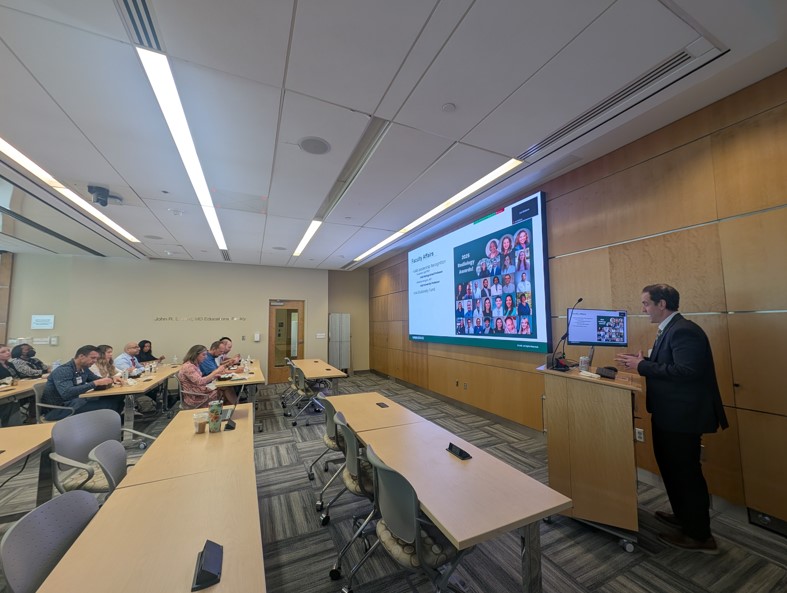
Mahmud Mossa-Basha, M.D., professor and chair, Witten-Stanley Endowed Chair of Radiology, presented the 2026 State of the Department on Thursday, April 23. Watch the recording here.
Mossa-Basha highlighted sustained growth, national recognition, and strategic investments across patient care, research, and education.
“Our focus is really to improve public health by providing outstanding, research-driven, imaging-based, clinical care through expertise, compassion, innovation, and education,” Mossa-Basha said. “And our vision is to advance cutting-edge healthcare through collaborative and multidisciplinary teams that lead discovery and train future radiology leaders.”
With continued expansion in faculty, imaging capacity, and academic impact, the department remains focused on delivering high-quality, research-driven care while preparing for future growth.
Patient care and clinical operations
UAB Radiology continues to expand clinical services across its enterprise, now supported by 117 faculty members and a growing imaging footprint. Over the past year, the department saw a 15 percent increase in total case volume, 37 percent growth in outpatient imaging, and 12 percent growth at Children’s of Alabama. Major service expansions include MRI, PET-CT, nuclear medicine, and interventional radiology, along with increased weekend and after-hours scanning.
Interventional Radiology has progressed to full day coverage 7 days per week, expanded advanced therapies such as Y90 chemoembolization, now ranking UAB as the third-largest site nationally, and implemented a rapid “code angio” process with a 40-minute turnaround time for acute bleeds. Mossa-Basha also outlined ongoing efforts to improve MR and CT access, with teams actively optimizing protocols, workflows, and scheduling to reduce scan times while maintaining quality.
“These are services that certainly provide excellent care for our patients,” Mossa-Basha said.
Research and innovation
Research remains a core strength of the department. UAB Radiology’s focused research team includes eight Ph.D. faculty and three clinician-scientists with more than $9 million in total research funding, including NIH support. Core research facilities, such as the cyclotron, Human Imaging Core, PET/MR, Research MR Core, and Small Animal Imaging Facility, generated $7 million in revenue, supporting both internal research and external collaborations.
Recent investments include a low-field 0.55T MRI, a xenon MR system as well as multinuclear systems, and expanded preclinical theranostics work in partnership with the Southern Research Institute. Looking ahead to 2026, research leadership is prioritizing recruitment, industry partnerships, streamlined clinical trial processes, and expanded research support resources to enable continued growth.
Education and faculty development
Educational programs remain a source of departmental pride. UAB Radiology supports 10 fellowship programs with 22 fellowship positions, 34 diagnostic radiology residents, and 10 integrated interventional radiology (IR) residents, with a 100 percent core exam pass rate in 2025. Rachel Oser, M.D., has assumed leadership of the integrated IR residency and independent IR fellowship, with plans to increase the integrated IR class size.
Faculty achievements were also highlighted, including the appointment of Suzanne Lapi, Ph.D., to Distinguished Professor and the designation of Desiree Morgan, M.D., as University Professor, along with multiple national awards recognizing excellence in research, clinical care, mentorship, and service.
“The strengths that they bring and the contributions that they provide, both to our department as well as to the institution, speak to the strength of our group overall,” Mossa-Basha said.
Looking ahead
The presentation concluded with highlights from department-wide initiatives, including major informatics transitions, international outreach efforts, and expanded wellness programming.
“The strength of the department is built on the strength of our amazing people,” Mossa-Basha said. “I really want to thank everyone for what they’ve done in 2025, and everything they’ve done so far in 2026, and everything that will be done in the near future.”