This is the first in a series of articles highlighting the divisions and sections within the UAB Department of Radiology.
Interventional Radiology (IR) is changing the landscape of traditional treatment options, offering patients less invasive options with faster recovery times and fewer complications.

The specialty uses advanced imaging, including X-rays, CT scans, and ultrasound, to guide procedures performed through very small incisions. Instead of traditional surgery, physicians insert thin tubes and instruments through tiny openings in the skin to diagnose and treat disease from inside the body.
This approach sets IR apart from both traditional surgery and diagnostic radiology. While diagnostic radiologists interpret images to identify problems, interventional radiologists use those images in real time to treat them. They also manage patient care before, during, and after procedures, making the field highly patient-focused.
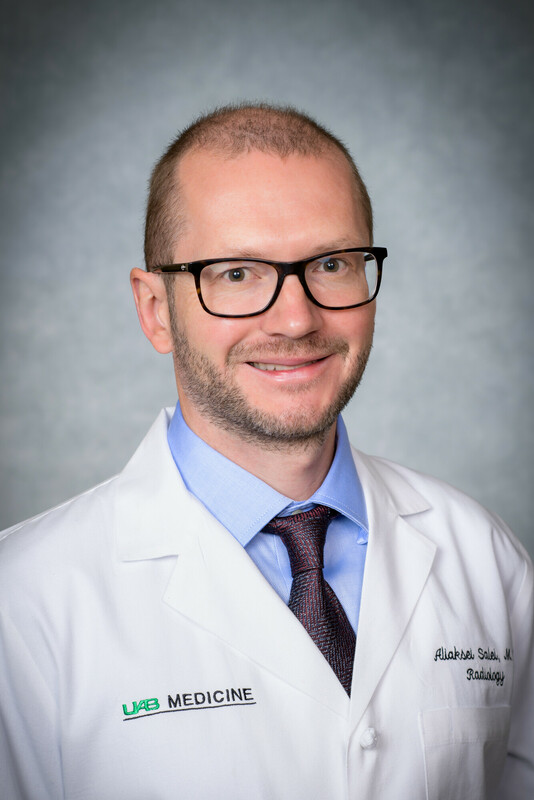
“IR is a patient-facing specialty where doctors offer high-precision, non-surgical alternatives for serious conditions,” said Aliaksei Salei, M.D., associate professor and interim vice chair of the Division of Interventional Radiology. “For patients who may not be candidates for traditional surgery, IR provides a safe and effective option, one that continues to expand as technology and expertise evolve.”
For many conditions, IR offers an alternative to open surgery. Procedures often require only local anesthesia and sedation rather than general anesthesia. As a result, patients typically experience less pain, lower risk, and shorter recovery times. Most can return home the same day with only a small bandage. Smaller incisions typically mean less pain, reduced need for medication, and a lower risk of infection or complications.
At UAB, the IR team treats a wide range of conditions. These include cancers of the liver, kidney, and lung, using techniques such as radioembolization and thermal ablation. The team also manages vascular conditions like deep vein thrombosis, arterial bleeding, and aneurysms. Additional treatments address uterine fibroids, varicoceles, and enlarged prostate, along with common procedures such as dialysis access, port placement, spinal compression fracture treatment, and care for portal hypertension.
The UAB Division of Interventional Radiology stands out for its ability to deliver highly specialized care in a complex clinical environment. As a tertiary care and Level 1 trauma center, UAB serves as a major referral hub, treating a high volume of complex cases that many other centers are not equipped to manage. The division also offers the region’s only dedicated outpatient IR clinic at The Kirklin Clinic of UAB Hospital, providing patients with a centralized location for consultations and follow-up care. In addition, UAB is equipped with five state-of-the-art angiography suites, allowing the team to perform advanced, image-guided procedures with precision and efficiency.
Collaboration is a key part of IR at UAB. Physicians work closely with specialists in Surgery, Oncology, Hepatology, Radiation Oncology and others through weekly conferences and tumor boards to coordinate patient care.
Education and research are also central to the program. UAB offers both Integrated and Independent IR residency pathways, as well as training opportunities for medical students and other learners. Faculty members lead clinical trials and research initiatives to expand treatment options and improve patient outcomes.
The division’s physicians are fellowship trained and board certified, with expertise spanning interventional oncology, complex vascular care, hepatobiliary disease, and pediatric interventional radiology.
By combining advanced technology, specialized expertise, and a strong commitment to patient-centered care, The UAB Division of Interventional Radiology continues to expand what is possible through minimally invasive medicine. As the field grows, the division remains at the forefront, offering innovative solutions for complex conditions while shaping the next generation of interventional radiologists.